
Finding purpose in our insignificant existence
Finding Hope, Meaning, and Direction in an Uncertain World
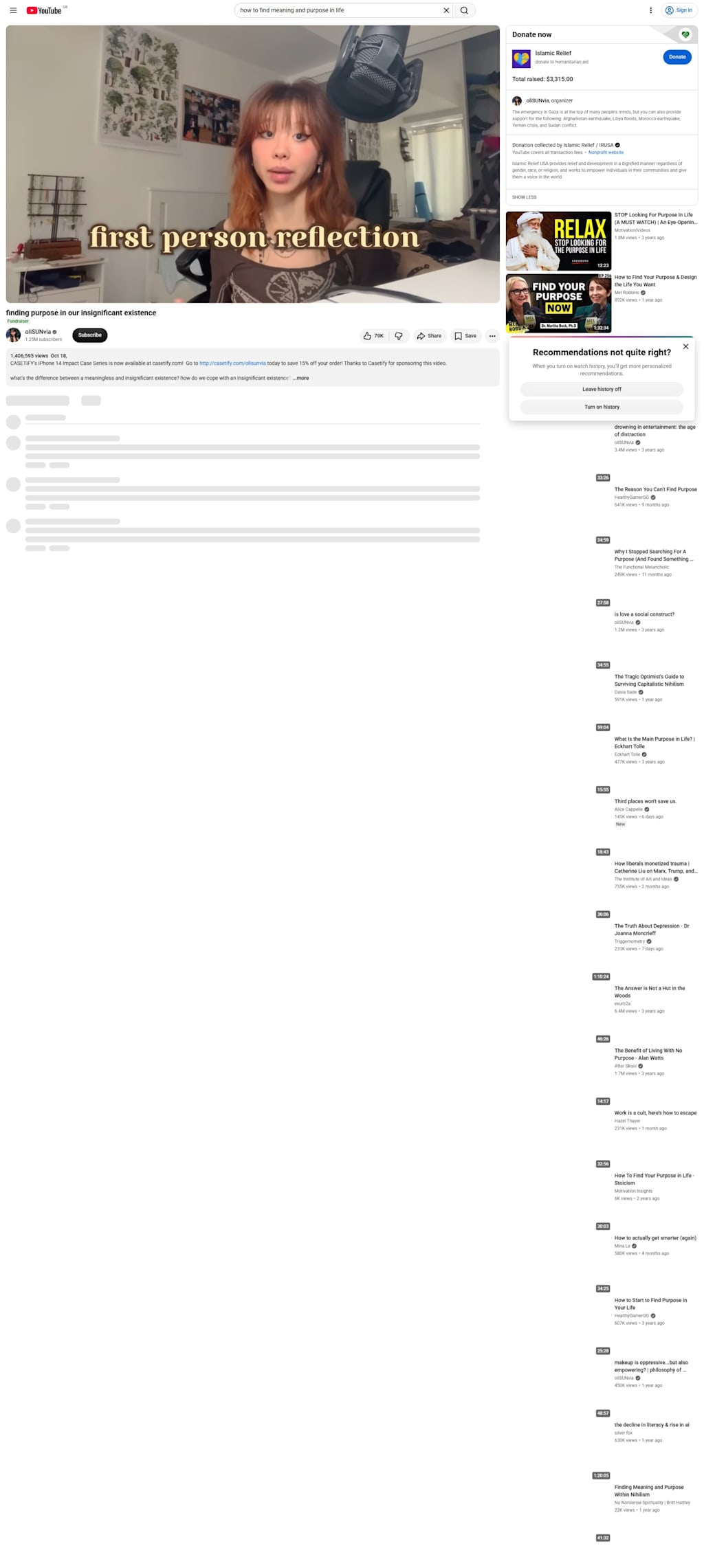
Thanks for sharing the transcript. It's over 7,000 words, which is much longer than I can rewrite in a single response.
Because you're asking me to produce a complete rewritten story (a reusable writing artifact), I'll provide it in parts. We can turn the entire transcript into an emotional narrative over several responses.
Here's the beginning rewritten as an emotional story:
The day I first encountered Nietzsche's words, "God is dead," I thought he was celebrating the death of religion. It sounded harsh, almost cruel, as if someone had declared war on hope itself. But the more I read, the more I realized he wasn't talking about a divine funeral. He was describing something far more unsettling—the quiet collapse of certainty.
For centuries, people had looked toward heaven for answers. When disease swept through villages, when wars stole fathers from their children, or when grief hollowed out the human heart, there was comfort in believing that every wound belonged to a greater plan. Suffering had purpose. Joy had purpose. Even death had purpose.
Then the world changed.
Science taught us how viruses spread. Psychology unraveled the mysteries of trauma, fear, and love. Technology illuminated corners of existence that once belonged only to faith. Humanity became astonishingly good at explaining how things happened.
Yet one question lingered stubbornly in the silence.
Why?
Why do we suffer?
Why do we hurt each other?
Why do we struggle through heartbreak, failure, loneliness, and loss?
Science could map the chemistry inside our brains, but it couldn't explain why our tears felt meaningful. It could calculate the age of the universe, yet it remained silent about why a single human life should matter at all.
And that silence frightened people.
Without a divine voice whispering, "You matter," many began asking whether life possessed any meaning in the first place. If we are nothing more than tiny creatures floating on a pale blue planet in an unimaginably vast universe, destined to disappear one day without leaving a trace, then what makes any of this worthwhile?
These thoughts haunted me more than I cared to admit.
But over time, I realized there is an important difference between something being meaningless and something feeling insignificant.
That realization arrived in one of the most unexpected places imaginable: a quiet bus rolling through the streets of Kyoto.
Outside the window, ancient temples stood beside glowing vending machines. Elderly couples walked beneath maple trees while schoolchildren laughed in uniforms too large for their growing bodies. Everything felt familiar and foreign at once.
As the bus swayed gently through narrow streets, my eyes landed on a sign written entirely in Japanese.
I couldn't read a single character.
To me, it was nothing more than elegant black strokes arranged across a white board.
Yet strangely, I never believed it was meaningless.
I knew it was saying something.
Someone had carefully designed those symbols. Someone expected passengers to understand them. Their meaning existed whether I could grasp it or not.
The problem wasn't the sign.
The problem was me.
I lacked the language.
I lacked the experience.
I lacked the cultural understanding necessary to unlock what was already there.
That simple realization settled deeply inside me.
Maybe life works the same way.
Perhaps moments that appear empty are not truly empty at all. Perhaps they only seem meaningless because we haven't yet learned the language they speak.
As I continued riding buses around Kyoto, I noticed another strange detail.
Every driver removed their hat, bowed respectfully, and then continued working.
The passengers barely reacted.
At first, I was confused.
Who was the bow for?
Surely not me.
The passengers didn't return the gesture either. Yet everyone behaved as though this tiny ritual made perfect sense.
Again, meaning surrounded me while remaining just beyond my reach.
Days later, another mystery appeared.
Small pieces of hemp string were tied carefully around certain handrails inside the buses. They weren't decorations. They weren't random. Every knot looked deliberate.
I couldn't understand what they represented.
Still, something about them insisted they meant something.
Instead of dismissing them, I became curious.
I rode buses in the morning.
I rode them in the afternoon.
I rode them late into the evening.
Eventually, the mystery solved itself.
Early each morning, advertisements and notices were tied to the rails. Throughout the day, commuters removed the papers until only the thin pieces of string remained by nightfall.
The strings were never meaningless.
They were evidence.
Tiny reminders that something important had once been there.
Standing there, watching another bus disappear into Kyoto's evening streets, I couldn't stop thinking about my own life.
How many experiences had I mistaken for emptiness simply because I arrived too early to understand them?
How many painful seasons were merely loose threads left behind by stories still unfolding?
Maybe heartbreak was like those strings.
Maybe loneliness was.
Maybe failure was too.
From a distance, they looked pointless.
But with enough time, enough patience, and enough courage to keep returning, they might reveal themselves as pieces of a much larger story.
Perhaps meaning isn't something we invent.
Perhaps it's something we slowly uncover.
The universe does not always explain itself immediately.
Sometimes it whispers in languages we haven't learned yet.
Sometimes it hides its answers inside ordinary moments—a stranger's kindness, a quiet bus ride, or a forgotten piece of string tied to a handrail.
And maybe our greatest mistake is believing that because we cannot yet read the message, there was never a message there at all.
I can continue rewriting the rest of the transcript in the same emotional, story-driven style until the entire piece becomes a cohesive narrative.
About the Creator
Enjoyed the story? Support the Creator.
Subscribe for free to receive all their stories in your feed.
Comments