
The Shadow of Perseus Is Really About the Women History Forgot
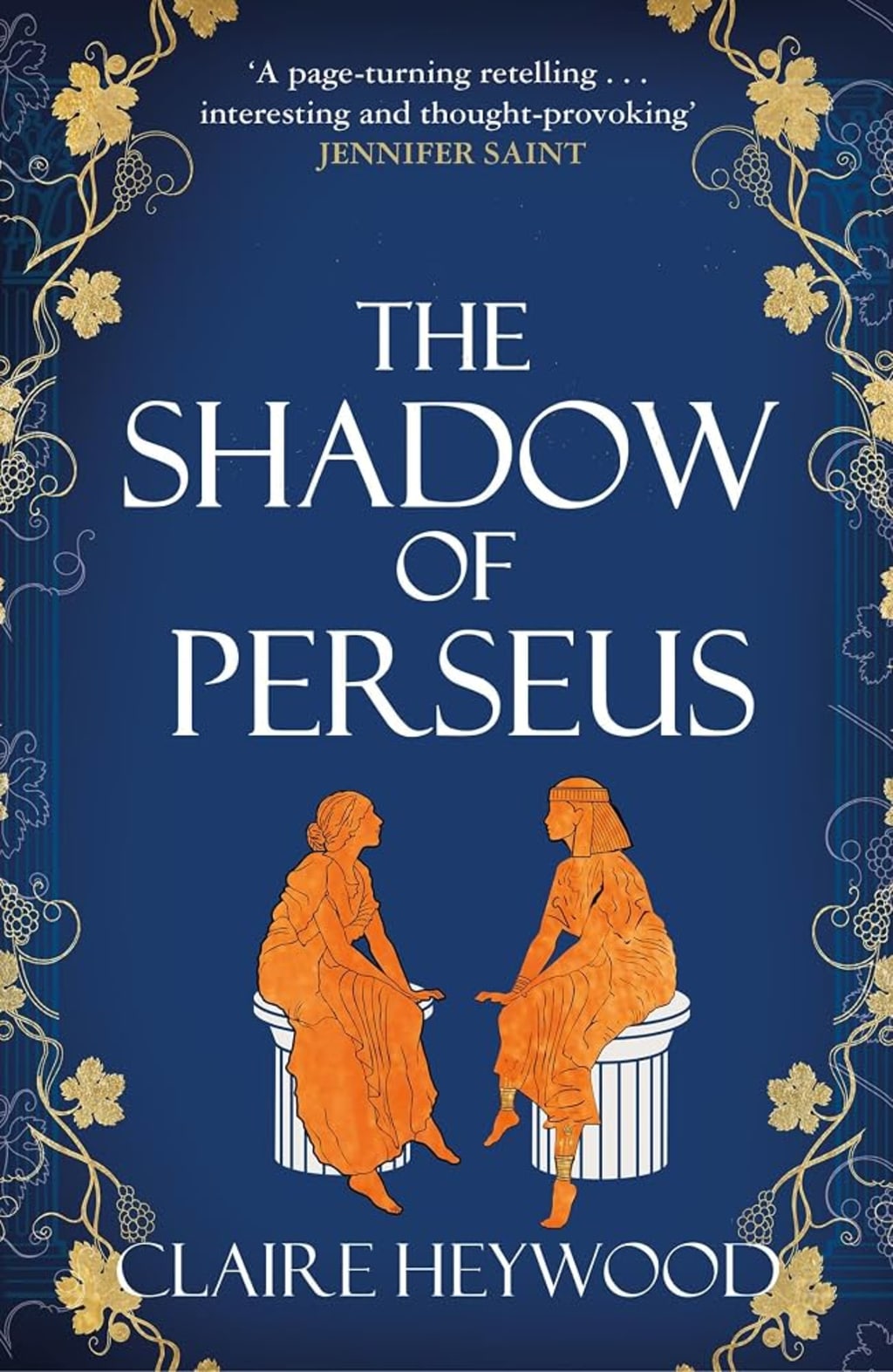
In her retelling of the myth of Perseus, Claire Heywood asks what happens when "heroes" write history, as the surviving women are finally given a chance to tell their story.

Trigger Warning: This article mentions rape and domestic violence.
Some books are light reads, but some require a person to put them down to process what they have just read.
Claire Heywood’s The Shadow of Perseus definitely falls under the latter category. While the summary suggests a fairly simple telling of the myth of Perseus, the book actually made me think about the difference between the myth’s popularity and its actual truth.
The expected story is the one of Perseus, the demigod, who slays the Gorgon Medusa, rescues the princess Andromeda from the monster, and becomes a hero. However, the real story is different.
Heywood brilliantly unveils Perseus’s persona by retelling the myth from the perspectives of three female characters: Perseus’s mother, Danae; the monster Medusa; and Andromeda. By doing that, the author removes the shine from Perseus’s heroic image, revealing his predatory nature. In the book, Perseus’s supernatural powers rarely appear, thus making him a flawed and insecure individual who thinks that he is the best.
Danae: The Woman Who Wanted a Life Of Her Own
Of all the characters in the myth, I find Danae’s fate to be the most surprising.
In the original telling of the myth, Danae’s role is only present as the mother of Perseus. Yet, before Perseus was born, Danae had a completely different image—a woman who decided to become a priestess of Artemis because she did not want to marry.
However, Acrisius, her father, did not want to let her go, so he imprisoned her.
I think it is important to note the extremity of his actions, for Danae’s choice was not an unusual one for women of her stature and background.
It seems utterly absurd that Acrisius would take such measures to prevent Danae from attending the temple of Artemis.
Still, despite the support of her uncle Proitos, as well as several friends and relatives, Danae’s fate does not change—she is imprisoned. While in prison, Danae is raped by Zeus and becomes pregnant.
Acrisius does not believe her, and in response to her protest, he banishes Danae and her unborn son to the sea. However, the wooden chest, in which they were placed, drifts to Seriphos, where a fisherman named Diktys rescues both her and the baby.
Diktys’s kindness and parenthood give Danae and Perseus new hope, with Danae now having a husband.
After Diktys’s death, Danae considers remarrying and even thinks of Polydektes—her longtime friend who had also been a supporter of Danae’s right to choose her own path in life. Still, as a mother, Danae sees her primary mission as educating Perseus.
Therefore, she raised him with endless devotion while living a simple life on the island. Yet, Danae’s upbringing of Perseus makes him arrogant, as he comes to terms with the fact that Danae sees him as something more than a regular human being.
Danae tries to let Perseus come into his own, but not without consequences. She wanted him to accomplish great things, but the expectation of such high importance pushed Perseus toward an unfortunate turn of events.
Ultimately, Perseus falls victim to his own obsession with fulfilling his predestined path as a hero.
Medusa Was Never the Monster
Medusa is next in line to be presented as not the monster from the island that Perseus had come to slay, but rather as a survivor.
After being attacked by Poseidon, she is unable to perform her duties as a priestess, but faithfully serves Athena throughout her life. She creates a sanctuary for survivors of sexual violence, unwed mothers, deserted wives, barren women, and unwanted girls. With the help of her sisters, Medusa takes care of them and gives them a place to call home.
In addition to caring for the vulnerable families, the sisters are ready to take care of orphaned children. They understand that children are the most vulnerable and the least likely to protect themselves, so Medusa dedicates herself to protecting these innocents.
When Perseus arrives, Medusa warmly invites him into her home. She feeds him, chats with him, and inquires about his personal life. However, because she refuses his advances, Perseus becomes violent, and she is killed by him.
Medusa is not presented as the villainess and the monster that Greek mythology had previously recognized. Instead, she is given a new personality and a different tale. Since Perseus is believed to have killed the monster, the author makes it clear that the old tales are precisely that: tales. Her story is one of defense and protection, not destruction and death. By presenting Medusa differently and giving Perseus a different role to play in her story, the author makes it clear that Medusa is not at fault for becoming a monster.
Andromeda Didn’t Want Perseus to Save Her
Claire Heywood’s version of the myth of Andromeda reinterprets the well-known tale of a helpless maiden tied to the rock awaiting Perseus to deliver her from the monster as a more empowered image of a young woman who made a choice that she thought was right for her country.
The young Ethiopian princess is from a nomadic tribe (the location of Ethiopia, according to the ancient geographer, was not in the present position but further to the west). She watched her homeland dry up from a terrible drought and decided to move to North Africa to start a new life.
When her parents tried to arrange her marriage and demanded ten goats as a dowry, the girl decided to sacrifice herself to save the goats that would otherwise have been killed at her wedding feast. The princess’s decision to offer herself as a sacrifice was a cruel but necessary choice for the survival of her people.
Perseus comes and saves the maiden, undoing the ropes to free her, but Andromeda is angry with him for taking away her only opportunity to make a sacrifice.
Her life with Perseus begins tragically as he kills one of her suitors in an argument and kidnaps her, trying to convince himself and others that he had rescued the maiden from a monster who did not exist.
Andromeda is also raped by Perseus; later, he presents her to the public as his bride, telling a fabricated story of how he saved her from the beast. She keeps quiet about the truth of her kidnapping, rape, and assault.
What Happens When the Victim Gets to Tell The Story?
This part of The Shadow of Perseus is genuinely disturbing.
Perseus not only tortures these women but also steals their narratives. In his story, Medusa becomes a “monster,” Andromeda – the princess who needed a “heroic rescue,” and Danae – the mother of a great “hero”.
These women do not have a chance to change their fate until they understand it themselves.
One particularly horrifying scene occurs when Andromeda finally tells Danae what she knew all along: that the oracle prophesied about the sandstorm, that Perseus had kidnapped her, that she had supposedly agreed to be Phineus’ bride, that Perseus killed the suitor, that she was raped, and that there never was a sea monster. Danae feels sick at the thought of her son and cannot meet Andromeda’s eyes. However, she does not try to explain or convince Danae that he did the right thing.
After all, who could ask Danae to forgive Perseus for what he has done? Even if Perseus has good intentions, stealing a woman cannot be justified. Maybe that is why Danae does the best thing she can for Andromeda: listens.
Perhaps one of the most crucial lessons of The Shadow of Perseus is that listening to the victim is an act of compassion. And not always speaking, but also the ability to stop yourself from doing so.
Andromeda’s Kindness Isn’t Forgiveness
Another intriguing detail concerning the character of Andromeda is the way she manages to survive. She knows how to soothe Perseus, to tell him exactly what he wants to hear, to hide her anger and resentment. Andromeda knows how to act pliantly toward Perseus in order to keep living.
Perhaps, when being under the control of another person, it is not always possible to speak the truth. Andromeda manages to keep her thoughts and feelings buried under the words of compliance, thus keeping a secret garden of her own in which Perseus is not allowed to enter.
Though thinking he knows his wife, Perseus is wrong in many ways, and the only way Andromeda can keep the freedom of thought and action is by maintaining this hidden inner world.
The Prophecy Doesn’t Win
When Perseus finally confronts Acrisius, it seems that the prophecy is destined to come true. Eager to kill the cruel king in vengeance for Danae, Perseus is about to fulfill Acrisius’s prediction by slaying his grandfather. Yet, Danae convinces Perseus to stop and, with the help of Andromeda, he even manages to do so.
This unexpected twist is probably one of the most impressive and outstanding ideas of the book, which actively differs from the initial myth. Namely, while in Acrisius’s myth the prophecy appears to be unavoidable and practically uncontrollable, in this version of the story, the prediction is defeated by simple human interference.
Indeed, Danae is the one who actively confronts Acrisius. Thus, not only does she manage to free Perseus from the fate foretold by the oracle, but she also teaches that a simple person’s choice can override even the gods’ will.
It is worth noting that Perseus’s decision to walk away from killing Acrisius also highlights the importance of this lesson. The hero could have completed the task the oracle ordered him to fulfill, but Perseus preferred to choose another path. Therefore, the prophecy was only destined to become a reality until Danae’s interference disrupted it.
Why This Story Feels So Relevant Right Now
It was here, in this passage, that I first felt the story lose something of its mythical quality.
We wonder if survivors should have been believed. We wonder if institutions serve to protect or to oppress. We wonder why they did not get out earlier. Why did they not come to us? Why do they stay? Why do they return? Why didn't they fight? Why didn't they shout louder? Why don't they just take the advice of their friends, family, and advocates and do what those people want them to do?
And we wonder why survivors face a system that all too often meets their needs with disinterest, with demands for proof, with inaccessibility, with costs, and with complexities.
In 2026, advocates are still raising alarms about the impact of proposed cuts to federal programs that support survivors.
The National Network to End Domestic Violence has raised concerns about the impact of the proposed budget cuts, which include reductions to Office on Violence Against Women programs, including transitional housing and legal assistance. At the same time, the Department of Justice continues to provide direct services to survivors of domestic violence, sexual assault, stalking, and other crimes.
Advocates continue to seek new ways to support survivors. Survivors need safe places to stay, and shelters need funding. Survivors need advocates to help them navigate the complexities of the justice system, but those advocates also need funding. Survivors need shelter, but what happens when the only place they can think of staying is with the abuser? Transitional housing is an option when available. However, many survivors, particularly those with children, find themselves needing to return "home", or face impossible choices between abuse and poverty.
This is why Medusa's sanctum is such an appealing prospect. She doesn't want the women to go anywhere, necessarily, but she wants them to have somewhere else to go.
Just as Danae's reply to Andromeda is in stark contrast to the questions I keep asking.
Questions that contain an implicit judgment of survivors, while Danae's statement is one of compassion.
The Women Step Out of Perseus’s Shadow
By the end, The Shadow of Perseus focuses less on the potential of Perseus being a hero and more on the prospect of the bearer of the sword being the measure of true power. Danae is willing to accept her father’s abuse, Medusa takes care of the women that society has judged, and Andromeda is a survivor of the life that was controlled by others. In the end, Danae takes Andromeda with her out to make sure that their family’s fate of prophecy does not continue to befall their future.
As they refuse to accept the gods and the hands of Perseus as their savior, they are able to give Perseus the opportunity to change the destiny that was set for him, not to chase the glory that was demanded of him, but to focus on keeping his family safe. The nuance of Perseus being a villain is presented as something that allows him to be much more than the accepted villain.
He is not absolved of his sins of the past but shown as a human who has lived through the pain and is now left to decide whether he will continue to chase Perseus or escape it.
That is how the book’s theme links with the title, ‘The Shadow of Perseus.’ We see the shadow that the hero casts over the lives of others. For centuries, the myth has been about the hero, the monster, and the damsel in distress. The Shadow of Perseus reimagines it, bringing Medusa not as a monster but as a protector, Andromeda as an agent, and Danae as a woman with her own wishes, failures, and dreams, not just the mother of Perseus.
I can relate to this book in many ways, and over time, I have come to dislike the obsession with the mainstream myths about the central figures while the underdogs remain forgotten. It is not the story of the hero but the story of the monster, the princess, and the mother, and how they want to live their lives without being overshadowed by the hero, the monster, or the king.
I want to hear about their lives, their memories, their dreams, and their feelings. Most of all, I want to see if the underdogs can rise to the top and save themselves instead of waiting for someone to rescue them when it is too late.
Instead of destroying the ancient myth, it would be a treat to hear the whispers of the old tales and find the forgotten voices in the poetry and fiction literature of times gone. The most critical aspect of the myth is not about the hero and the sword that he bears, but the shadow that it casts over the woman who has defended herself from the sword.
I think that is a significant message in this book: that we have been looking for answers in the wrong places. It should not be about who needs to be rescued but what the rescuers failed to hear for centuries.
About the Creator
Jenna Deedy
Just a New England Mando passionate about wildlife, nerd stuff & cosplay! 🐾✨🎭 Get 20% off @davidsonsteas (https://www.davidsonstea.com/) with code JENNA20-Based in Nashua, NH.
Instagram: @jennacostadeedy
Enjoyed the story? Support the Creator.
Subscribe for free to receive all their stories in your feed. You could also become a paid subscriber, letting them know you appreciate their work.
Comments
There are no comments for this story
Be the first to respond and start the conversation.