Book of the Year
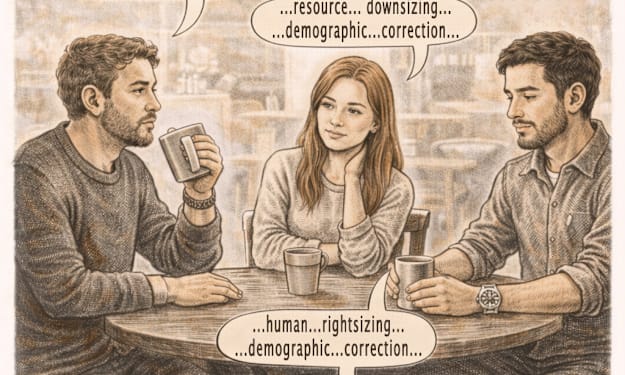
Words of Dehumanization, THE MISCOMMUNICATION TRILOGY, “The Tower of Babble, Vol. III”, Part 17
The Language of Exclusion: A Critical Review of Words of Dehumanization The Anatomy of Human Reduction Words of Dehumanization stands as one of the most intellectually ambitious and socially relevant volumes within The Tower of Babble, the third installment of The Miscommunication Trilogy. At its core, the book explores a question that has haunted human history from antiquity to the present: how do ordinary individuals come to perceive other human beings as less than human? Rather than approaching this problem exclusively through political history or moral philosophy, the work constructs a multidisciplinary investigation that combines psychology, sociology, communication theory, ethics, linguistics, and social cognition. The result is a comprehensive examination of the linguistic and psychological mechanisms through which humanity itself becomes negotiable. One of the greatest strengths of the book lies in its refusal to treat dehumanization as an isolated historical phenomenon. Instead, it presents it as a recurring feature of social life that can emerge wherever communication becomes detached from empathy and responsibility. The volume demonstrates that dehumanization rarely begins with overt hatred or explicit violence. More commonly, it starts with subtle shifts in perception. Individuals cease to be encountered as complex persons and become categories, stereotypes, demographic groups, ideological enemies, or administrative abstractions. Through this process, language gradually loses its capacity to represent human complexity and instead becomes an instrument of simplification. Particularly impressive is the book’s exploration of moral disengagement theory and related psychological frameworks. The discussion of cognitive mechanisms that enable individuals to justify harmful conduct provides a compelling explanation for how people maintain positive self-images while participating in exclusionary or destructive systems. The text repeatedly illustrates that human cruelty often depends less upon active malice than upon forms of moral distancing that weaken emotional and ethical connections. Equally important is the volume’s analysis of online communication, cyberbullying, and digital aggression. By examining contemporary forms of mediated interaction, the book reveals how technological environments can facilitate dehumanization by reducing social cues, increasing anonymity, and weakening empathic engagement. These chapters are particularly relevant in an era when a growing proportion of social life unfolds through digital platforms. The book succeeds in demonstrating that the technological transformation of communication has introduced new pathways through which individuals can disengage from the humanity of others while remaining convinced of their own moral innocence. Through these investigations, Words of Dehumanization establishes itself as a significant contribution to contemporary discussions about language, morality, and social fragmentation.
By Peter Ayolov5 months ago in BookClub
8 Books You’ll Start and Refuse to Put Down. AI-Generated.
We all know the feeling of opening a book “just to read a few pages” and suddenly realizing hours have passed. The outside world fades, time becomes irrelevant, and all that exists is the story unfolding in front of us. These are not ordinary books—they are immersive experiences that pull us in so completely that stopping feels unnatural.
By Diana Meresc5 months ago in BookClub
8 Romance Books You Won't Be Ready For. AI-Generated.
Romance literature has always held a powerful place in storytelling because it speaks directly to one of the most universal human experiences—love. But not all romance books are light, predictable, or comforting. Some are emotionally overwhelming, deeply thought-provoking, and even heartbreaking in ways we don’t anticipate. These are the stories that stay with us long after we turn the final page, the ones we revisit in memory because they changed how we think about relationships, sacrifice, healing, and emotional connection.
By Diana Meresc5 months ago in BookClub
8 Great Books That Will Turn You Into a Reader. AI-Generated.
Becoming a reader isn’t about forcing yourself through dense pages or memorizing literary theory—it’s about finding the right stories at the right time. We often assume reading habits are built through discipline, but in reality, they’re built through emotion: curiosity, excitement, wonder, and connection.
By Diana Meresc5 months ago in BookClub
8 Fantasy Books For Those Who Struggle Getting Into Fantasy. AI-Generated.
Fantasy is one of the most beloved literary genres in the world, yet many readers find it surprisingly difficult to enter. The challenge isn't a lack of imagination—it's often the overwhelming worldbuilding, unfamiliar terminology, sprawling casts of characters, and hundreds of pages of lore that can make newcomers feel lost before the story truly begins.
By Diana Meresc5 months ago in BookClub
8 Best Books To Help Overthinkers. AI-Generated.
Overthinking can feel like being trapped in a maze built by your own thoughts. One moment you're reflecting on a decision, and the next you're replaying conversations from three years ago, predicting worst-case scenarios, and questioning every choice you've ever made. While thoughtful reflection is valuable, chronic overthinking can lead to stress, anxiety, indecision, poor sleep, and emotional exhaustion.
By Diana Meresc5 months ago in BookClub
Surface Speaking, THE MISCOMMUNICATION TRILOGY, “The Tower of Babble, Vol. III”, Part 16
The Empire of Appearances: A Review of Surface Speaking Communication at the End of Depth Surface Speaking is one of the most timely and intellectually ambitious contributions to contemporary debates about language, technology, and communication. Situated within a wider investigation of the transformation of language in the digital age, the book examines a phenomenon that has become increasingly difficult to ignore: the gradual replacement of depth by immediacy, reflection by reaction, and understanding by performance. Rather than treating digital communication as a neutral technological development, the work approaches it as a civilizational shift that is reshaping the conditions under which language operates. The central achievement of the book lies in its ability to connect a diverse range of topics—including social media, online identity, misinformation, deception, expertise, netspeak, blogging, virtual communities, and digital culture—into a coherent account of contemporary communication. One of the strongest aspects of the book is its refusal to reduce the digital revolution to either technological optimism or technological pessimism. Instead, the analysis remains focused on the structural consequences of digital communication systems. The argument is not that technology itself is inherently harmful, but that every communication medium carries cognitive, cultural, and social consequences. The internet has dramatically expanded access to information, yet the book persuasively argues that information abundance does not automatically generate understanding. On the contrary, the unprecedented availability of information often produces new forms of intellectual superficiality. Knowledge becomes fragmented into disconnected pieces, and communication increasingly favours speed over reflection.
By Peter Ayolov5 months ago in BookClub
8 Books That Help You Get Through Suffering. AI-Generated.
Whether it arrives through grief, trauma, anxiety, loss, heartbreak, or uncertainty, it can feel isolating—like we are the only ones struggling to make sense of pain. Yet across cultures, history, and psychology, one truth remains consistent: suffering is not only survivable, it can also become transformative.
By Diana Meresc5 months ago in BookClub
8 Great Books To Read On Rainy Afternoons. AI-Generated.
The soft patter of raindrops against the window, the dimmed natural light, and the cozy atmosphere create the perfect environment for immersion into a powerful story. On days like these, we naturally slow down, turning inward and seeking comfort, reflection, and emotional depth. And what better companion for such moments than a truly great book?
By Diana Meresc5 months ago in BookClub
8 Mystery Books with Clever Twists You’ll Catch on a Re-Read. AI-Generated.
Mystery fiction has always held a unique power over readers, but the true magic happens when a story doesn’t just surprise us—it redefines itself. A great twist doesn’t simply end a book; it sends us back to the beginning, questioning every clue, every conversation, and every assumption we made along the way. That moment of realization—when everything clicks into place—is what makes twist-driven mysteries unforgettable.
By Diana Meresc5 months ago in BookClub
8 Best Historical Fiction Books You Must Read In 2026 . AI-Generated.
Historical fiction has a rare power: it transports us across time while keeping us emotionally anchored in human experience. Through carefully researched settings and vividly imagined characters, the genre allows us to witness history rather than simply learn about it. We don’t just read about wars, revolutions, or cultural shifts—we feel them unfolding through love stories, moral dilemmas, and personal struggles.
By Diana Meresc5 months ago in BookClub
8 Self-Improvement Books About Kindness. AI-Generated.
Kindness is often misunderstood as a soft skill—something pleasant but optional. In reality, kindness is one of the most powerful forces for personal growth, emotional resilience, stronger relationships, and meaningful success. Research from fields such as positive psychology, neuroscience, and behavioral science consistently shows that acts of kindness benefit not only those who receive them but also those who give them.
By Diana Meresc5 months ago in BookClub