
Words of Dehumanization, THE MISCOMMUNICATION TRILOGY, “The Tower of Babble, Vol. III”, Part 17
Book Review

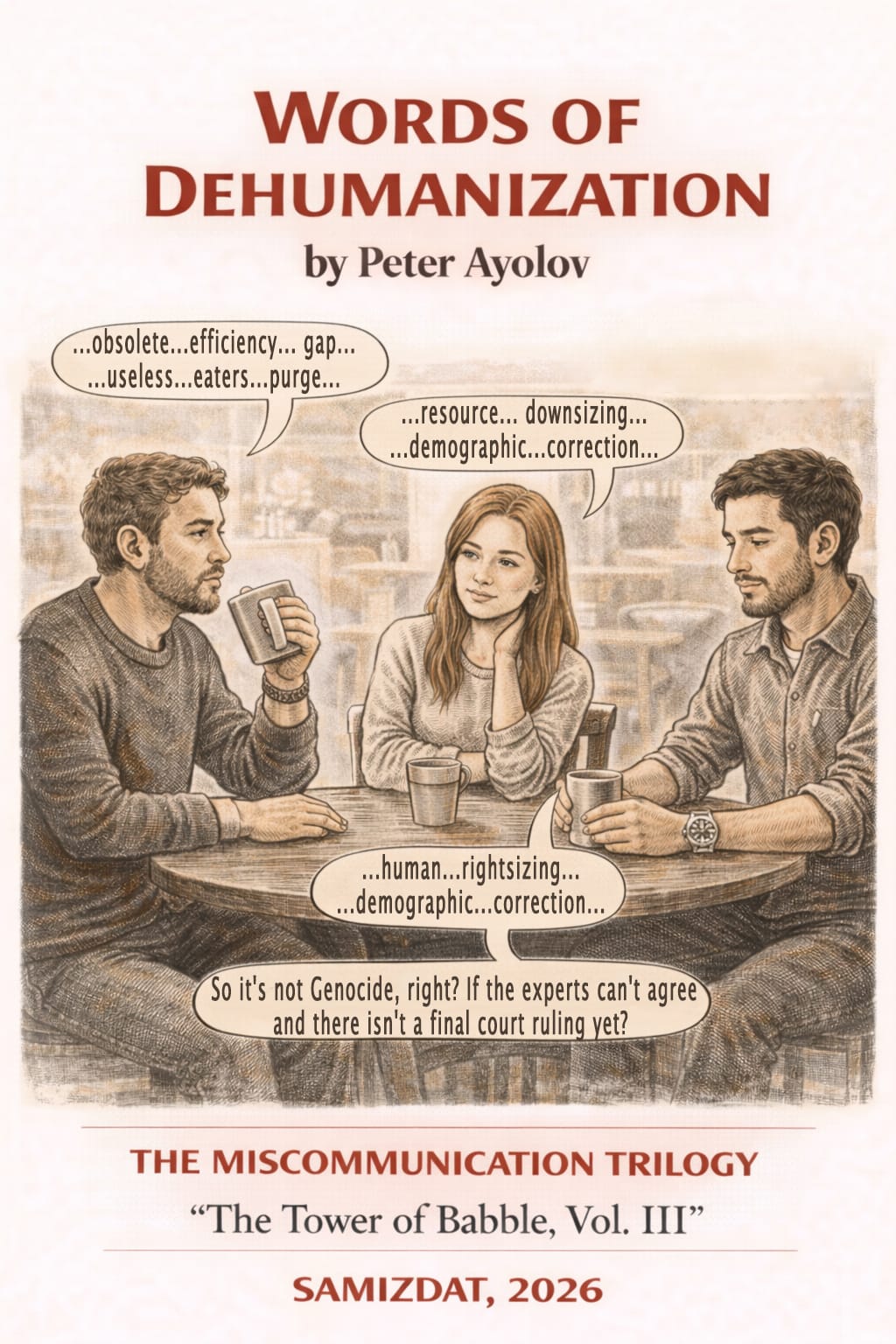
The Language of Exclusion: A Critical Review of Words of Dehumanization
The Anatomy of Human Reduction
Words of Dehumanization stands as one of the most intellectually ambitious and socially relevant volumes within The Tower of Babble, the third installment of The Miscommunication Trilogy. At its core, the book explores a question that has haunted human history from antiquity to the present: how do ordinary individuals come to perceive other human beings as less than human? Rather than approaching this problem exclusively through political history or moral philosophy, the work constructs a multidisciplinary investigation that combines psychology, sociology, communication theory, ethics, linguistics, and social cognition. The result is a comprehensive examination of the linguistic and psychological mechanisms through which humanity itself becomes negotiable. One of the greatest strengths of the book lies in its refusal to treat dehumanization as an isolated historical phenomenon. Instead, it presents it as a recurring feature of social life that can emerge wherever communication becomes detached from empathy and responsibility. The volume demonstrates that dehumanization rarely begins with overt hatred or explicit violence. More commonly, it starts with subtle shifts in perception. Individuals cease to be encountered as complex persons and become categories, stereotypes, demographic groups, ideological enemies, or administrative abstractions. Through this process, language gradually loses its capacity to represent human complexity and instead becomes an instrument of simplification. Particularly impressive is the book’s exploration of moral disengagement theory and related psychological frameworks. The discussion of cognitive mechanisms that enable individuals to justify harmful conduct provides a compelling explanation for how people maintain positive self-images while participating in exclusionary or destructive systems. The text repeatedly illustrates that human cruelty often depends less upon active malice than upon forms of moral distancing that weaken emotional and ethical connections. Equally important is the volume’s analysis of online communication, cyberbullying, and digital aggression. By examining contemporary forms of mediated interaction, the book reveals how technological environments can facilitate dehumanization by reducing social cues, increasing anonymity, and weakening empathic engagement. These chapters are particularly relevant in an era when a growing proportion of social life unfolds through digital platforms. The book succeeds in demonstrating that the technological transformation of communication has introduced new pathways through which individuals can disengage from the humanity of others while remaining convinced of their own moral innocence. Through these investigations, Words of Dehumanization establishes itself as a significant contribution to contemporary discussions about language, morality, and social fragmentation.
The Psychology of Distance and the Crisis of Recognition
A particularly noteworthy feature of the volume is its sustained focus on the relationship between language and moral perception. Throughout the text, words are treated not merely as descriptive tools but as active forces that shape social reality. The book persuasively argues that communication influences the boundaries of moral concern by determining who is perceived as worthy of empathy, protection, and recognition. Drawing on research concerning infrahumanization, social identity, empathy, cyberaggression, moral disengagement, and situationism, the work constructs a broad theoretical framework that explains how individuals categorize others and assign varying degrees of humanity to different groups. The discussion of intergroup relations is especially illuminating. By analyzing the ways ingroups are humanized while outgroups are denied uniquely human characteristics, the book reveals how collective identities contribute to social division. Rather than presenting dehumanization as a pathology restricted to extremists or authoritarian regimes, the text demonstrates that the tendency to reserve full humanity for one’s own group may emerge under ordinary social conditions. This insight gives the work considerable explanatory power. It helps account not only for historical atrocities but also for contemporary polarization, cultural conflict, and ideological hostility. Equally valuable is the volume’s engagement with debates surrounding situationism, virtue ethics, natural law, and objective morality. These discussions expand the analysis beyond social psychology and invite readers to consider broader philosophical questions concerning responsibility, character, and ethical judgment. The exploration of situationist theories is particularly effective because it challenges simplistic explanations of human behavior. Rather than attributing dehumanization solely to individual dispositions or external circumstances, the book emphasizes the complex interaction between personal characteristics and situational influences. This balanced perspective allows for a more nuanced understanding of moral conduct. The treatment of empathy likewise avoids sentimental simplifications. The text acknowledges that empathy alone does not guarantee ethical behavior and that cognitive processes can sometimes override emotional concern. This recognition contributes to the intellectual sophistication of the work. Furthermore, the examination of organizational contexts, political ideologies, media environments, and institutional structures broadens the scope of the analysis. Dehumanization is presented not merely as an interpersonal phenomenon but as a systemic process that can be embedded within bureaucratic arrangements, cultural narratives, and technological infrastructures. Such an approach enhances the relevance of the book by connecting individual psychology with larger social dynamics. The result is a rich and multilayered account of how recognition can be weakened and how moral responsibility can become increasingly diffuse in complex societies.
The Future of Humanity in an Age of Linguistic Decline
Perhaps the most significant achievement of Words of Dehumanization lies in its ability to connect seemingly diverse topics into a coherent argument concerning the fragility of human recognition. Although the book covers an impressive range of material, from cyberbullying and online aggression to virtue ethics, natural law, moral objectivity, social identity, and situationist philosophy, these themes are unified by a common concern: the conditions under which human beings cease to encounter one another as fully human. This thematic coherence gives the volume considerable intellectual depth and allows it to function simultaneously as a work of social criticism, moral psychology, and communication theory. The broader significance of the book becomes particularly clear when viewed within the context of The Miscommunication Trilogy. Throughout the trilogy, language is portrayed as a social institution undergoing a process of gradual deterioration. Words of Dehumanization extends this argument by demonstrating that the degradation of language has consequences that extend beyond misunderstanding and misinformation. When language loses its capacity to sustain empathy, complexity, and mutual recognition, the very foundations of human coexistence become vulnerable. The book therefore transforms the study of dehumanization into a broader reflection on the moral consequences of communicative decline. Its analysis suggests that the planned obsolescence of language is not simply a linguistic phenomenon but a civilizational one. As communication becomes increasingly fragmented, accelerated, and mediated, individuals face growing difficulties in perceiving others as complete persons. The reviewer's impression is that the volume succeeds not because it offers simple solutions but because it illuminates the complexity of the problem. Rather than presenting dehumanization as the product of a single cause, it reveals an intricate network of psychological, social, cultural, and linguistic factors that interact in dynamic ways. The work ultimately serves as both a warning and an invitation. It warns that the erosion of empathy and responsibility can occur gradually and often invisibly. At the same time, it invites readers to reconsider the role of language in preserving human dignity. Through its interdisciplinary scope, theoretical richness, and contemporary relevance, Words of Dehumanization emerges as one of the most compelling examinations of the relationship between communication and humanity. It is a book that challenges readers not merely to understand dehumanization but to recognize the subtle ways in which language itself shapes the moral boundaries of human life.
About the Creator
Peter Ayolov
Peter Ayolov’s key contribution to media theory is the development of the "Propaganda 2.0" or the "manufacture of dissent" model, which he details in his 2024 book, The Economic Policy of Online Media: Manufacture of Dissent.
Enjoyed the story? Support the Creator.
Subscribe for free to receive all their stories in your feed.
Comments
There are no comments for this story
Be the first to respond and start the conversation.