
Surface Speaking, THE MISCOMMUNICATION TRILOGY, “The Tower of Babble, Vol. III”, Part 16
Book Review

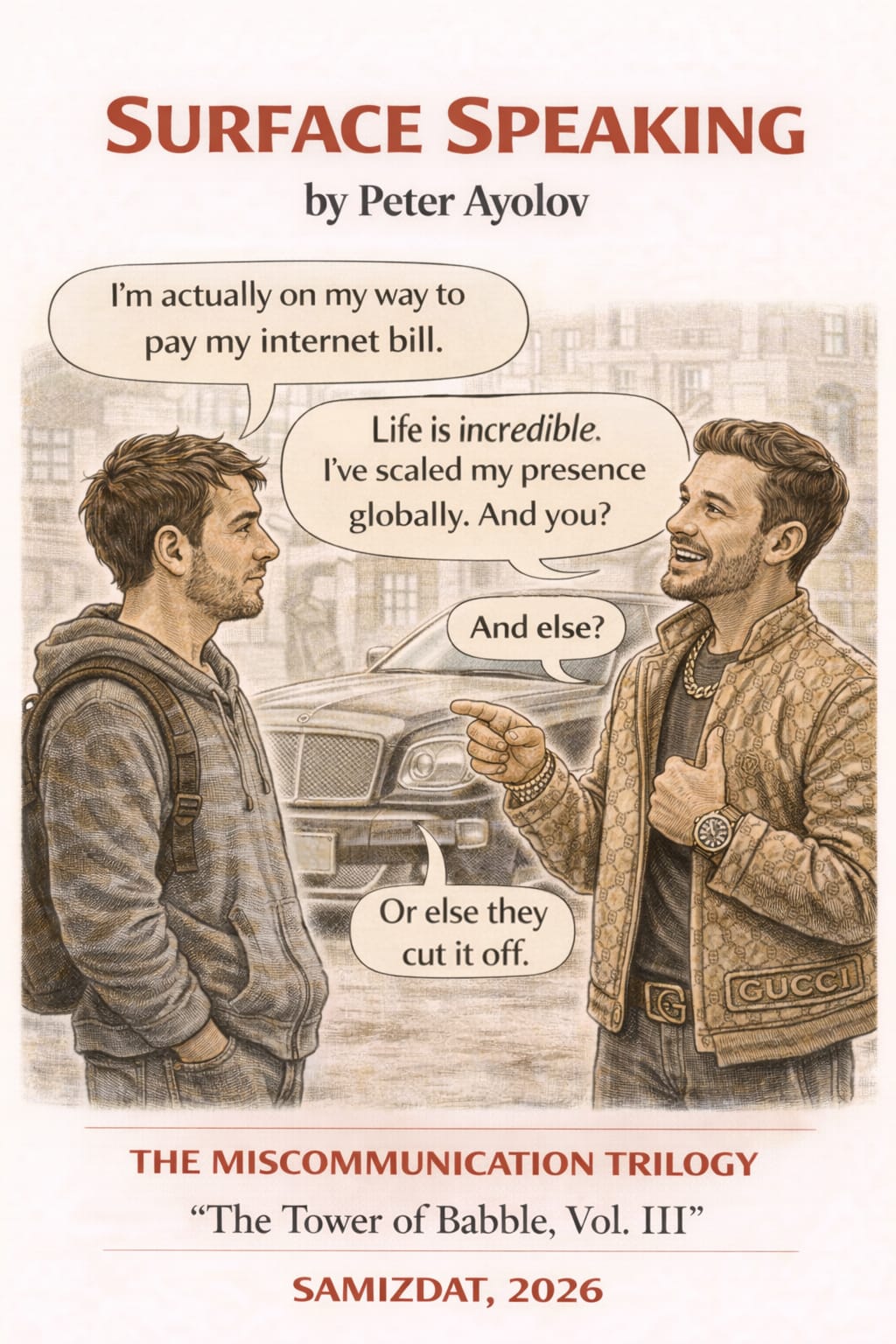
The Empire of Appearances: A Review of Surface Speaking
Communication at the End of Depth
Surface Speaking is one of the most timely and intellectually ambitious contributions to contemporary debates about language, technology, and communication. Situated within a wider investigation of the transformation of language in the digital age, the book examines a phenomenon that has become increasingly difficult to ignore: the gradual replacement of depth by immediacy, reflection by reaction, and understanding by performance. Rather than treating digital communication as a neutral technological development, the work approaches it as a civilizational shift that is reshaping the conditions under which language operates. The central achievement of the book lies in its ability to connect a diverse range of topics—including social media, online identity, misinformation, deception, expertise, netspeak, blogging, virtual communities, and digital culture—into a coherent account of contemporary communication. One of the strongest aspects of the book is its refusal to reduce the digital revolution to either technological optimism or technological pessimism. Instead, the analysis remains focused on the structural consequences of digital communication systems. The argument is not that technology itself is inherently harmful, but that every communication medium carries cognitive, cultural, and social consequences. The internet has dramatically expanded access to information, yet the book persuasively argues that information abundance does not automatically generate understanding. On the contrary, the unprecedented availability of information often produces new forms of intellectual superficiality. Knowledge becomes fragmented into disconnected pieces, and communication increasingly favours speed over reflection.
The book’s discussion of shallow thinking and surface language is particularly compelling. By drawing attention to the ways digital environments reward interruption, multitasking, and constant stimulation, it reveals how communication technologies influence patterns of attention and cognition. Reading becomes scanning. Discussion becomes reaction. The patient accumulation of knowledge is replaced by the rapid circulation of information. What emerges is a culture in which language remains omnipresent while meaningful engagement with language becomes increasingly rare. Equally impressive is the way the book situates these developments within broader historical transformations. Surface Speaking does not treat social media, blogs, or online platforms as isolated phenomena but as part of a long history of changing communication technologies. This historical perspective gives the work intellectual depth and prevents it from becoming merely another critique of contemporary media. The result is a study that successfully explains why the digital age has produced not simply new tools of communication but new forms of consciousness. Communication is no longer merely something people do; it increasingly becomes the environment in which they exist. The book therefore provides a powerful framework for understanding one of the defining cultural conditions of the twenty-first century.
Digital Selves, Manufactured Realities, and the Crisis of Trust
A major strength of Surface Speaking lies in its exploration of how digital environments transform identity, authenticity, and trust. The book demonstrates that communication in networked environments is no longer simply the transmission of information from one individual to another. It is also a process of self-construction, performance, and social positioning. Social media profiles, blogs, online reviews, comments, and digital interactions become stages upon which individuals continuously present and negotiate versions of themselves. Identity becomes increasingly fluid, curated, and mediated through technological platforms. The chapters devoted to online deception, impersonation, social media identity, and digital authenticity are among the most thought-provoking sections of the book. Through discussions of sockpuppetry, online hoaxes, false identities, fabricated expertise, and deceptive communication practices, the work reveals how easily digital environments blur the distinction between reality and representation. The internet provides unprecedented opportunities for self-expression, yet it also creates conditions in which trust becomes increasingly difficult to establish. Digital identities can be manufactured, manipulated, and strategically performed. The result is a communicative landscape characterised by uncertainty, where appearances often matter more than verification.
Particularly insightful is the book’s treatment of online communities and social networking sites. Rather than dismissing digital communities as artificial or inauthentic, the work recognises their genuine social significance while simultaneously examining the tensions they create. Social media platforms allow individuals to connect across geographical and cultural boundaries, yet they also encourage forms of interaction that prioritise visibility and performance. The presentation of self becomes inseparable from the pursuit of attention. Identity is increasingly shaped by audience expectations, algorithmic incentives, and platform architectures. In this environment, communication is never entirely private and authenticity becomes a negotiated achievement rather than a stable condition. The discussion of English as a lingua franca in digital environments further enriches the analysis. The book demonstrates how online communication encourages linguistic innovation, hybridity, and experimentation. English functions as a shared communicative resource while simultaneously being adapted, localised, and transformed by diverse communities of users. This section highlights one of the book’s most important insights: language is not merely being simplified by digital communication but also reconfigured in creative and often unexpected ways. The digital environment encourages new forms of linguistic flexibility while simultaneously creating pressures toward brevity and simplification.
Perhaps most importantly, the book identifies a broader crisis of trust emerging from these developments. Expertise, authority, and credibility become increasingly contested in environments where everyone can publish, comment, and participate. Traditional institutions of knowledge no longer possess unquestioned legitimacy, yet no stable alternatives have emerged. Surface Speaking convincingly argues that this crisis of trust is one of the defining challenges of contemporary communication. It is not merely a problem of misinformation but a deeper transformation in the social foundations upon which knowledge and authority depend. In illuminating these dynamics, the book provides valuable insight into the cultural and political tensions shaping the digital age.
Language, Attention, and the Future of Communication
The most enduring contribution of Surface Speaking may be its exploration of the relationship between language and attention. Throughout the book, communication is presented not simply as a social activity but as a cognitive and cultural process intimately connected to the ways individuals perceive, interpret, and understand reality. The digital environment transforms attention into a scarce resource. Every platform competes for it, every notification interrupts it, and every algorithm seeks to direct it. As a result, communication increasingly takes place within systems designed to maximise engagement rather than understanding. The book argues persuasively that this transformation has profound implications for language itself. Language flourishes when individuals possess the time and attention necessary to engage with complexity. Deep reading, thoughtful conversation, sustained reflection, and careful interpretation all depend upon forms of concentration that digital environments frequently undermine. Surface speaking emerges as the linguistic expression of fragmented attention. Communication becomes shorter, faster, more reactive, and more emotionally charged. Meaning is compressed into symbols, slogans, hashtags, and abbreviated exchanges. What is gained in speed is often lost in depth.
Yet the book avoids simplistic nostalgia for an imagined pre-digital past. It recognises that every communication technology reshapes language and that linguistic change is neither inherently positive nor inherently negative. Instead, the work asks a more fundamental question: what kind of communicative culture is being created by contemporary technologies? This question gives the book its philosophical significance. The issue is not merely whether people communicate differently online. The issue is whether the conditions necessary for understanding, wisdom, and meaningful dialogue can survive within increasingly accelerated communication systems. The book’s conclusion is particularly effective because it balances critique with possibility. While acknowledging the dangers of superficiality, misinformation, and digital distraction, it also emphasises human adaptability and agency. Communication technologies influence behaviour, but they do not determine it. Individuals remain capable of cultivating attention, critical thinking, and intellectual depth. Educational institutions remain capable of fostering media literacy and reflective engagement. Societies remain capable of valuing expertise while maintaining democratic participation. The future of communication is therefore not fixed. It depends upon cultural choices regarding how technologies are designed, used, and understood.
As a book review, it is difficult to identify significant weaknesses in the work because its scope is intentionally broad. If there is a limitation, it lies in the very complexity of the subject matter. The issues explored—identity, language, technology, misinformation, expertise, and social media—are so vast that each could justify a volume of its own. Yet this breadth is also one of the book’s greatest strengths. Rather than isolating these phenomena, Surface Speaking reveals their interconnectedness. It demonstrates that the crisis of communication is not a collection of separate problems but a single transformation affecting multiple dimensions of contemporary life. Ultimately, Surface Speaking succeeds as both a diagnosis and a warning. It offers a penetrating analysis of how digital communication reshapes language, identity, attention, and social reality. More importantly, it challenges readers to reconsider what communication should accomplish in an age increasingly dominated by visibility, speed, and information overload. The book reminds us that language is more than a tool for exchanging information. It is a medium through which human beings create meaning, establish relationships, and understand the world. In an era increasingly defined by surfaces, this reminder may be more important than ever.
About the Creator
Peter Ayolov
Peter Ayolov’s key contribution to media theory is the development of the "Propaganda 2.0" or the "manufacture of dissent" model, which he details in his 2024 book, The Economic Policy of Online Media: Manufacture of Dissent.
Enjoyed the story? Support the Creator.
Subscribe for free to receive all their stories in your feed.
Comments
There are no comments for this story
Be the first to respond and start the conversation.