Analysis
From Fanfiction to Bestsellers: Why We Need a More Honest Conversation About Storytelling
Few books have generated as much online discussion in recent years as Alchemised, the fantasy romance by SenLinYu that originated as the popular Harry Potter fanfiction Manacled.
By Jenna Deedy4 months ago in BookClub
Sisyphean Horror and Human Frailty; A Review of The Long Walk
Some pieces of media age like milk, there's no denying that; there's a reason why we have the phrase 'of its time' on hand. I can't say I feel that way about The Long Walk. Some argue it as an anti-war stort and given when the first draft was written and the overtly militaristic tones I can get that (if you squint), but over all of that it seems to me to be more of an anti-military industrial complex book. Not a cry against war itself, but a clean, targeted shot at the people who sent young men into a meat grinder seemingly without reason to many people.
By S. A. Crawford5 months ago in BookClub
Why "Clytemnestra" Reframes One of Greek Mythology’s Most Misunderstood Queens
For centuries, Clytemnestra has occupied a familiar place in the Greek mythological canon: the murderous wife who kills Agamemnon upon his return from Troy. In many traditional tellings, she is often reduced to a single act–an archetype of betrayal, ambition, and vengeance.
By Jenna Deedy5 months ago in BookClub
Why Willy Wonka Chose a New Heir
Willy Wonka, the famous owner of the chocolate factory in Roald Dahl's novel Charlie and the Chocolate Factory, is one of the most memorable characters in children's literature. He is known for his creativity, intelligence, and mysterious personality. Throughout the story, Wonka appears to be an eccentric businessman who enjoys making extraordinary sweets and surprising people with his inventions. However, behind his cheerful and unusual behavior lies an important concern: he needs someone to inherit his factory. The search for an heir becomes the central purpose of the Golden Ticket contest and ultimately leads him to choose Charlie Bucket. Wonka's need for an heir reflects his desire to preserve his life's work and ensure that the factory remains in capable hands.
By Gladys W. Muturi5 months ago in BookClub
The Allure of Dark Academia
The Secret History: a book I’ve coveted for so long and only a few short years ago got my hands on. Everyone on Booktok, Tumblr, and Instagram, read this book, and therefore, it only made logical sense that I should do so as well. During winter break, of course, I had to match the aesthetic of the novel whilst also having a break from my studies.
By caitodoesstuff5 months ago in BookClub
What Kant's Most Difficult Book Was Actually Trying to Say. AI-Generated.
In 1781, a fifty-seven-year-old Prussian philosopher named Immanuel Kant published a book he had been thinking about for over a decade. It was 856 pages long, written in dense, technical prose that its first readers found almost impenetrable. One early reviewer complained that it was impossible to understand. Another said it would take a lifetime to read properly. Kant himself acknowledged that the writing was not easy and produced a shorter version two years later in an attempt to make the core argument accessible.
By Hassan Shah5 months ago in BookClub
A Brief History of Time: Stephen Hawking’s Masterpiece That Made the Universe Accessible Read time
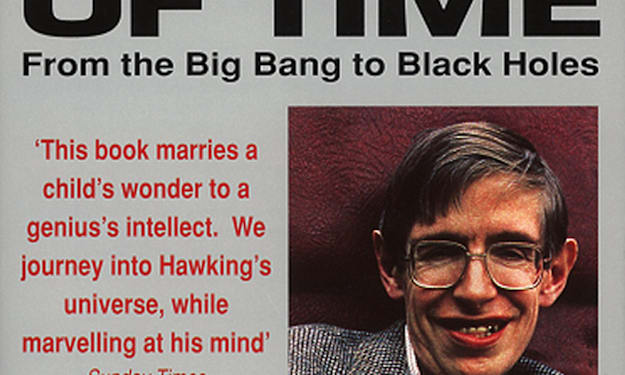
In 1988, a groundbreaking book transformed how millions understood the cosmos. A Brief History of Time: From the Big Bang to Black Holes by Stephen Hawking became an international phenomenon, selling over 25 million copies in more than 40 languages. It spent a record 237 weeks on the London Sunday Times bestseller list and remains one of the most influential popular science books ever written.153f11 Hawking, the brilliant theoretical physicist diagnosed with ALS (motor neuron disease) at age 21, achieved what many thought impossible: explaining complex ideas like black holes, the Big Bang, quantum mechanics, and the nature of time in language accessible to non-scientists — with almost no equations (just one: E=mc²).64a35a This article explores the book’s background, key ideas, cultural impact, and why it still matters in 2026. The Man Behind the Book Stephen William Hawking (1942–2018) was Lucasian Professor of Mathematics at the University of Cambridge. Despite losing nearly all physical abilities, he communicated through a speech synthesizer and continued groundbreaking work on cosmology, black holes, and quantum gravity. Hawking wrote A Brief History of Time with the goal of answering big questions for ordinary readers: How did the universe begin? Does time have a beginning or end? What are black holes really like? He avoided heavy math, focusing on clear explanations and analogies.c134cf The book’s success surprised everyone, including Hawking. It turned him into a global icon, featured in documentaries, The Simpsons, and films like The Theory of Everything. Structure and Key Chapters: A Journey Through the Cosmos The book has 12 chapters that build from historical context to cutting-edge (for 1988) theories. Here’s a chapter-by-chapter overview of the core ideas: Chapter 1: Our Picture of the Universe Hawking starts with humanity’s evolving view of the cosmos — from Aristotle’s Earth-centered model to Ptolemy, Copernicus, Galileo, and Newton. He introduces the quest for a unified theory that explains everything.aef0ff Chapter 2: Space and Time This explores relativity. Newton saw space and time as absolute. Einstein’s special and general relativity showed they are intertwined as “spacetime,” curved by gravity. Time slows near massive objects or at high speeds.167ae9 Chapter 3: The Expanding Universe Evidence from Edwin Hubble showed galaxies moving away from us — the universe is expanding. This points to a beginning: the Big Bang. Hawking discusses Friedmann’s models and the cosmic microwave background radiation as leftover heat from the early universe.e2f0c5 Chapter 4: The Uncertainty Principle Hawking introduces quantum mechanics. Heisenberg’s principle says we cannot precisely know both position and momentum of particles simultaneously. This challenges classical determinism and introduces probability into physics.3d25bc Chapter 5: Elementary Particles and the Forces of Nature Covers quarks, leptons, and the four fundamental forces: gravity, electromagnetism, weak and strong nuclear forces. Hawking explains particle physics and the search for grand unification. Chapter 6 & 7: Black Holes (and “Black Holes Ain’t So Black”) Black holes form when massive stars collapse. Their gravity is so strong that nothing, not even light, escapes the event horizon. Yet Hawking showed they emit radiation (“Hawking radiation”) due to quantum effects near the horizon, eventually evaporating. This was revolutionary.b99744 Chapter 8: The Origin and Fate of the Universe Discusses Big Bang singularities and possible futures — endless expansion, Big Crunch, or a flat universe. Hawking favors no-boundary proposals with imaginary time. Chapter 9: The Arrow of Time Why does time flow forward? Linked to entropy (disorder increasing). The psychological, thermodynamic, and cosmological arrows of time align in our universe.2196de Chapter 10: Wormholes and Time Travel Explores theoretical possibilities of time travel via wormholes, but notes practical barriers like energy requirements and paradoxes. Chapter 11: The Unification of Physics The quest for a “Theory of Everything” combining general relativity and quantum mechanics — perhaps string theory or M-theory. Chapter 12: Conclusion Hawking ends philosophically: understanding the universe through science may be “the ultimate triumph of human reason” — knowing the mind of God.465332 Major Themes and Breakthrough Ideas The Universe Has Rules: Laws of physics govern everything, from quarks to galaxies. Time and Beginnings: The Big Bang suggests time had a start. Singularities challenge classical physics. Black Holes and Quantum Gravity: Hawking’s work bridged relativity and quantum mechanics. Human Curiosity: Science is a collective, evolving endeavor. We may be close to understanding the universe’s fundamental laws.fbc369 The book balances wonder with humility — we still don’t have all answers. Cultural Impact and Legacy A Brief History of Time popularized cosmology like no book before. It inspired generations of scientists, students, and curious readers. It was adapted into a 1991 film and updated editions (including illustrated versions) kept it relevant.63a924 Critics praised its clarity; some noted it remains challenging for absolute beginners. In 2026, while some details (like certain cosmological parameters or pre-Higgs boson understanding) are dated, the core explanations and philosophical questions endure.1ef42b Its success proved complex science can sell if presented with clarity and awe. Why It Still Matters in 2026 With JWST discoveries, gravitational wave detections, and advances in quantum computing, Hawking’s foundational ideas remain a perfect entry point. The search for a unified theory continues. Questions about the multiverse, dark energy, and time’s nature are as alive today as in 1988. Reading it encourages scientific literacy in an era of misinformation and rapid technological change. It reminds us that curiosity about the universe is a deeply human trait. Final Thoughts: The Triumph of Reason A Brief History of Time isn’t just about physics — it’s about our place in the cosmos. Hawking showed that even with immense personal challenges, the human mind can grasp the universe’s deepest secrets. If you haven’t read it, start today. Pair it with newer books on recent discoveries for a complete picture. As Hawking wrote, understanding the universe may be the greatest achievement of all. What did you think of the book if you’ve read it? Which concept fascinated (or confused) you most — black holes, the Big Bang, or time travel? Share in the comments.
By jahidul Islam Sifat5 months ago in BookClub