
I Spent Three Years Trying to Brighten My Skin. My Dermatologist Told Me to Stop.
Everything I was told about building tolerance was wrong, and the proof was on my own face.
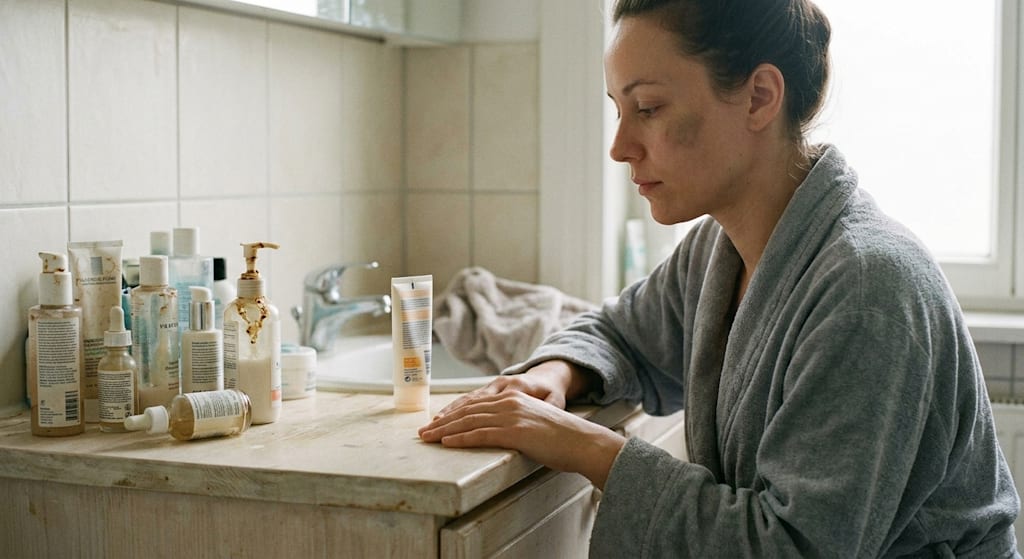
Every Product That Promised to Brighten My Skin Made It Worse
A reader sent me a photo of her cheek last spring. Red, flaking, and darker in the exact spot she had been trying to lighten. She had been using a 10% niacinamide serum for six weeks. Someone in a comment section told her the stinging meant it was working.
I recognized her face. I had worn it.
For about three years I cycled through the standard lineup: high-concentration niacinamide, a low-pH vitamin C, a retinol-adjacent acid toner, and at one point a 377 cream I bought because a video said it was the strongest option available. Each time, the first week looked promising. My skin had that tight, polished look that photographs well. Each time, somewhere around week three, my cheeks started flushing after every application. Then came the dry patches. Then came the spots, darker than the ones I started with.
I kept going because the internet told me to. Build tolerance. Push through. The purge is normal.
What I got wrong
The advice to push through stinging is everywhere, and it is not supported by anything I have since read.
Stinging, heat, and redness are signs that the top layer of your skin has been compromised. Skin does not develop immunity to irritation the way a muscle adapts to weight. What people call "building tolerance" is usually the skin going quiet after repeated injury. The nerves stop reporting. The damage continues.
I asked a dermatologist about this two years ago. She put it plainly: if a product hurts, the product is the problem, not your pain tolerance. I had never heard anyone say that out loud.
What the research actually shows
I started reading the studies behind the ingredients instead of the marketing. A few things stood out.
Niacinamide was not developed as a brightening ingredient. It was used to treat pellagra, a nutritional deficiency, and it moved into skincare in a meaningful way after 2000. Its mechanism is narrow: it blocks melanin from moving from the deeper layers of skin to the surface. It does not stop melanin from being produced. It does not clear pigment that has already settled. When you stop using it, the melanin that was held back in deeper layers gets released, and the tone often drifts back toward where it started.
That matched what I had experienced, and it matched the emails I get. People write to tell me they spent six months on a serum, loved the results, stopped for two weeks, and watched the progress disappear.
The concentration story is similar. At 1% to 2%, niacinamide is well tolerated but does very little for tone. At 2% to 5%, it does more, and the irritation risk rises with it. Above 10%, the immediate look can be brighter, but so is the chance of a reaction. There is no version of this where you get maximum effect and zero cost.
377, or phenylethyl resorcinol, has genuinely strong data for blocking tyrosinase, the enzyme that drives melanin production. It is also irritating enough that the standard industry limit is 0.5%. When people use it at higher concentrations, or mix it with acids, the common outcome is redness followed by new pigment. The spot they were trying to fade comes back larger.
L-ascorbic acid is the same story with different details. To stay active, it needs a strongly acidic formula. That acidity is hard on skin. I have talked to readers with dry or sensitive skin who simply cannot use it at all, no matter how slowly they introduce it.
None of this means these ingredients are useless. It means they are narrow tools with real costs, and the way they get sold online strips out every caveat.
The part that made me stop
What finally changed my mind was the rebound.
The first time I quit the niacinamide serum, my face went darker in about ten days. I assumed I had done something wrong. I started again. Same cycle. Quit, darken, restart.
I eventually understood what was happening. I had been trading a temporary surface effect for ongoing irritation, and the irritation itself was producing new pigment. Every flush, every dry patch, every inflamed follicle leaves a mark on skin that is prone to it. I was creating the problem I was trying to solve.
What I do now
My routine is boring and it took me a long time to accept that.
I wear sunscreen every day, including cloudy days and days I do not leave the house. I use a mineral SPF 50 on my face and reapply if I am outside for more than two hours. This is the only step I would argue with anyone about.
I use a gentle cleanser at night and water in the morning. I moisturize more than I used to. I stopped layering actives, because I could never tell which one was causing a reaction, and the only way to find out was to start over.
For tone, I moved toward gentler ingredients. Glabridin, extracted from licorice root, is one I have used for about a year. It works differently from niacinamide. It interferes with tyrosinase directly, and it also seems to calm the skin's stress response, which matters for anyone whose pigment flares when their skin is irritated. Some of the studies behind it are small, and I want to be honest about that. The 2026 paper on glabridin combined with licochalcone A and 4-butylresorcinol showed improvement in melanin index and ITA° in human trials, but it was a single study with a modest sample. I am not going to pretend that is a mountain of evidence.
What I can say is that my skin stopped reacting. It stopped flushing. The spots on my cheeks faded slowly over about four months, not dramatically, and they have stayed faded. Nothing about it was fast.
What I tell people now
If a product stings, stop using it. If a stranger online tells you the stinging is the point, they are repeating something they heard from someone else who heard it from someone else.
If you want to fade spots, sunscreen is not optional and it is not a supporting player. It is the whole thing. Everything else is a smaller variable.
If you have spots that are not responding to anything you try, or if they are getting darker while you treat them, see a dermatologist. Some pigment conditions need a prescription or a procedure, and no serum will reach them.
The reader who sent me the photo of her cheek wrote back in August. She had stopped the niacinamide, gone back to a basic moisturizer, and started wearing sunscreen daily. Her skin was calmer. The spots were still there, but lighter.
She said the thing that stuck with me. She said she had spent two years trying to fix her skin, and it turned out her skin just wanted to be left alone.
About the Creator
Jin
Writer of reamstories
https://reamstories.com/jin
Enjoyed the story? Support the Creator.
Subscribe for free to receive all their stories in your feed. You could also become a paid subscriber, letting them know you appreciate their work.
Comments
There are no comments for this story
Be the first to respond and start the conversation.