instruments
All about musical instruments, their tunes, and the people that play them.
Craigology Paints Emotion Through Piano
There’s a certain kind of album that doesn’t just play in the background — it quietly changes the atmosphere around you. Piano in the Wilderness by Craigology is one of those records. The moment the first notes land, everything feels a little slower, a little softer, a little more reflective. It’s the kind of music that makes you stop scrolling for a second and actually sit with your thoughts.
By mysoundMusic5 months ago in Beat
The Shadow Boxer: Phrygian Mode . AI-Generated.
While the Ionian (Major) scale basks in the blinding, optimistic rays of the noonday sun, and the Aeolian (Natural Minor) weeps with the predictable grace of a rainy afternoon, there is a third sibling. A sibling that prefers the flickering candlelight of an ancient library or the scorched earth of a Mediterranean plain.
By Nathan McAllister6 months ago in Beat
Ode to the Suspended Chord
The Breath Between Notes: An Ode to the Suspended Chord In the architecture of a vocal arrangement, the major chord is a sturdy wall and the minor chord is a shadowed corner. But the suspended chord? The suspended chord is the open window. It is the musical equivalent of a held breath, a lingering gaze, or a question left hanging in the silver air of a cathedral.
By Nathan McAllister6 months ago in Beat
Beyond the Triad (Extended Chords)
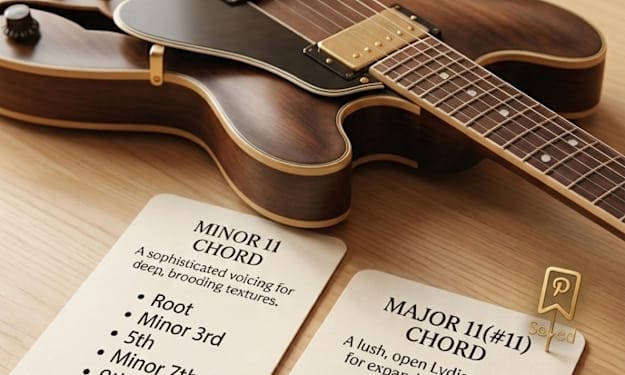
If basic triads are the bones of a composition, and seventh chords are the flesh, then the extensions—the 9ths and 11ths—are the breath in the lungs. They are the colors that turn a simple chord progression from a flat sketch into a living, breathing landscape.
By Nathan McAllister6 months ago in Beat
Theremin - A Playlist
Introduction The theremin is an unconventional electronic instrument, named after its Soviet inventor Léon Theremin in 1928, and which doesn't require any contact to be operated. The fruit of research into proximity sensors, the theremin's setup is usually consisting of two metal antennas that sense the distance to the player's hands and react accordingly, one controlling the volume of the sound, and the other controlling the frequency and therefore the pitch. By moving both hands in the air and changing the distance to the antennas, musicians produce an eerie electronic sound.
By Mike Singleton 💜 Mikeydred 6 months ago in Beat
Diminished and Augmented Chords (Practice Tips & Exercises)
In the vast landscape of music theory, major and minor triads are the stable earth beneath our feet—the destinations, the homes, the resting places. But music, much like any gripping narrative, requires conflict to make the resolution meaningful.
By Nathan McAllister6 months ago in Beat
Oh Tetrad, Hearken unto Me!
The triad is stone. It is the foundation, structurally sound and completely static. It stands there, immovable, declaring its major or minor allegiance with absolute, unwavering certainty. But the triad has no narrative. It has no pulse.
By Nathan McAllister6 months ago in Beat
Modes of D for Guitar
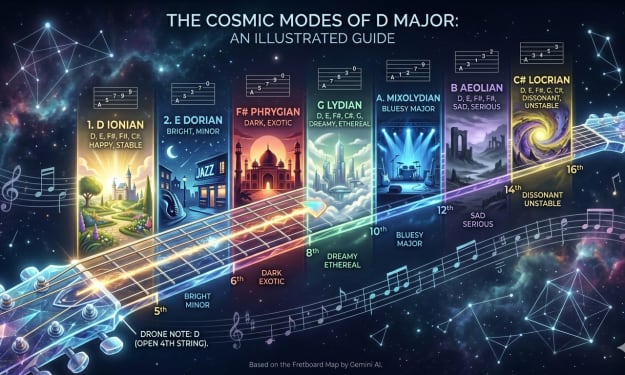
Understanding the modes in the Key of D Major involves using the same set of notes (D, E, F#, G, A, B, and C#) but starting and ending on a different note for each mode. This shift in the "center" changes the intervals and the overall emotional character of the music.
By Nathan McAllister7 months ago in Beat
Welcome to the machine
1: The rise of the machines A long time ago I wanted nothing more than to be a rock star. My late teens were spent devouring music like some kind of junkie crawling through records in shops for my next fix. I learned to play guitar, bass and a bit of keyboards and I tried to sing.
By Phill Ross7 months ago in Beat