
Ode to the Suspended Chord
Expand your songwriting repetoire

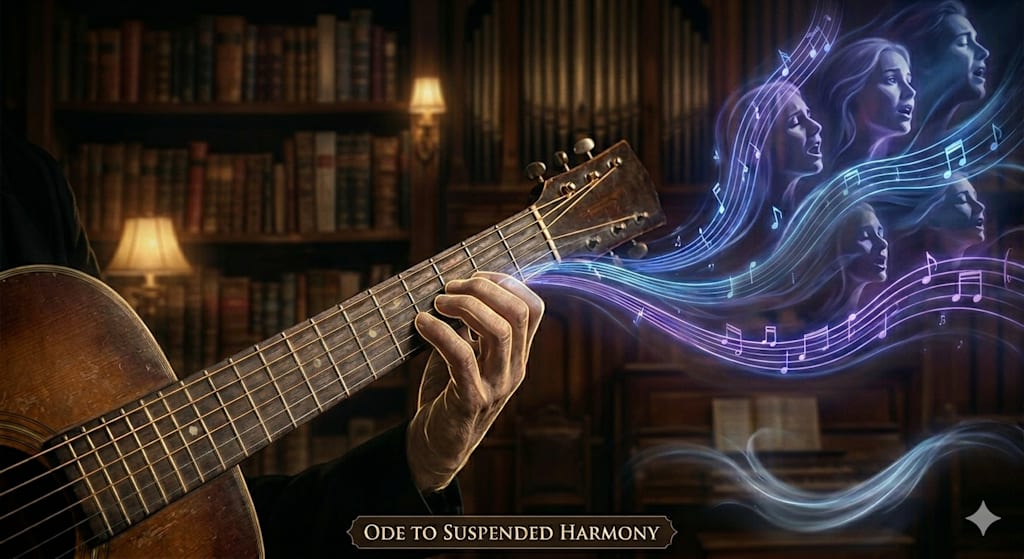
The Breath Between Notes: An Ode to the Suspended Chord
In the architecture of a vocal arrangement, the major chord is a sturdy wall and the minor chord is a shadowed corner. But the suspended chord? The suspended chord is the open window. It is the musical equivalent of a held breath, a lingering gaze, or a question left hanging in the silver air of a cathedral.
To use a "Sus" chord in a vocal piece is to embrace the beauty of not yet.
The Anatomy of Longing
When voices cluster into a suspension, they defy the gravity of resolution. By replacing the traditional third with a second or a fourth, you strip away the definitive "happy" or "sad" labels, leaving the listener in a state of exquisite, shimmering neutral.
The Sus4 (The Yearner): This is the soul reaching upward. When the altos or tenors hold that fourth, it creates a delicious friction against the root. It’s the sound of a plea, a "please stay," or the moment of tension right before a heart breaks—or mends.
The Sus2 (The Wanderer): Gentle, airy, and profoundly modern. The Sus2 feels like mist over water. It doesn’t demand a resolution as much as it invites the listener to drift. It gives a vocal ensemble a sense of "expensive" space.
Why Voices Love the Tension
There is something visceral about human voices singing a cluster. Unlike a piano, where the hammers strike and fade, a vocal section can bloom into a suspension.
"A suspended chord is the 'comma' in the middle of a musical love letter. It tells the listener that while the sentence isn't over, the pause itself is where the meaning lives."
When a soprano line hangs on a suspended fourth while the rest of the choir anchors the root, the resulting beat frequencies—that physical "rub" of the notes—vibrate in the listener's chest. It is a physical manifestation of anticipation.
The Art of the Resolution (Or Lack Thereof)
The true magic of the suspended chord lies in its promise. When that suspended note finally slides down (or up) into the third, the release of dopamine is unrivaled. It’s the "Amen" that actually feels earned.
However, in the hands of a true poet, the suspension is never resolved. It is left to ring out into the silence, proving that sometimes, the most beautiful thing a voice can do is refuse to give an easy answer.
Suspended chords aren't just harmony; they are the ghost in the machine of the melody.
On the guitar, suspended chords are a study in displacement. To build one, you are essentially evicting the 3rd—the note that dictates whether a chord is major or minor—and inviting a neighbor to take its place.
Because the 3rd is gone, the chord loses its emotional bias. It becomes a structural "chokepoint" of tension that wants to collapse back into a resolution.
The Theoretical Blueprint
In a standard triad, we use the 1st, 3rd, and 5th tones. To suspend the chord, we swap that middle man:
Sus2: 1 - 2 - 5 (The 3rd moves down a whole step to the 2nd).
Sus4: 1 - 4 - 5 (The 3rd moves up a half step to the 4th).
On the fretboard, this usually means moving a single finger by one or two frets while the rest of the chord shape remains an anchor.
Common Open Position Tabs
These are the "bread and butter" suspensions. They utilize open strings to let the tension ring out with maximum resonance.
The "D" Family
The high E-string houses the 3rd (F sharp in D Major). By lifting or adding a finger, you shift the color instantly.
Plaintext
D Major Dsus2 Dsus4
E|-----2-----------0-----------3-------|
B|-----3-----------3-----------3-------|
G|-----2-----------2-----------2-------|
D|-----0-----------0-----------0-------|
A|-----x-----------x-----------x-------|
E|-----x-----------x-----------x-------|
The "A" Family
Here, the B-string holds the 3rd (C\sharp).
Plaintext
A Major Asus2 Asus4
E|-----0-----------0-----------0-------|
B|-----2-----------0-----------3-------|
G|-----2-----------2-----------2-------|
D|-----2-----------2-----------2-------|
A|-----0-----------0-----------0-------|
E|-----x-----------x-----------x-------|
Movable Barre Chord Shapes
For jazz or more complex arrangements, using movable shapes allows you to maintain the "suspension" across the entire neck. These follow the E-shape and A-shape logic.
E-Shape (Root on 6th String)
Example: Gsus4
Plaintext
G Major Gsus4
E|-----3-----------3-------|
B|-----3-----------3-------|
G|-----4-----------5-------| <-- The 3rd (4th fret) moves to 4th (5th fret)
D|-----5-----------5-------|
A|-----5-----------5-------|
E|-----3-----------3-------|
A-Shape (Root on 5th String)
Example: Csus2
Plaintext
C Major Csus2
E|-----3-----------3-------|
B|-----5-----------3-------| <-- The 3rd (5th fret) drops to 2nd (3rd fret)
G|-----5-----------5-------|
D|-----5-----------5-------|
A|-----3-----------3-------|
E|-----x-----------x-------|
The "Wildcard" Jazz Voicing (7sus4)
In sophisticated vocal or jazz arrangements, the 7sus4 is the ultimate "unresolved" sound. It functions like a dominant chord but with all the edges sanded off.
Example: G7sus4
Plaintext
E|-----x-------|
B|-----6-------| (Interval: 7th)
G|-----5-------| (Interval: 4th)
D|-----3-------| (Interval: Root)
A|-----5-------| (Interval: 5th)
E|-----3-------| (Interval: Root)
Pro Tip: When playing these, pay attention to the voice leading. The ear isn't just hearing a new chord; it’s hearing a specific note move. On the guitar, try to keep the root and 5th rock-steady so the listener's focus is entirely on the shifting 2nd or 4th.
About the Creator
Nathan McAllister
I create content in the written form and musically as well. I like topics ranging from philosophy, music, cooking and travel. I hope to incorporate some of my music compositions into my writing compositions in this venue.
Cheers,
Nathan
Enjoyed the story? Support the Creator.
Subscribe for free to receive all their stories in your feed.
Comments
There are no comments for this story
Be the first to respond and start the conversation.