
The Shadow Boxer: Phrygian Mode
A new scale to try

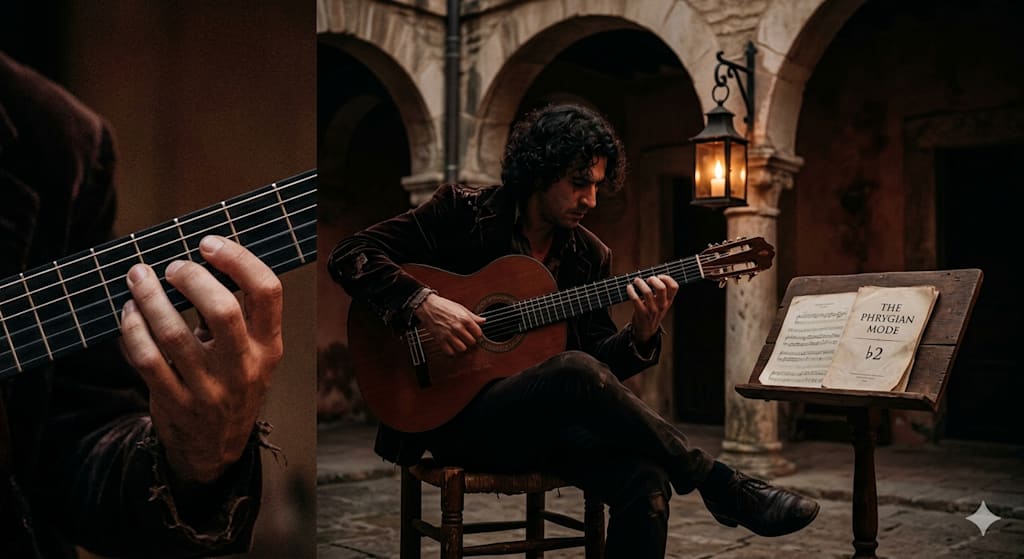
While the Ionian (Major) scale basks in the blinding, optimistic rays of the noonday sun, and the Aeolian (Natural Minor) weeps with the predictable grace of a rainy afternoon, there is a third sibling. A sibling that prefers the flickering candlelight of an ancient library or the scorched earth of a Mediterranean plain.
I’m talking, of course, about the Phrygian Mode.
If music were a wardrobe, the Major scale would be a crisp white linen suit, and Phrygian would be a heavy, velvet cloak—dark, mysterious, and smelling slightly of exotic spices and impending revolution.
The Friction of the "Flat Two"
What makes Phrygian so intoxicating? It all comes down to a single, delicious point of tension: the minor second.
In technical terms, the Phrygian mode is the third mode of the Major scale. If you play all the white keys on a piano starting on E, you’ve found it. But don't let the simplicity of those white keys fool you. The intervalic structure is where the magic (and the danger) happens:
1st - \flat 2nd - \flat 3rd - 4th - 5th - \flat 6th - \flat 7th
That flat 2nd is a dagger. While other scales give you room to breathe between the first and second notes, Phrygian crowds you. It creates an immediate, visceral sense of friction. It is the sound of a secret being whispered too close to your ear. It doesn't just ask for your attention; it demands your submission.
From the Bullring to the Mosh Pit
The Phrygian mode is a shapeshifter. It is perhaps the most "visual" of all the modes, capable of conjuring entire landscapes with just a few notes.
The Flamenco Soul: Close your eyes and play a Phrygian cadence, and you are suddenly in Andalusia. It is the backbone of Cante Jondo, the "deep song" of Spain. It carries the dust, the heat, and the tragic pride of the matador.
The Metal Menace: When guitarists like Kirk Hammett or Jeff Hanneman want to evoke pure, unadulterated dread, they often turn to Phrygian. That half-step slide from the root to the flat second is the sound of a monster lurking just outside the campfire’s light.
The Cinematic Mystery: Composers use Phrygian when the hero enters the tomb, or when the spy realizes they've been double-crossed. It feels ancient. It feels like fate.
Why We Need the Darkness
In a world obsessed with "upbeat" playlists and the sterile perfection of pop-major progressions, the Phrygian mode offers us catharsis. It doesn't try to cheer you up; it validates your intensity. It acknowledges that life isn't always a resolution—sometimes, it’s a lingering, beautiful tension that never quite lets go.
To love Phrygian is to love the shadows. It is the mode of the misunderstood, the seeker, and the storyteller. It is proof that you don't need a "happy ending" to create a masterpiece; sometimes, you just need a really sharp minor second and the courage to let it ring.
Note to the Reader: If you’re feeling bold, go to your instrument tonight. Find a root note, drop that second degree by a half-step, and see where the shadows take you. Just don't say I didn't warn you when you start seeing ghosts.
About the Creator
Nathan McAllister
I create content in the written form and musically as well. I like topics ranging from philosophy, music, cooking and travel. I hope to incorporate some of my music compositions into my writing compositions in this venue.
Cheers,
Nathan
Enjoyed the story? Support the Creator.
Subscribe for free to receive all their stories in your feed.
Comments
There are no comments for this story
Be the first to respond and start the conversation.