
My Exclusive Interview With Alessandra Levy
Take a trip back to the 90s as you discover why this producer still relies on analog technology.

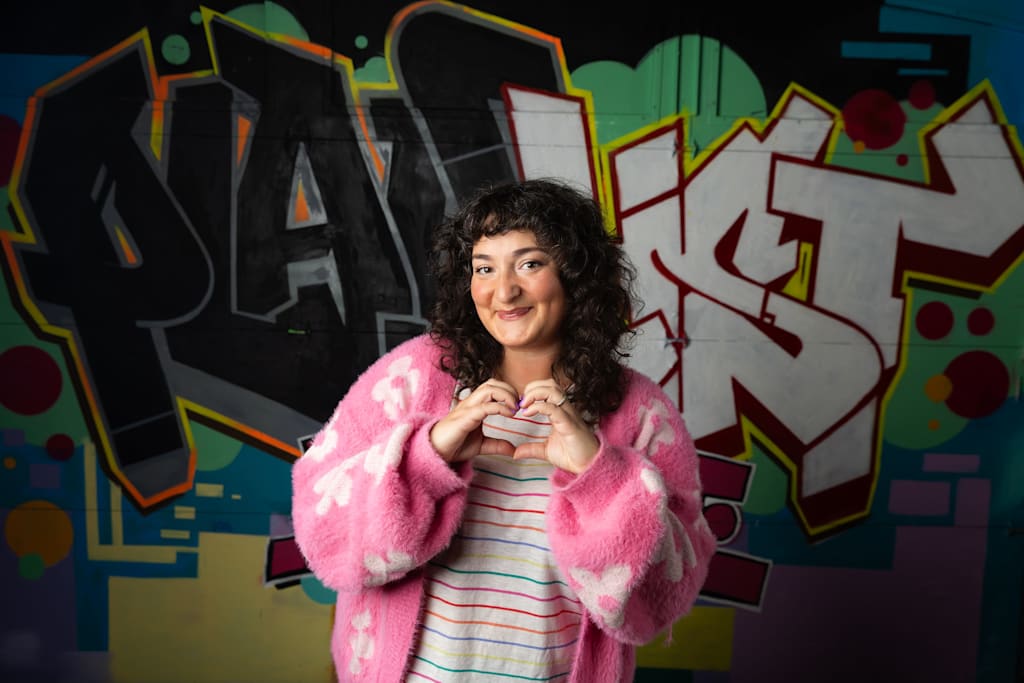
In a world of digital music production, Alessandra Levy still takes an old-school approach with her Music Production Center (MPC) that dates back to the 90s. This model has everything you'd expect from a piece of analog technology—large grey buttons, beige colors, a tiny digital screen—but these limitations help Levy produce fun, eclectic beats that earned the artist a large social media following. With nearly 50,000 followers on Instagram alone, Levy's introducing the MPC60II to a whole new audience, and this interview gives you a look at the skills, education and technology that made Levy a rising Internet star.
1. For the uninitiated (like me), what exactly is an MPC? What inspired you to start using one, and how do you use it to create beats?
An MPC, aka MIDI/Music Production Center, is a piece of music gear used in music production, mostly used to make beats/chop samples and program drums. I was inspired to use it a few days before New Year's (2026) because of a song I heard on the way home from record shopping. I thought, "I wanna chop this up and flip it!" The rest is history...10 months in so far—ha! I use my MPC60II and MPC Sample to create beats by chopping up samples, playing instruments into it, and programming drums and sequencing songs.
2. From what I've seen on your social media, the MPC is fairly low-tech. What are the benefits of using an MPC over more advanced equipment? Does it accomplish anything that you can't get with newer technology?
I'm personally using the MPC60II, which is from '91-'94 roughly, and I actually enjoy the limitations. It forces me to be even more creative within those limitations. I have started to use the MPC Sample more recently, and I enjoy it as well. I feel I am using a bit of everything as far as more "advanced equipment," such as my laptop for more arranging and adding in live instruments. But I would say the biggest thing it accomplishes for me that newer technology can't really do is the specific feel and sound of it.
3. Do you think that working as a voice actor influences the way you make music? Likewise, do you think that your musical background influences the way you approach voice acting? Does excelling in one of these fields make it easier to succeed in the other?
I've been making music long before I became a voice actor, but I will say that performing throughout my life, whether it's acting in a play or recording in the studio, has helped me become a better artist. All the creative endeavors go hand in hand with each other for sure, and I find that as I become a better actor, I'm a better musician, a better writer and a better performer. It's constantly building!
4. Your first album, Beat Tape Vol. 1, arrived exclusively as a physical release. Can you talk more about the value behind buying physical releases and owning your media? What do vinyls and cassette tapes offer that you can't get with streaming?
My debut album did start out on Bandcamp as a digital download, and then streaming, but the lovely Producer Plug wanted to support my music and asked if I wanted to make vinyl, tapes and CDs. I couldn't say no, because in the age where we own almost nothing, I felt it was the right moment to make something permanent. I am an analog gal, and I love collecting vinyl, so I felt it was a great idea!
5. When you're creating a beat with your MPC, what does the process look like? How long does it take to complete a single beat
Generally, it takes me 20-60 minutes to get the idea and form right. If I want to add instruments on top and rearrange it in Ableton, that adds some more time, but I like to get into a flow state, and it's usually pretty quick to get my initial ideas out.
6. What's your favorite music to use for samples? When you find a track, how do you remix it to turn it into your own beat? On a similar note, what do you do when you need inspiration?
I love classical music and jazz mostly, and I find those genres the most fun to dig into for samples. I also love to sample myself and my husband. Between the two of us, we play mostly everything, so it's really fun to make music and then chop it up and sample ourselves. When I find the right "moment," I will put it into the MPC and mess around with length, pitch and speed, then find other spots in the song to make my own new arrangement.
7. Switching gears a little: what exactly does a session vocalist do? What kinds of projects do you take on, and what makes this job different from a "traditional" vocalist job? How did you get into this field?
I got my degree from the Frost School of Music in Miami. My major was Studio Music and Jazz Performance, which was not only jazz performance for voice (I also played bass and a little piano there), but also learning how to be in studio sessions when you're handed an arrangement and you record it, as well as sight-reading and excelling in a high-pressure, time-is-money type of situation.
I wanted to sing jingles for commercials, but that kind of died when I got out of college, so I began singing on records for colleagues and other clients I was hired to sing for. I also do live gigs singing (and playing bass), and it is definitely a different skill set, although the basics are the same: be a great singer, be easy to work with and know how to perform well.
8. On social media, you've talked about growing up in a musical family. What was your upbringing like, and how did it lead to a musical career? Do you think you would've always become a musician and producer even if you had a totally different background?
Both my parents are musicians, and I was surrounded by music constantly as a child. I started music lessons at four, and took lessons from then through college. From about age five or so, it became pretty clear to me and my parents that I was going to have some sort of career in performing arts, whether that was in acting or music...surprise, it's both! As far as music production, I didn't ever think I'd be doing that, but I'm having so much fun with it and realizing it's another skill I have and can continue to hone over time.
If you're a fan of Alessandra Levy's beats, you can buy a physical release, follow her on Instagram, TikTok, YouTube and Threads, download her music on Bandcamp, and stream her tracks on Spotify, SoundCloud and Apple Music.
About the Creator
Kaitlin Shanks
Music journalist. To support my work, please send a tip (even $1 helps!) or shop from my Amazon storefront.
Last Living Girl (novel) • Instagram • TikTok • YouTube • Substack • Medium • Wattpad • Spotify Playlists • Linktree
Enjoyed the story? Support the Creator.
Subscribe for free to receive all their stories in your feed.
Comments
There are no comments for this story
Be the first to respond and start the conversation.