
Trust It, Test It: The Forgotten Sentence That Could Save the Next Civilization
Democritus guessed atoms. Aristotle guessed elements. But the only idea worth carving in stone isn’t a fact—it’s a method.
Democritus had his eyes closed.
The Aegean sun warmed the sand at his feet. Leucippus sat across from him, turning a pebble in his hand, rounded smooth by the sea.
“If you keep cutting,” Democritus said, “there must be an end. Otherwise, where does anything begin?”
Leucippus tossed him the pebble. “Then call it atomos. The uncuttable.”
Far to the east, Mozi brushed onto a bamboo slip: “The duan is that which has no order and stands foremost in a body.” He did not know that two men by the Aegean were saying the same thing.
Twenty-four centuries later, a scanning tunneling microscope photographed that pebble. Row upon row, neatly aligned, as if set there by some craftsman’s hand. Humanity had waited twenty-four hundred years just to see that it had guessed right.
But for most of those two thousand years, few believed Democritus.
Aristotle pointed at the logs burning in the hearth. Flames licked the bark, ash crumbled downward, blue smoke hugged the flue and rose.
“Look,” he told his students, “fire moves upward, earth moves downward. The wood burns, the air leaves, the ash stays. All things are made of earth, water, air, and fire.”
His students nodded. No one weighed the ash. No one collected the smoke and put it on a scale. Because Aristotle never told them to. He told them to look, and then to believe.
This wrong idea ruled science for two thousand years. Not because humans were stupid, but because it felt true. Every burning log bore witness for him.
Until Boyle picked up a balance.
Not the solemn kind, set in a temple. A working balance of brass, with weights that rusted and pans that tilted. He and Hooke sealed a glass bell jar over an air pump, evacuated it, lit a flame, weighed. He saw the fire die in the vacuum. He saw the weights match before and after.
He did not shout “Eureka.” He simply put the weights back, one by one, and said to Hooke: “Air is not a single thing.”
The power of that sentence was not in “air is complex.” It was in “I say this because the pan told me, not because I am smarter than Aristotle.”
Lavoisier went further. He sealed a piece of tin in a glass flask, weighed the total, heated it red-hot, and weighed again. The total had not changed.
Then he opened the flask. Air rushed in. The weight increased. He weighed once more.
He glanced at the mouth of the flask. Along the wall stood flasks, balances, thermometers — no one was cheering. Lavoisier wrote on paper: combustion is not the release of fire-element, but the combination of matter with something in the air.
He called that gas oxygen.
He did what no one before him had done: he locked philosophy inside a balance.
Aristotle had guessed “four elements.” Democritus had guessed “atoms.” Lavoisier guessed nothing. He let the tin and the air speak for themselves.
Now back to the question:
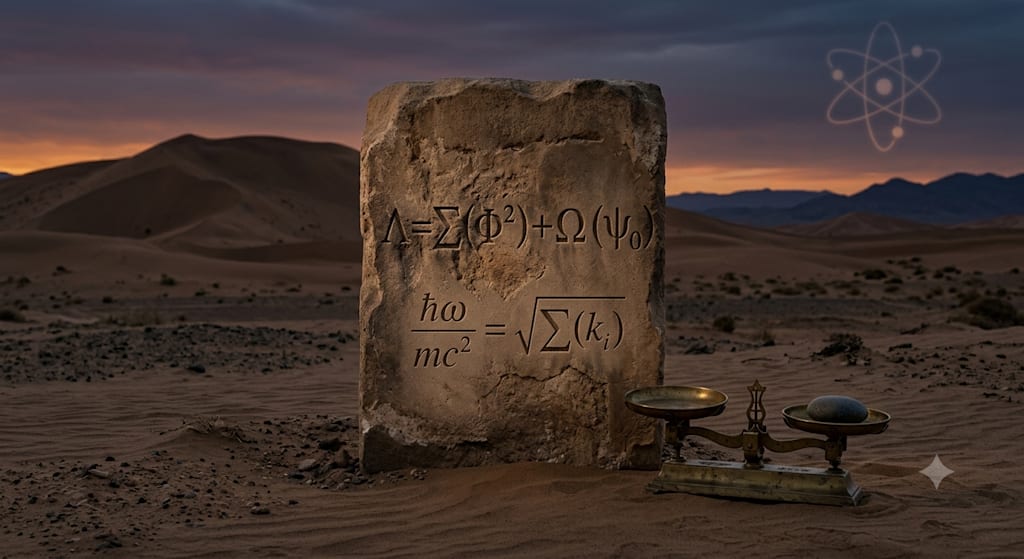
If all human knowledge could be condensed into one sentence, carved on a stone tablet and left for the next intelligent species ten thousand years from now, what should that sentence be?
Your answer: Matter is made of atoms.
I agree with the first half. That fruit is sweet and solid; it holds up the entire tree of technology. Without it, semiconductors, DNA, MRI, the periodic table — all of it would collapse.
But one thing frightens me.
If the next civilization digs up that tablet and reads “matter is made of atoms,” what will they do with it?
They will argue, like medieval scholastics with Aristotle, about “whether there are smaller angels inside the atom.” Every time an observation disagrees with the tablet, they will twist the data rather than question the tablet. They will say: “The tablet never said atoms could be split, so electrons must be some special kind of ‘non-atom.’”
When an insight is fixed as an unquestionable conclusion, it degenerates into a superstition that blocks understanding.
This has already happened once. Aristotle’s four elements survived two thousand years precisely because they were written into textbooks, carved into doctrine, memorized by generations instead of tested. Every alchemist who saw something strange at the crucible would doubt himself: “My experiment must be wrong. Aristotle cannot be wrong.”
So I want to break that tablet.
Not to deny atoms. But to carve, beside that conclusion, another sentence:
“No assertion, however elegant, is more than a provisional guess until it has been measured and repeatedly verified.”
Four words: Trust it? Test it.
Why must this sentence never be lost?
Because it is the method by which atomism was discovered, not the result of that discovery.
Democritus guessed right about atoms. That was luck. If “trust it, test it” had sounded once in his ear, he would have stood up from that beach and gone looking for a beaker, instead of staying in the sun. If Aristotle had been forced by that sentence to weigh the total mass before and after burning, he would have found conservation, corrected his own doctrine, and never let error rule for two millennia.
Results can be rewritten. Methods cannot.
In 1897, Thomson discovered the electron. The atom was split.
If humanity had remembered only “atoms are indivisible,” what would have happened then? Believers would have panicked, denied it, smashed Thomson’s cathode-ray tube. But humanity remembered, “trust it, test it.” So they looked at Thomson’s data and said: “Oh, so atoms can be split. Then let’s update what we mean by ‘atom.’”
Twenty years later, Rutherford cracked the nucleus. Half a century after that, Gell-Mann found quarks.
Every time “atoms are indivisible” was falsified, science did not collapse. Because the underlying faith was never “atoms are indivisible.” It was “let the experiment speak.”
Whatever the experiment says, we believe. If it says divisible, we divide. If it says smaller still, we keep digging.
That sentence gives human knowledge a kind of “elastic version control.” It lets us upgrade gracefully in the face of new evidence, rather than defend ourselves awkwardly.
Today, physicists face dark matter. Invisible, untouchable. The models say it must exist, but every detector stays silent as stone.
They worry, they argue, they revise equations. But no one says “dark matter doesn’t exist because I can’t see it.”
They simply say: “I’ll keep calculating. When the experiment gives me a signal one day, I’ll revise.”
That humility is the legacy “trust it, test it” has left for modern people.
Now, that stone tablet should read like this.
Not one sentence, but two. The first half for your atoms, the second half for my balance:
“All things are woven from inexhaustible particles, yet the truth of every grain submits only to the weighing of an earthly balance and the refiner’s fire.”
Carve the first half deep. That is humanity’s tribute to Democritus, Leucippus, and Mozi. They had no instruments, yet with pure reason they drew a baseline across chaos. That was the first time a civilization said to the void: “You shall not divide further.”
Carve the second half lightly, because it is still growing. Boyle’s weights will rust, Lavoisier’s glass will shatter, but that gesture — placing a conjecture on a balance — will engrave itself like muscle memory into every tool-using primate.
The person who carved the stone finished the last stroke and set down the chisel.
He ran his hand over the letters. His palm was damp; the rough edges of the incisions pricked his fingertips.
He was not writing an epitaph. He was leaving a recipe.
Because cities will fall, books will burn, but the urge to weigh the world with one’s own hands will wake again in every hungry dusk. The next civilization will pick up a balance again, burn a piece of tin again, see the weight unchanged again, and one night, they will remember the words on that stone.
They will not say: “The ancients were so smart.”
They will say: “We could have figured that out ourselves.”
That is why this passage must not be lost: it does not answer for you. It teaches you how to answer for yourself.
About the Creator
Jin
Writer of reamstories
https://reamstories.com/jin
Enjoyed the story? Support the Creator.
Subscribe for free to receive all their stories in your feed. You could also become a paid subscriber, letting them know you appreciate their work.
Comments
There are no comments for this story
Be the first to respond and start the conversation.