
The Taste of Life
On the lies we keep, the hearts we can't read, and the flavors that never stop arriving.
0:17 AM
Just before I turned off the light, my mother called. We talked for three minutes about ordinary things. Right before she hung up, she added: "Your father had his checkup. Nothing serious. His blood pressure is a little high. The doctor said to keep an eye on it."
Her voice was steady, as if she were telling me what vegetables she'd bought that day. But I knew: the checkup had been last Friday, and the results only came out yesterday. She had waited until now to tell me. A full two days and two nights in between. During those two days, she had probably gone over every number on that report, looked up how serious "high blood pressure" really is, and weighed which was more agonizing—telling her daughter or not telling her. In the end, she chose the flat version and set it down gently at the end of a late-night call.
I didn't call out those two days of silence.
I stood in the kitchen, listening to the dull hum of the refrigerator compressor, and remembered the time my father taught me to ride a bicycle. He ran behind me, one hand on the seat, saying, "I'm holding it. Go ahead, ride." When I looked back after fifty meters, he was no longer there. That was his first lie to me.
Lies are endless. But from that day on, I gradually understood that some lies have a soft texture. Like a worn-out sweater. They block the wind not because they're airtight, but because you know the stitchwork of the person who knitted them.
Before the Tea Cools
There is a north-facing window in the office pantry. Outside it is the gray wall of the building next door. Every day at 3 p.m., Sister Zhou from the next cubicle makes herself a cup of jasmine tea, stands quietly for three minutes, then returns to her desk and continues typing.
We've worked together for four years. She never joins department dinners, nor does she post anything personal on social media. I used to think she was cold. Then one day, the system crashed and everyone had to work late. She left her phone on the desk, and the screen lit up. A text from "Rehabilitation Department": "Ms. Zhou, please be on time for your physical therapy next Wednesday afternoon."
I looked away. Then I understood: those three minutes at 3 p.m. every day were her time to swallow some kind of pain alone. She didn't need to be understood. She only needed not to be questioned.
You can't see through people's hearts. But sometimes, not seeing through is precisely the prerequisite for tenderness. You don't need to know the exact temperature of her tea. You only need to know that when she carries it to the window, you don't disturb her.
On that gray wall outside the window, the afternoon sunlight crawls slowly, moving from one brick to another. She watches that light move, as if watching some kind of unspoken scale. I never again speculated whether she was "doing well" or not. How she is—that's her own business. All I can do is, when she occasionally forgets her water bottle, quietly fill a cup of warm water and place it at the corner of her desk, saying nothing.
That Old Suitcase
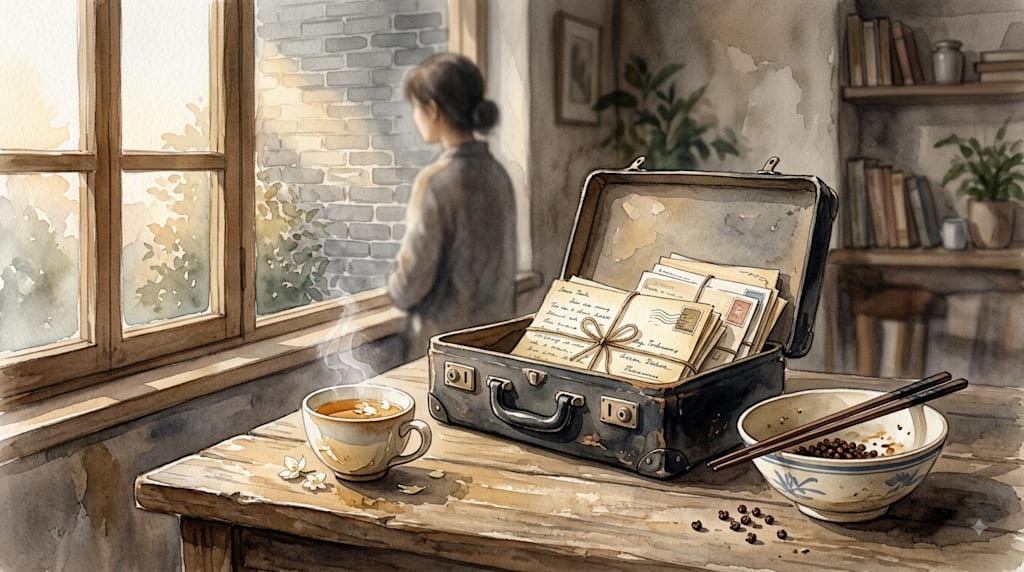
When I was moving, I dug out an old black suitcase from the deepest corner of the storage room. The zipper had rusted shut, and I had to wrestle with it to get it open. Inside were all the letters and postcards I'd received during my four years of college.
On top was one from my friend Xiaolin. He wrote that he was in Xi'an, that the wind on the city wall was strong, and that it reminded him of the snow we watched together in our junior year. The edges of the paper had yellowed, but the handwriting was still clear: "You always say you're not afraid of being alone, but I know you are. That's okay. It's okay to be afraid."
I sat on the floor and read every single letter. Most of the people who wrote them—I hadn't been in touch with them for years. Some had moved to other cities, some had changed phone numbers, and some I couldn't even remember what they looked like. But that afternoon, holding that old suitcase, I sat in the storage room for a long time.
You can't let go of your attachments. They're not like objects you can decide to throw away. They're more like the suitcase itself. You had forgotten it existed, but once you see it, every piece of paper inside reminds you of how you were loved, remembered, and earnestly thought of by others.
I closed the suitcase again. I didn't throw it away. I just moved it from the storage room to the top shelf of my bedroom wardrobe. In the future, whenever I move, I'll take it with me. I know it's there. Just as I know that those people scattered across different cities, at certain moments, have also thought of me.
The Blind Man's Tongue
Last winter, I went to a massage parlor run by a blind man. His surname was Chen. He was in his sixties and had been blind for nearly thirty years. After working on my shoulders and neck, he asked if I was hungry and said there was a good noodle place downstairs. I was surprised: "You can't see. How do you know it's good?"
He laughed. "It's precisely because I can't see that I know better."
He told me that only after losing his sight did he learn to taste food. Before, he used to judge dishes by how they looked. Now he uses his tongue. He could tell whether the noodle soup had been simmered with bones for six hours or made with bouillon cubes. He could tell whether the greens were picked that morning or the day before. He could tell whether the vinegar was authentic Zhenjiang vinegar or cheap imitation. "Your tongue doesn't lie to you," he said. "When it tastes bitter, it's bitter. When it tastes spicy, it's spicy. It's more honest than your eyes."
I ordered a bowl of the noodles he recommended—with preserved mustard greens and shredded pork. The broth was savory, the mustard greens finely cut, the pork hand-torn with a chewy texture. At the bottom of the bowl, a few Sichuan peppercorns had settled, and my tongue tingled slightly. In that moment, I realized how long it had been since I'd eaten a bowl of noodles with such care. Most of the time, I'd scroll through my phone while eating, food reduced to background noise.
The sour, sweet, bitter, and spicy are never exhausted. Not because they have no end, but because we often forget to taste with our tongues. We rush through a meal, rush through a day, marking "sour" and "bitter" as things to get over, and "sweet" and "spicy" as highlights. But Master Chen made me understand: no flavor needs to be skipped. Bitter is bitter. It doesn't need to be transformed into "worthwhile" or "meaningful." It only needs to be tasted completely.
7:31 AM
After that, I developed a habit. Every morning, while making tea, I don't look at my phone.
I boil the water, pour it into the cup, and watch the leaves slowly sink. Sometimes it's Longjing, sometimes Pu'er, sometimes just plain hot water. In those three minutes, I don't think about any "life philosophies." I just hold the cup and wait for it to cool to a drinkable temperature.
One morning, I noticed a single tea leaf standing upright at the bottom of the cup, like a tiny tree. I stared at it for a long time, until it finally fell over. That probably lasted only a few seconds, but in those seconds, I felt that nothing had happened. And yet everything had happened.
I no longer rush to expose lies. When my mother says "nothing's wrong," I say, "Got it. You should get to bed early too." I no longer fret over not reading people's hearts. When Sister Zhou carries her tea to the window, I keep typing. I no longer force myself to let go of attachments. When I reach for seasonal clothes and bump against that old suitcase on the wardrobe shelf, I give it a gentle pat. And I no longer run from any taste. When it's bitter, I let it be bitter, without reaching for the comfort of "bitter ends, sweet begins."
At 7:31, the tea has cooled. I lift the cup and drink the last sip.
So this is life, indeed. Lies that don't stop. Hearts that stay opaque. Attachments that hold tight. And the tastes—sour, sweet, bitter, spicy—keep coming. And yet—
That old suitcase is still on the top shelf. Sister Zhou still goes to the pantry every day at 3 p.m. My mother still calls late at night, in that steady voice, saying "nothing's wrong." Master Chen is probably downstairs at that noodle shop right now, using his tongue to tell whether the new vinegar is a different brand.
I stand up, rinse the cup, and put it back on the drying rack. Outside the window is the same gray morning, but today's clouds are different. I open the door and step out. Today's bitterness hasn't arrived yet, and neither has today's sweetness. But in those three minutes of waiting for the tea to cool, I confirmed one small thing:
I am still here. And I will still finish a bowl of noodles down to the last drop.
About the Creator
Jin
Writer of reamstories
https://reamstories.com/jin
Enjoyed the story? Support the Creator.
Subscribe for free to receive all their stories in your feed. You could also become a paid subscriber, letting them know you appreciate their work.
Comments
There are no comments for this story
Be the first to respond and start the conversation.