
The Revenge That Broke the Avenger: What The Count of Monte Cristo Actually Takes From You
It’s not about getting even. It’s about what you become while you’re doing it.
I
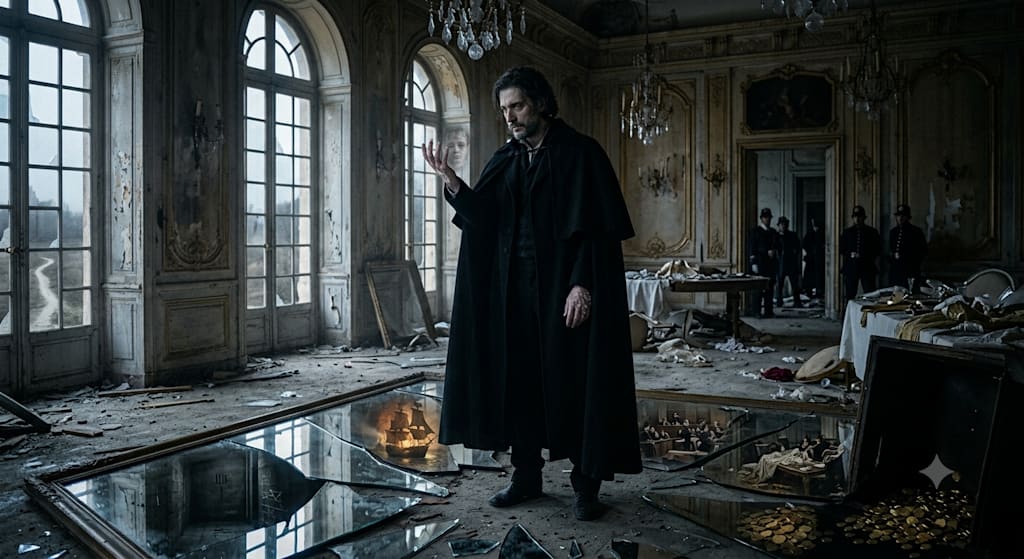
The meal that Edmond Dantès was pulled away from at his engagement banquet—he never finished it.
Alexandre Dumas opens the novel with extraordinary lightness. Someone knocks at the door. Military police are standing there. The young first mate of the Pharaon sets down his glass and rises. He probably knocked over his chair as he stood. Perhaps he even said, “Excuse me, wait for me.” He thought he was simply going to clear up a minor matter and would be back shortly—back to the laughter, back to the wine that was still warm.
He never returned to that table.
By plot summary alone, The Count of Monte Cristo is the progenitor of what we now call “power fantasy fiction”: framed and imprisoned, granted a miraculous turn of fortune in utter despair, returning under a new identity to crush his enemies one by one. In an era overrun by “golden fingers” and “face-slapping” tropes, it seems perfectly reasonable to crown it the nineteenth-century ancestor of online wish-fulfillment novels. But we should be careful: a revenge story that is too perfect often feels frivolous precisely because it is emotionally saturated. The Count of Monte Cristo has held its place in the literary canon for over a century precisely because, beneath its “power fantasy” skeleton, it embeds a dense set of grave propositions about how money alienates the human heart and how revenge devours the avenger himself.
Dumas is not teaching us how to exact vengeance. He is writing about a man who spends the better part of his life verifying a truth—only to shatter that truth with his own hands at the very moment of its confirmation.
II
Danglars, Fernand, Villefort, the rise of these three men is itself a pathological slice of nineteenth-century French society.
Danglars was the purser of the Pharaon. He wrote the denunciation letter out of jealousy over Dantès’s promotion. Fourteen years later, he had become one of the richest bankers in Paris, seated at the center of the city’s capital flows, manipulating interest rates and telegraph dispatches. Fernand was Dantès’s rival in love. To take Mercédès for himself, he joined the conspiracy. Fourteen years later, he had changed his name to become the Count de Morcerf, respected in the Chamber of Peers, his chest covered with military decorations. Villefort was the prosecutor assigned to Dantès’s case. To conceal his own father’s political stain, he consigned Dantès to a dungeon from which there would be no trial and no release. Fourteen years later, he had secured the position of chief royal prosecutor in Paris, and the more cases he handled, the less anyone dared to investigate him.
These three men had erased Dantès from the face of the earth with a single sheet of paper. Fourteen years later, they stood in the most respectable salons of Paris, wielding power, surrounded by guests and admirers. That evil men rise without hindrance is a fact colder than any conspiracy. It is not that society failed to notice them—it is that society simply did not care. As long as you occupy your position, no one will dig up your past.
So the first thing Dumas has the Count of Monte Cristo do is not to draw his sword and challenge his enemies to duels, but to enter their monetary system. He first appears in Rome, engineering a carefully staged “coincidence” through which Danglars’s daughter meets a false aristocrat. He then uses a forged telegraph dispatch to strip Danglars of the bulk of his fortune within days. He uses Haydée’s testimony at a parliamentary hearing to expose Fernand’s treason in Greece. He introduces Madame de Villefort to the world of toxicology, allowing this woman—who already coveted her inheritance—to act on her own.
The Count does not use his fists. He uses monopoly over information and the flow of capital. He is better at the rules of the game than his enemies—better at the very rules by which they live.
Many readers reduce all of this to “money solves everything.” That is not wrong, but it misses a layer: Dumas is not celebrating the power of money; he is showing us what has become of justice in a money-driven society—the only form justice can take has been twisted beyond recognition. Shi Nai’an had the Liangshan outlaws crush the Liao dynasty, a romantic sustenance of “acting for Heaven” within an agrarian civilization. Dumas has the Count smash through the ceiling of Parisian high society with cash. He is not writing a fairy tale about cosmic retribution. He is writing this: in France under the July Monarchy, even revenge must operate by the logic of capital. You want justice? Learn to manipulate stock prices first.
This is why the first half of the story feels so satisfying—because the reader subconsciously accepts these rules. We all know money is not omnipotent, but under Dumas’s pen, we can only watch as it works, again and again. And each time it works, it tells us the same thing: justice in this world was priced long ago.
III
But Dumas’s pen is even colder than that.
The Count’s revenge is not merely precise—it is elegantly precise. He never lifts a hand himself. He lets his enemies march toward their own ruin. Fernand walks into his room and shoots himself after hearing Haydée’s testimony. Villefort goes mad in the courtroom as his wife’s poisonings are exposed. Danglars is hollowed out by his own mortgaged fortune, starved down to his last breath.
The Count stands outside these scenes. And watches.
Abbé Faria gave him two things: knowledge and wealth. But he gave him a third, and the most dangerous—the priest made him believe that he could become the agent of Providence. In Parisian society, he does indeed live as a god: pale-faced, cold-eyed, every word a verdict descending from on high. He is no longer a wronged young man. He is a blade that has been forged in fire. The blade itself has no emotion. It simply falls where it must.
But the blade does not recognize faces.
The most harrowing turn in the entire novel is the death of little Édouard de Villefort. The child ingests poison by mistake—poison intended for others—because of his mother’s greed, and collapses in the garden. The Count had calculated everything. The poison would eliminate those standing between Madame de Villefort and her inheritance: old Madame de Saint-Méran, the servant Barrois. But he had not counted on the child. Or rather, he had counted on him, and he did not stop.
After the child falls, the Count reaches out and touches his forehead. His hand comes away covered in cold sweat. He draws his hand back and stares at the sweat in his palm, as though he does not recognize what it is. That instant throws him back from god to man.
A man can tell himself “I act for Heaven” a hundred times. But when a child’s warmth vanishes from your palm, every belief you held about “Providence” shatters within a second. He suddenly realizes something terrible: he had been enjoying the thrill of power over others; and that thrill was the very same thing as the greed of the three men he despised. The only difference was that he had draped his violence in a cloak called “justice,” while they had not bothered to drape theirs.
The dragon-slayer becomes a dragon not because the dragon’s blood is poisonous, but because in the moment of swinging his sword, he fell in love with the swing itself. Dumas uses Édouard’s death to shatter that mirror, so that the Count might see clearly: the pale-faced, black-robed figure in the glass is not so far from the Danglars who wrote that letter all those years ago.
This is colder than the ending of Water Margin, where Song Jiang and his men are “cooked and killed after the hare is caught.” Song Jiang’s tragedy comes from the outside: the court betrayed him. The Count’s tragedy comes from within: he discovers that he himself may have been standing in the wrong place. He has not been betrayed by anyone. He has been devoured by his own illusion of righteousness.
IV
So where do we go from here?
If the story ended with the three enemies ruined, and the Count standing among the ruins exhaling a long breath, the novel would ultimately fall back into the cage of “power fantasy.” The saving grace is that Dumas does not stop there. In the final act, facing Danglars—starved nearly to death—the Count speaks a line that fundamentally alters the novel’s entire texture:
“I am the man you sold, the man you had imprisoned, the man you destroyed. I had intended to condemn you to die of hunger. Today, I forgive you—because I too need to be forgiven.”
Notice the logic: he forgives not because Danglars deserves it, but because he needs it.
This is an extraordinarily modern psychological awakening. The Count finally realizes that fourteen years of hatred is a double-edged sword. Yes, it pierced his enemies. But for fourteen years, it has also been sawing away at him, day and night. In Danglars’s gaunt, hunger-sunken face, he sees his former self—the man locked in the Château d’If, a man who had nearly forgotten his own name. By letting Danglars go, he is essentially releasing the past version of himself—the one curled in the corner of his cell, scratching days into the wall with his fingernails.
This is utterly unlike the “happy reunion” or “heroic martyrdom” of classical Chinese narrative. Song Jiang and his men sought the court’s pardon and recognition to their very last breath. Their anchor of value was forever in someone else’s hands. The Count’s forgiveness, by contrast, turns inward. He will no longer be a vengeful ghost. But he will not be a savior either. In the end, he leaves Paris with Haydée, walking toward the horizon, leaving behind those words: “Wait and hope.” What he wants is not for society to give him justice. What he wants is to withdraw entirely from the rules of winning and losing that this society has defined.
He does not take revenge anymore. Nor does he forgive that society. He simply walks away.
V
Looking back over the novel, Dumas has taken us on a vast, million-word detour, only to arrive at a very simple answer: after a person has suffered an unspeakable wrong, how does one live out the rest of one’s life without carrying that wrong forever?
“Power fantasy” only answers the first half: how to get revenge. It does not answer the second: what do you feel after it is done? Dumas does the harder thing—he lets the Count pause at the moment when revenge is closest to completion, look down at his own hands, and discover that his palms are covered in other people’s blood and his own cold sweat.
He does not wash his hands clean. He simply stops looking at them.
So when I look back at that opening scene—the engagement banquet interrupted by the police—I cannot help but wonder: what would Dantès have become if he had never been taken away? Probably an ordinary, decent, somewhat impulsive ship’s captain. He would have married Mercédès, raised children, worked on the Pharaon until retirement, and never once in his life given serious thought to words like “justice” or “vengeance.”
But fate pushed him onto another road. He walked that road to its end. And at the road’s end, he turned a corner, and did not look back.
That is something that no label like “power fantasy” could ever contain.
About the Creator
Jin
Writer of reamstories
https://reamstories.com/jin
Enjoyed the story? Support the Creator.
Subscribe for free to receive all their stories in your feed. You could also become a paid subscriber, letting them know you appreciate their work.
Comments
There are no comments for this story
Be the first to respond and start the conversation.