History
Classic & Poetic
The Wanderer Above the Sea of Fog: A Story of Solitude and Soul The fog curled around the mountain peaks like a living thing, soft and silent, veiling the world below in mystery. From the jagged precipice where he stood, the wanderer could see only hints of what lay beneath—black ridges cutting through the pale, sea-like mist, like islands afloat in a spectral ocean. He had climbed since dawn. Now, as the wind curled his coat and tugged gently at his unkempt hair, he stood alone at the edge of the world, and time itself seemed to pause. He had no name anymore. Names were for towns, for people who lived among roads and roofs and reasons. Up here, among the rocks and clouds, he was simply a presence—a figure. The world had called him many things before: soldier, scholar, lover, son. Each of those labels had been shed along the way, dropped like stones in a river until the currents of time smoothed them out and carried them from memory. What remained was the journey. He had taken to the mountains years ago. At first, it had been an escape—from war, from heartbreak, from the sharp disappointments that come with living among men. Later, it became a search. For what, he hadn’t known. Still didn’t. Only that something called him forward, from ridge to ridge, from one lonely path to the next. The journey had changed him. Where once he had feared silence, he now found comfort. Where once he sought answers, he now embraced the questions. The mountains taught him to listen—not just to the howling wind or the crunch of boots on gravel, but to the quiet voice within. The one that whispers truths you cannot hear amid the noise of cities. And now he stood here, above the sea of fog, on a summit he'd chased for weeks. The sky above was iron-gray, vast and indifferent. No sun broke through. No birds called. Only the whisper of wind through the rocks. Yet the moment was not empty. It was everything. He thought of the countless souls below, caught in their cities, their days structured by clocks and debts and dreams not their own. He had once been one of them—working for a future written by other hands, walking streets that led to nowhere he wanted to be. But out here, with no audience but the sky, he had found a new freedom. A terrifying, beautiful kind. He closed his eyes. He remembered a woman once—soft-voiced, strong-eyed. She had loved him once, or at least tried to. But he had always looked beyond her, toward some invisible horizon. She had said he was always somewhere else, even when he was with her. Maybe she was right. Maybe he had always been chasing this very moment—the stillness, the view, the feeling of being nowhere and everywhere at once. He opened his eyes. The fog below shifted, revealing for a moment the shadow of a forest. Then it closed again. Like memory. Like time. He knew he would leave again. Climb down. Move forward. The journey was not over; perhaps it never would be. But for now, he allowed himself this one moment to simply be—a silhouette carved against the mist, a question without an answer. The world had become too full of noise, too full of certainty. Everyone shouted, everyone knew. But up here, the silence spoke truer than a thousand books. It said: You are small, and that is not a tragedy. It said: The world does not need to make sense to be beautiful. It said: You, too, are fog and stone, here and gone. He smiled faintly. The wind bit colder, reminding him he was still flesh. Still breathing. Still climbing. One day, perhaps, someone would find a painting of this moment—him, standing above the sea of fog—and wonder who he was. Some might call him a Romantic, a dreamer, a lost soul. Others might project meanings onto his stillness: rebellion, melancholy, transcendence. But he would not be there to confirm or deny. His truth was not in stories or labels. It was in the wind that tugged at his coat. In the ache in his legs. In the beauty of the unspoken. He turned away from the cliff’s edge, not because he had found what he was looking for—but because the journey was calling again. The path ahead, half-shrouded in mist, promised no answers, only more mystery. And that, he had learned, was enough. Author’s Note: Inspired by Caspar David Friedrich’s iconic painting “The Wanderer above the Sea of Fog,” this story imagines the life behind the silhouette—the soul who climbs not just mountains, but the invisible terrain of human longing. In a world obsessed with certainty and speed, sometimes it’s the wanderers—those who pause, question, and walk alone—who see most clearly.
By Soul Draftsabout a year ago in Art
Neymar: The Samba Magician
In the bustling streets of Mogi das Cruzes, a small city outside São Paulo, a barefoot boy danced with a football as if it were part of him. His name was Neymar da Silva Santos Júnior—known to the world simply as Neymar. Born on February 5, 1992, he grew up in modest surroundings but with a wealth of talent that would soon make him one of the brightest stars in the football universe.
By Abdullah khanabout a year ago in Art
Blind Beauty
In a world so often defined by what we see, the very idea of “visual art” seems inseparable from vision itself. Galleries, exhibitions, digital portfolios—all curated for the eye. But a quiet revolution is underway, one led by artists who defy that assumption. Visually impaired and blind artists are reshaping not only what art is but how we experience it. Their work forces us to ask: Is seeing really the only way of knowing?
By Mehtab Ahmadabout a year ago in Art
The Silence Behind the Pearl
The Silence Behind the Pearl They called her Griet, though no one really knew if that was her name. In the narrow alleyways of Delft, where cobblestones held the whispers of merchants and painters alike, her face became legend long before anyone knew her story. And yet, it was never her voice they remembered. Only the way she looked back over her shoulder—caught between movement and stillness—her lips slightly parted, her eyes questioning, a single tear-shaped pearl catching the dim, filtered light. Before she was immortalized in paint, she was only the maid. She arrived at the Vermeer household during a summer thick with heat and tension. The house at Oude Langendijk, filled with children, canvases, and shadows, was no easy place for a girl of sixteen. Her hands were calloused from peeling potatoes and scrubbing copper pans, but it was her eyes that gave her away. Quiet, knowing eyes—too perceptive for a maid. Johannes Vermeer noticed her in that way painters notice things others don't. She would tilt her head to observe how sunlight streamed through a stained-glass window, watching the way it lit the pewter jug on the kitchen table. He saw her pause at the threshold of his studio when she thought no one was watching, marveling at the rich indigo pigments, the glint of light caught in a brass chandelier. He never said much, and neither did she. But gradually, an unspoken understanding bloomed between them, a fragile thread woven with glances and silences. His wife, Catharina, busy with their eleven children, rarely paid Griet any mind—until she started cleaning his studio. It began innocently. Griet was precise and respectful. She never moved the instruments of art—the brush jars, the pigments, the angled easel. She dusted only where she must, never disturbing the compositions he left behind. Vermeer noticed her restraint and admired it. One day, he asked her to grind lapis lazuli for ultramarine. She had never touched pigment before. Her fingers trembled. "It's not poison," he said quietly, though his gaze was sharp. She began to assist him, cautiously at first, then with increasing confidence. She learned the language of light—how it curved around a cheekbone, how it darkened beneath a brow. She didn’t speak of it, but he saw it in the way she looked at the world. In another life, perhaps, she could have painted. Then came the request. He asked her to sit. Not as a model, not at first. Only to test the lighting, he said. Only to hold a pose. But Griet knew better. She had seen the way he looked at her—not with desire, but with a kind of hunger. The need to capture something fleeting. She said yes, because how could she say no? He gave her a yellow turban, a silk thing from the East, vibrant and strange. He adjusted it with careful hands, his fingers brushing her forehead. Then he brought out the pearl—just one, heavy, luminous. He fastened it to her ear, and in that moment, she felt herself slipping into another world, one where she was not a maid, but something softer, grander, untouchable. He painted her in silence. The studio held its breath. She sat unmoving, though her mind raced. She thought of her family, her place, her small room in the attic that smelled of starch and candle wax. She thought of Catharina, who began to notice the missing pearl. And she thought of Vermeer—how he never touched her, yet held a piece of her she didn’t know she had given. When the painting was done, he said nothing. He merely turned the canvas so she could see. She gasped. There she was—suspended in oil and time. Her gaze eternal, her lips parted with the promise of speech. It was not vanity she felt, but something stranger—loss, maybe. Or the birth of a self she’d never known. But the pearl could not stay with her. Catharina found it, of course. She stormed into the studio one afternoon with fury on her lips and betrayal in her eyes. The painting was hidden, but secrets never sleep long. Griet was sent away that very night. No farewell. No payment. Only the cold slap of the door behind her. Years passed. Vermeer died poor and uncelebrated. His canvases scattered, forgotten for generations. And the girl? No one remembered her name. Griet, perhaps. Or something else. She never married. She worked as a laundress, then as a seamstress. She wore no pearls. But the painting endured. It was found decades later, dusty and silent in a Dutch estate. Scholars puzzled over the identity of the girl. Some called her a daughter, others a lover. None knew the truth—that she had been neither muse nor mistress, but something rarer still: a moment. A breath caught in time. And so she remains, watching us through centuries. Not a maid. Not a mystery. Just a girl with a pearl earring, and the weight of silence in her gaze.
By Soul Draftsabout a year ago in Art
Love in the First Rain . AI-Generated.
Love in the first story The sky was a deep shade of grey, the clouds swollen with anticipation. The air was heavy with the scent of wet earth and ozone. A storm was brewing, and the atmosphere was electric. For Ayesha, it was as if the universe was holding its breath, waiting for something momentous to happen.
By Sophia Graceabout a year ago in Art
The Day I Finally Saw My Mother
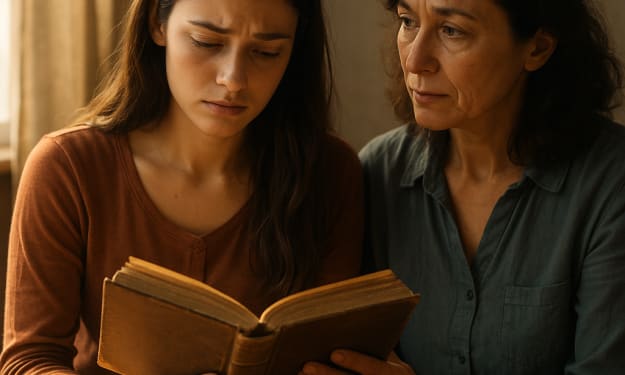
The Day I Finally Saw My Mother For most of my life, my mother was a constant, unshakable presence. She was the woman who woke me for school, packed my lunches, scolded my mistakes, and clapped the loudest at every small success. She was always there—a fixture in the background of my childhood. But I never really saw her. I saw “Mom.” Not the woman. Not the story behind the tired eyes and practiced smile. It wasn’t until I turned twenty-two that the illusion cracked. We were packing up my grandmother’s house after she passed—a quiet, sad chore filled with yellowed photographs, forgotten trinkets, and dusty memories. In one old box, buried beneath worn blankets, I found a faded journal with my mother’s name etched inside. I almost put it back. But curiosity won. The pages were filled with delicate handwriting—letters to herself, raw confessions, moments of joy, pain, hope, regret. I read about a teenage girl who dreamed of escaping her small town. A young woman who fell in love, only to lose herself trying to please everyone else. A new mother terrified of failing. It hit me like a storm. My mother wasn’t just my mom. She was a whole, complicated, fragile human being. She had fears. Regrets. Dreams she buried for my sake. When I looked up, she stood in the doorway, watching me with quiet understanding. “You found it,” she said softly. I nodded, unsure what to say. For the first time, I didn’t see just “Mom.” I saw the woman she used to be—the one who laughed, rebelled, made mistakes, broke hearts, had hers broken too. We sat for hours, sharing stories. She told me things I never imagined—how scared she was when she had me, how lonely motherhood could be, how she lost parts of herself along the way. I cried. She cried. But beneath it all, I felt our relationship shift. That day, I didn’t just see my mother. I saw her—and I loved her more for it.
By Straylightabout a year ago in Art
Secret Love in the Classroom. AI-Generated.
I never thought a classroom could hold so many secrets. But it wasn’t the books, the chalkboard, or even the whispered gossip that left the biggest impact on me—it was a pair of eyes that kept finding mine across the room, day after day. Her name was Areeba. Quiet, graceful, and always lost in a book. She wasn’t the type to seek attention, and maybe that’s why I noticed her in the first place. While others laughed loudly and passed notes under the desks, Areeba always sat in the same spot by the window, her notebook filled with poetry and thoughts too big for her age. I was the complete opposite. Known among friends for my jokes, late homework, and endless chatter, I never imagined anyone like her would even look my way. But one day, during a boring math lecture, I looked up—and she was already staring. She quickly turned away, but not fast enough to hide the blush on her cheeks. That was the moment something changed. At first, we didn’t speak. It was all in the glances, the smiles, the pauses in the hallway. The unspoken language of something new and exciting. A secret love, hidden between lessons and lunch breaks, growing quietly like a flower between cracks in the concrete. Then came the day of the school trip. We were paired together by chance—or maybe fate. I don’t know. As we sat beside each other on the bus, silence turned into conversation. She talked about her favorite poets, how she wanted to become a writer, and how she sometimes felt invisible in a world that moved too fast. And I listened—really listened—for the first time in a long time. By the end of the trip, we both knew something real had begun. But school isn’t a place where secret love survives easily. Rumors start fast. Friends ask questions. Teachers watch too closely. And in a society where even friendship between a boy and a girl can be questioned, we knew we had to keep it hidden. So we did. Our relationship became a secret routine. Passing notes in books. Waiting after class to walk out together unnoticed. Smiling from across the room when no one else was watching. It was innocent, it was pure—but it was also fragile. Then came the final exams. The pressure was intense, and Areeba started withdrawing. I didn’t understand at first. My texts went unanswered. Our glances became fewer. I thought maybe she was just focused on studies—until one day, she didn’t show up at school at all. A week later, I found out her family was moving. Her father had gotten a transfer, and she had left the city without saying goodbye. For days, I felt like someone had erased a part of the classroom. Her seat by the window remained empty. The silence she once brought with her now echoed painfully. And the poetry notebook I had once secretly read was all I had left of her. Years have passed since then. Life has moved on, and so have I. But
By Sophia Graceabout a year ago in Art
Linder: ‘Danger Came Smiling’ Review
Nestled in the Hayward Gallery’s brutalist concrete, ‘Linder: Danger Came Smiling’ takes its lead from the violent beauty of its surroundings. Inexplicably, this is the first retrospective of the feminist visionary’s work, but she is well loved: an adorable older male gallery worker taps me to say I “just missed, five minutes ago” Linder herself taking a tour. I needn’t have worried: the power and charisma Linder holds doesn’t need to be witnessed to be felt. Though modest, the exhibition is well-marketed and visited, as well as apparently hiring fan-only staff: I overhear another Southbank Centre employee gushing about her ‘aura’ as a lecturer in room three.
By Jessica Baileyabout a year ago in Art