History
"The Curious Cat and the Mysterious Door". AI-Generated.
Once upon a time in a quiet village, there lived a little gray cat named Luna. She was not like other cats—Luna was very curious. Every day, she would explore the gardens, the rooftops, and even peek into open windows.
By Omar Mohammed about a year ago in Art
"To the World You Are a Dad": Gifting Love. AI-Generated.
Unlock the Perfect Gift for the Dads in Your Life Finding the perfect gift for Dad can feel like an Olympic sport. You want something meaningful, something he'll actually use or cherish, and something that truly expresses your appreciation. Forget the last-minute tie or the generic mug. This year, let's unlock the secret to a gift that speaks volumes and creates lasting memories.
By Fashion Worldabout a year ago in Art
Taylor Swift: The American Music Icon Reshaping the Industry, One Era at a Time
Taylor Swift: The American Music Icon Reshaping the Industry, One Era at a Time In the ever-evolving landscape of American music, few artists have commanded attention, broken records, and redefined the industry rulebook quite like Taylor Swift. From her early days as a country music prodigy armed with a guitar and a diary full of stories, to her current status as a global pop culture and economic powerhouse, Swift's trajectory is not just a career; it's a phenomenon, a masterclass in songwriting, business acumen, and connecting with an audience on an unprecedented scale.
By Nivard Annaabout a year ago in Art
Happy Father's Day: The Gift of Order. AI-Generated.
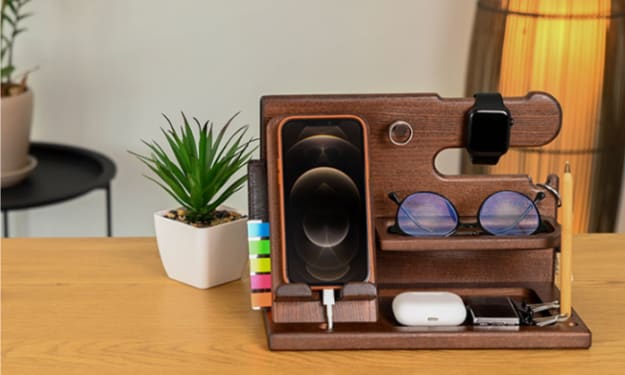
Don't Miss Out: The Trending Father's Day Gift Every Dad Needs Father's Day is just around the corner, and if you're like many, the annual quest for the perfect gift has begun. This year, ditch the predictable ties and socks and consider a gift that truly elevates his daily routine: the all-in-one desktop organizer and charging station.
By Fashion Worldabout a year ago in Art
"The Clockmaker's Secret"
In a quiet village tucked between rolling hills and whispering pines stood a modest clock shop. Its sign, faded with age, read Grantham Timepieces — Est. 1892. Inside, the scent of oil, brass, and old wood lingered like the spirit of time itself. The shop was run by Arthur Grantham, a man in his seventies with silver hair, round spectacles, and a demeanor as meticulous as the clocks he crafted. Arthur rarely spoke more than necessary. His neighbors admired his skill but knew little about his past. Some whispered he’d once worked on something extraordinary during the war — something he’d never spoken of again. But Arthur kept to his routine: wake at dawn, wind the clocks, brew his tea, and sit at his bench adjusting gears too small for most eyes to see. One rainy evening, just before closing, a young woman entered the shop. Her coat was soaked, and she carried a worn leather satchel. “Mr. Grantham?” she asked, her voice tremulous. Arthur looked up slowly. “Yes?” “My name is Eliza Morven. I believe… I believe you knew my grandfather, Thomas Morven.” The name struck Arthur like a dropped chime — sudden and shattering. “Thomas,” he whispered, his hands stilling over the clock mechanism. “I haven't heard that name in decades.” Eliza nodded. “He passed away last winter. I was going through his things and found letters—letters between the two of you. And blueprints. I think you were working on something together… something secret.” Arthur gestured to a chair. “Sit. Please.” She did, placing the satchel on his workbench. Carefully, she unfolded aged, creased blueprints. Arthur’s breath caught in his throat. Before him lay the design of the Chronometris, a theoretical device he and Thomas had envisioned — a time-measuring mechanism so precise it could detect minute fluctuations in temporal flow. The military had funded it briefly during the 1940s, thinking it might help with navigation or communications. But when their research reached a mysterious dead end, it was quietly buried. “I thought it was destroyed,” Arthur said softly. “Not all of it,” Eliza said. “My grandfather kept these… and he left a journal. He believed the device could actually detect moments—fractures in time where something significant had occurred. He called them ‘temporal echoes.’” Arthur stood and walked to the back of the shop. From behind a false panel, he removed a velvet-covered box and opened it. Inside was the central core of the Chronometris — a silver disk etched with impossibly fine gears and a faintly glowing sapphire centerpiece. “I kept working on it after they shut us down,” Arthur said. “But I never finished. Without Thomas, it felt… empty.” Eliza looked at the device with awe. “Can it still work?” Arthur hesitated. “Possibly. But there’s a cost.” He explained that when the Chronometris was activated, it didn’t just detect echoes — it could reveal them. Memories. Regrets. Decisions never made. But the user might not like what they saw. The past was not a museum; it was a mirror, and some reflections were painful. Eliza, undeterred, asked to see a demonstration. They worked through the night. Arthur’s fingers, though weathered, moved with purpose. Eliza assisted, her hands steady, her curiosity deepening. As dawn broke, Arthur held the completed Chronometris. He turned a dial and pressed a button. The sapphire glowed brighter. A faint hum filled the air. Then, a shimmering image formed in the air between them — a workshop from decades ago. Two younger men — Arthur and Thomas — stood over the very same table, laughing. But then the scene shifted. Thomas held a letter. His face fell. Arthur looked away. “I can’t,” Arthur had said. “They want to weaponize it.” “But think of what it could do! We could understand history, protect the future—” Arthur shook his head in the memory. “Not like this.” The vision dissolved. Eliza looked at Arthur, tears brimming. “You turned away… to protect it.” “I thought I was doing the right thing,” Arthur whispered. “But I lost a friend.” They sat in silence. Then Eliza said, “Maybe this isn't just a memory machine. Maybe it’s a warning. A way to understand what not to repeat.” Arthur smiled faintly. “Perhaps it’s time the world remembered.” Together, they wrote down everything — the blueprints, the ethics, the dangers. They created a manuscript to be stored in a museum, not a laboratory. Not for control, but for understanding. Months later, The Clockmaker’s Secret became a sensation in academic circles. Some dismissed it as fiction. Others weren’t so sure. But Arthur, now older and lighter in spirit, finally left his shop one last time, the Chronometris sealed in a time capsule, set to be opened fifty years hence — when the world might be ready. And every hour, in the little shop that still ticked on, a single clock chimed — not with the sound of passing time, but with the memory of a man who once built something to hold it.
By Muhammad bilalabout a year ago in Art
A 43,000-year-old Neandertal fingerprint has been found in Spain
Multispectral photography of 43,000-year-old red pigment on a rock in Spain revealed an embedded fingerprint. Each red line is about 0.5 millimeters wide. The most likely culprit was an adult man painting with the tip of his finger.
By SHYAKA MARSabout a year ago in Art
"Giants of Thought". AI-Generated.
Throughout human history, the progress of civilization has often hinged on the thoughts and actions of a few extraordinary individuals. These men and women, armed not with armies but with ideas, reshaped the course of the world through philosophy, science, politics, art, and spiritual insight. They are the giants upon whose shoulders we stand — the thinkers who dared to challenge conventions, dream beyond their times, and illuminate paths for future generations. This essay explores some of these brilliant minds, examining how their ideas changed history and continue to influence our world today.
By Zain Ul Abidin Khanabout a year ago in Art