Drawing
The Great Niko Pirosmani
I've been working on this story for several months, and it's going to be long but I just wanted to put a lot of things about Pirosmani in one place. You can read it in parts or come back to it, whatever is more convenient. But if you are into art, this is going to be a treat.
By Lana V Lynx2 months ago in Art
One Work: Pirosmani by Picasso
I've been trying to find a way to write about Picasso's sketch of Pirosmani as a separate piece and Paul gave it to me by publishing a piece on Guernica. So, the connection for Raymond Taylor's great challenge is from Picasso's horror of the war to his somewhat chaotic awe of a fellow genius artist he never met in person and learned about very late in life, several months before his own death.
By Lana V Lynx3 months ago in Art
I Stopped Paying for Mockup Subscriptions. Here Is the Free Workflow I Use Now.
Last winter I sat down to pay my bills. One line made me stop. It was a mockup subscription. I was paying every month to drop my posters into nice scenes. I had not opened the app in weeks. The math felt silly. So I canceled it.
By Deborah Ferguson3 months ago in Art
Watercolour on Canvas: Techniques, Artistic Methods, and the Future of Watercolor Art in Mixed Media Painting
Watercolor has long been associated with delicate washes, translucent layers, and paper-based compositions that highlight its fluid nature. However, a growing number of artists are now exploring Watercolour on Canvas, a technique that challenges traditional boundaries and opens new possibilities in contemporary painting. By combining the softness of watercolor with the durability of canvas, artists can achieve striking visual effects that are both expressive and long-lasting.
By Anniey Miller3 months ago in Art
Drawing is More Than Just a Hobby: The Surprising Benefits Many People Don't Know. AI-Generated.
When we think of drawing, we often picture professional artists in quiet studios or children doodling with crayons on scrap paper. For most people, drawing is categorized strictly as a hobby—a pleasant pastime to kill boredom if you happen to possess natural talent. However, viewing drawing through such a narrow lens misses its true value. Scientific research and psychological studies have shown that the act of putting pencil to paper is a transformative practice. It offers a wide array of surprising benefits for the brain, mind, and body that go far beyond creating a pretty picture. A Powerful Weapon Against Stress and Anxiety In our modern, fast-paced world, stress has become a chronic condition. Many people turn to meditation or exercise to cope, but drawing offers a uniquely effective alternative. When you draw, you enter a psychological state known as "flow." This is a state of deep absorption where your worries, anxieties, and the chaotic noise of daily life simply fade away. The repetitive motion of sketching and shading regulates your nervous system, slowing down your heart rate and lowering cortisol levels. Unlike passive activities like scrolling through social media, which can actually increase anxiety, drawing actively engages your brain in a calming, rhythmic task. It serves as an emotional escape valve, allowing you to process heavy emotions without needing to find the right words to speak them. Enhancing Memory and Cognitive Function One of the most surprising benefits of drawing is its profound impact on memory and cognitive longevity. A study conducted by researchers at the University of Waterloo discovered that drawing information is one of the most effective ways to retain it. In fact, drawing was found to boost memory retention far better than writing notes, visualization, or simply looking at images. This happens because drawing forces the brain to process information in multiple ways simultaneously: visually, spatially, and kinesthetically. It creates a robust "memory trace" in the mind. Because of this powerful neurological engagement, engaging in drawing regularly is increasingly recommended as a preventative practice to keep the brain sharp and delay cognitive decline in older adults. Rewiring the Brain Through Neuroplasticity Every time you pick up a pencil to sketch, you are essentially giving your brain a rigorous workout. Drawing requires intense coordination between the eyes, hands, and various regions of the brain responsible for spatial awareness, geometry, and pattern recognition. This complex coordination stimulates neuroplasticity—the brain's ability to reorganize itself by forming new neural connections. As you analyze shapes, calculate proportions, and decide how light falls on an object, you are sharpening your problem-solving skills and enhancing your visual literacy. People who practice drawing regularly often find that they become much more observant in their daily lives, noticing fine details, textures, and subtle changes in their environment that others completely overlook. The Rise of Fine Motor Skills and Focus We live in a digital age dominated by typing, tapping, and swiping on smooth screens. This reliance on technology has led to a gradual decline in fine motor skills and hand-eye coordination for many individuals. Drawing acts as an antidote to this digital numbness. Controlling a pencil requires a high degree of precision, strengthening the small muscles in the hands and wrists while refining neural pathways. Furthermore, drawing is an exercise in sustained attention. In an era where human attention spans are shrinking due to short-form digital content, sitting down to complete a drawing forces you to practice patience and prolonged focus. It trains your mind to resist distractions, a skill that directly translates into improved productivity and concentration in your professional and academic life. Conclusion: A Universal Tool for Well-being The greatest misconception about drawing is that you need to be "good at it" to reap its rewards. The psychological and neurological benefits of drawing do not care if your final sketch looks like a masterpiece or a childlike doodle. The magic lies entirely within the process of creation, not the final product. Drawing is a universal, low-cost, and deeply accessible tool for self-care, brain health, and personal growth. It is a language of the subconscious, a gym for the brain, and a sanctuary for the stressed mind. So, the next time you feel overwhelmed, forgetful, or mentally fatigued, do not hesitate. Pick up a pencil, find a blank piece of paper, and start drawing—your brain and body will thank you for it.
By Yasmine Yessou3 months ago in Art
How a Single Painting Can Completely Change Your Psychological State. AI-Generated.
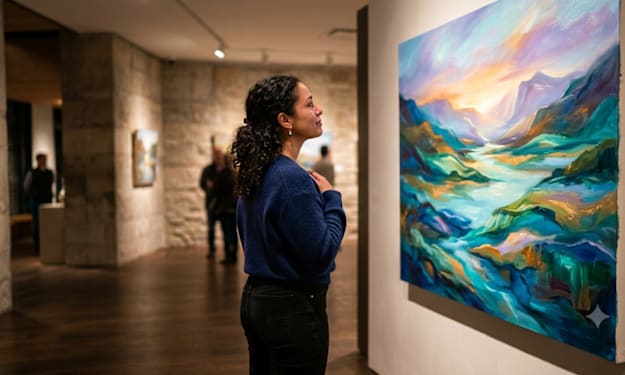
Have you ever stood in front of a painting and felt an unexpected wave of calm wash over you, or perhaps a sudden prickle of tears? You might have walked into the gallery carrying the heavy weight of a stressful day, yet a few minutes spent staring at a canvas washed in deep blues and soft golds completely altered your mood. It feels like magic, but it is actually a profound psychological phenomenon. Art is not merely a decorative object or a luxury for the elite; it is a powerful tool capable of shifting our emotional state, rewiring our brain chemistry, and completely transforming our psychological well-being. The Brain on Art: A Neurological Shift To understand how art changes our mood, we must first look at what happens inside our brains. When we look at a piece of art that we find beautiful, our brains experience a reaction similar to the sensation of falling in love. Neurobiologist Semir Zeki conducted research showing that viewing a powerful work of art triggers an immediate release of dopamine—the "feel-good" neurotransmitter—in the orbitofrontal cortex of the brain. This chemical surge instantly elevates our mood, providing a sense of pleasure and emotional satisfaction. Furthermore, art engages the brain’s default mode network (DMN), which is involved in self-reflection and internal thought. By stimulating this network, a single painting can pull us out of a cycle of negative overthinking and guide us into a state of peaceful meditation. The Language of Color and Emotion The most immediate way a painting communicates with our subconscious is through color psychology. Colors carry specific emotional frequencies that our minds decode instantly. For instance, a painting dominated by soft blues, muted greens, and gentle earths can act as a natural tranquilizer for a chaotic mind. These cool tones lower our heart rate and reduce cortisol levels, the hormone responsible for stress. Conversely, if you are feeling lethargic, depressed, or emotionally drained, stumbling upon a canvas filled with vibrant yellows, fiery oranges, and energetic reds can act as a psychological spark. These warm colors stimulate mental activity, increase energy levels, and inject a sense of hope and enthusiasm into our psyche. A single masterpiece holds the power to balance our internal emotional climate simply through its palette. Escapism and Cognitive Reframing Life often traps us in rigid routines and stressful environments. A painting serves as a visual portal, offering an immediate escape. When you look at a landscape painting of a misty forest or a vast, quiet ocean, your mind undergoes a process called "cognitive reframing." For a few moments, your current reality fades into the background, and your brain adopts the peace of the painted world. This aesthetic distance allows you to step away from your problems. By focusing on the brushstrokes, the depth, and the light within the frame, you give your overworked mind a chance to rest. When you finally look away from the canvas, you often find that the problem that seemed insurmountable just ten minutes ago now feels manageable. The art didn't change your situation, but it completely changed the psychological state from which you view it. Emotional Resonance and the "Mirror" Effect Sometimes, we feel lonely or misunderstood, carrying emotions we cannot quite put into words. This is where abstract or highly expressive art becomes therapeutic. When you see a painting that captures a sense of chaos, grief, or overwhelming joy, you experience a moment of profound validation. Through what psychologists call "emotional resonance," the painting acts as a mirror for your soul. It tells you: "Someone else has felt exactly what you are feeling right now, and they turned it into something beautiful." This realization breaks the illusion of isolation. The externalization of internal pain onto a canvas allows you to process your own complex emotions safely, leading to a state of emotional catharsis and deep psychological relief. Conclusion: Art as Daily Medicine In a fast-paced world that constantly demands our attention and drains our mental energy, we often look for complex solutions to preserve our mental health. However, the remedy might be much simpler and more accessible than we think. You do not need to be an art expert or own an expensive masterpiece to experience this transformation. Hanging a print that speaks to your soul in your living room, or spending fifteen minutes looking at a classic painting online, can be enough to reset your mind. A single painting possesses the extraordinary power to disrupt our daily chaos, heal our silent wounds, and completely rewrite our emotional state, proving that art is not just a feast for the eyes, but a sanctuary for the human psyche.
By Yasmine Yessou3 months ago in Art
An In-Depth Exploration of Journey to the Center of the Earth
Few adventure novels have captured the imagination of readers as powerfully as Journey to the Center of the Earth. Written by Jules Verne and first published in 1864, this groundbreaking work blends science, adventure, and fantasy into a thrilling tale of exploration beneath the Earth’s surface. As one of the earliest works of modern science fiction, the novel not only reflects the scientific curiosity of the 19th century but also demonstrates Verne’s extraordinary ability to transform speculative science into gripping storytelling.
By Ibrahim Shah 3 months ago in Art
PiCatso
I didn’t know he was an aspiring artist. He had gone upstairs and disappeared for a while. I thought he was taking a nap, but I was apparently wrong. A couple of hours later, when I thought it was odd that he had been gone so long, I went up to see if he was still napping. That’s when I found out my orange tabby was a pastel artist.
By Alexandra Grant3 months ago in Art