
Writing Radio Drama
What do I know?


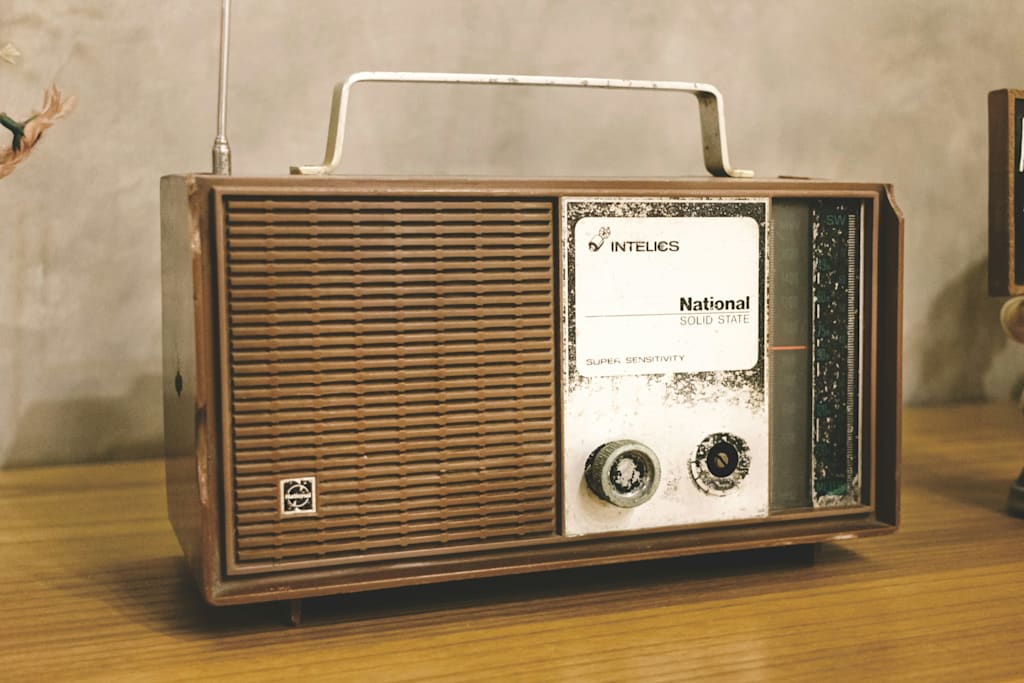
The sound of someone tapping the side of a glass against the general hubbub of a social gathering. Eventually the background noise filters out.
“Hey everybody! Exciting News!”
“I wrote an audio play. Imagination Theater performed and broadcast it, and you can listen to it now on YouTube.”
Next sound effect – rapturous applause.
There is a special thrill in hearing my name being mentioned in the opening credits.
But I’m going to be honest I didn’t find this an easy task. So, I’m going to share with you the few things I have learned so far about the art of audio drama.
Setting
Let’s start with the obvious – objectively your audience can’t see anything. But within their imagination they should be able to see everything. This is daunting. How can you get them to see the place of the action? But it is also exciting. You can place the action anywhere. Imagination has no bounds, no difficulty in sourcing a good setting, or paying for special computer-generated effects. The drama can be in the cockpit of an aeroplane, an undiscovered village along the Amazon, a glorious Regency ballroom, a churchyard populated with ghosts, outer space. However, usually, getting the listener to that place has to be done quickly and can only be achieved through sound and dialogue. So, from the very beginning you have to imagine what a place sounds like.
I have a visual brain, so this was an issue for me. I wanted to think about velvet curtains, and swishing clothes and the visual spectacle of grand landscapes or the dinginess of city nights.
To get me through this, I produced a little exercise to start me writing. It goes like this:
Sound effect
Line of Dialogue
Another Sound effect
Line of Dialogue
If I can’t establish place through this, then I might need to rethink either setting or characters.
Characters
While the budget doesn’t matter when it comes to setting, it does when it comes to the size of the cast. Also, for the sake of the listener, it becomes important to limit the number of voices they are expected to be able to differentiate. Write your cast list. Then cut a couple of characters. Think about how you can usefully let the actors know how to make each character stand out. Give them notes on accents, pace and pitch of speech, tone and volume.
And then there are the names. In writing this radio play, I had the names of the two main protagonists because I was writing for a series that had already been developed. But I also had to find names for the other characters and to make life easy for the listener I had to make sure that those names were mentioned regularly, which can feel a little artificial.
Narrators
In most story-telling there is the old adage – show, don’t tell. However, radio drama doesn’t have the same access to showing. While in other mediums the idea of a narrator can feel clunky or outdated, in radio drama, especially in the age where we listen tuned into our earbuds, it can add to the intimacy and authority of the story-telling. But there is a key pitfall to avoid - The over-explanation of the sound effect:
“Oh my, you’re being stabbed by a large man with a glass eye, over and over. You’re so badly injured you can’t run away.”
I probably don’t need to tell you this doesn’t work as dialogue, and so unlike other mediums you move away from the action to reporting of the action. It can feel counter-intuitive, but flashbacks and investigations based on dialogue work better than squishy sound effects and screams.
You can hear if I succeeded in the link below:
But the big question is how did I get it to the attention of a production company. And this is where I have to make an admission. I had connections. Many years ago, I was an usherette at a theatre, where I met lots of fabulous people, some of whom over 30 years later I’m still in touch. One of them is Matthew J Elliot, who works as a script editor and commissioner for Imagination Theater.
At some point, I’m going to write a piece about the problems of trying to break into the creative industries with their excessive gate-keeping – auditions, competitions, (and competition fees), expensive courses, being in the right place at the right time, having to find money to travel for opportunities, unpaid internships, face fitting in – or not, etc, etc. And this is before I talk about the larger structural issues like ageism, racism, misogyny, homo and transphobia, ableism. Even as show business and publishing have a reputation for welcoming the weird and the marginalised, it still plays favourites and panders to what it perceives as mainstream tastes.
So, I don’t have any clever words about how to get your work out there. I’ve been lucky, this time. But the biggest boundary to any creative work is self-censorship and not even trying.
Now that I’ve had this play produced, I will be getting to the sticky business of trying to find another mystery for Hilary Caine to solve.
If you've enjoyed what you have read, consider subscribing to my writing on Vocal. If you'd like to support my writing, you can do so by leaving a one-time tip or a regular pledge. Thank you.
About the Creator
Rachel Robbins
Writer-Performer based in the North of England. A joyous, flawed mess.
Please read my stories and enjoy. And if you can, please leave a tip. Money raised will be used towards funding a one-woman story-telling, comedy show.
Enjoyed the story? Support the Creator.
Subscribe for free to receive all their stories in your feed. You could also become a paid subscriber, letting them know you appreciate their work.
Comments
There are no comments for this story
Be the first to respond and start the conversation.