
The AI Watermark Isn’t Permanent — Here’s How Writers Can Smash It
Four ruthless cuts to break Claude’s statistical signature without losing your voice or your flow.
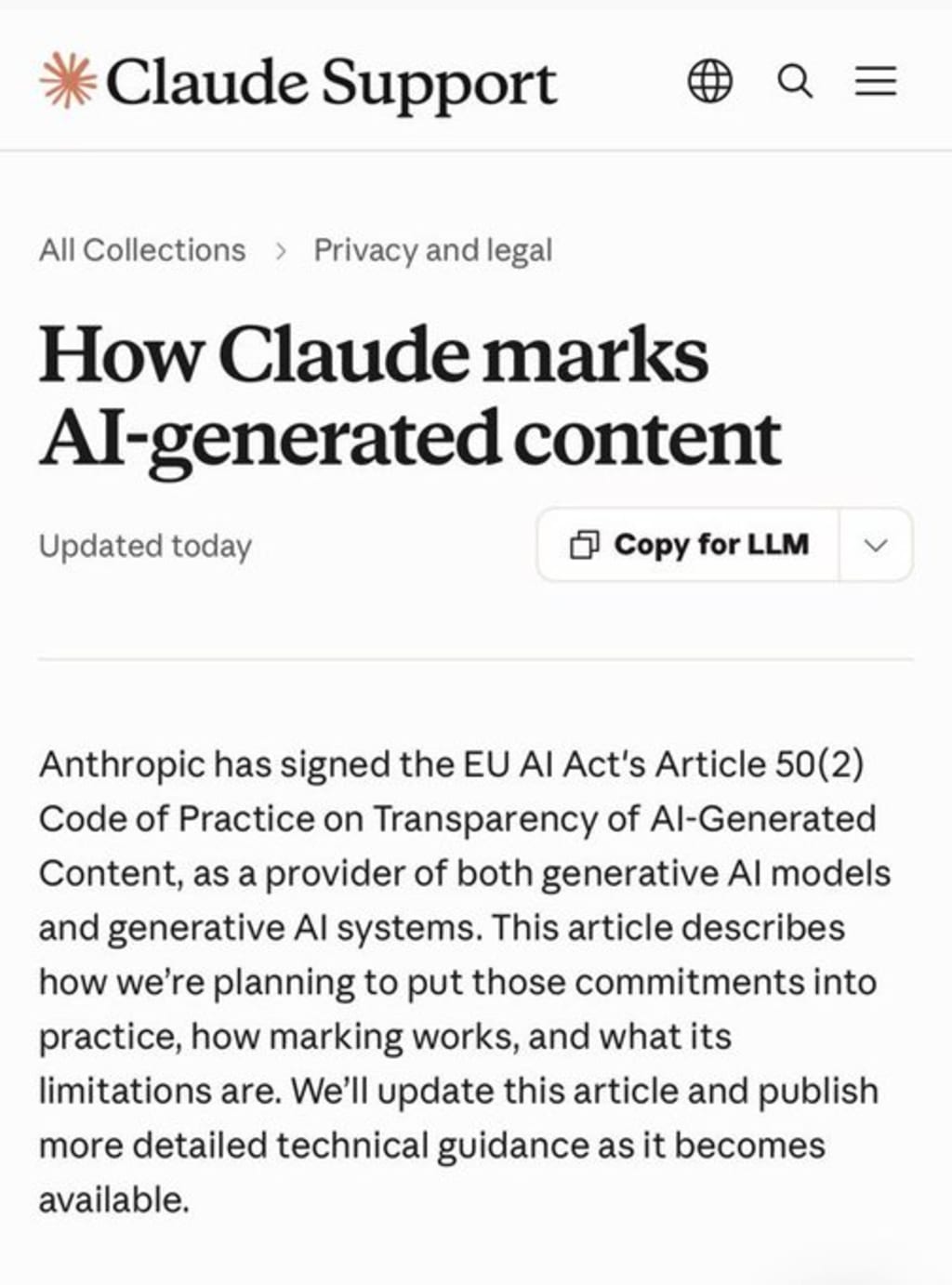
Claude's watermark is a statistical ledger. It doesn't read words; it reads probabilities. Long‑form text is its home turf, but that doesn't mean writers have to surrender.
To break it, first understand how it's built.
The watermark's mechanism: at each token‑sampling step, the model randomly splits the candidate pool into two groups, A and B, and slightly boosts the probability of group A. The shift per token is imperceptible to the human eye, but past three thousand words, the statistical signal pierces through the random noise. Like a person with a slight limp: three steps go unnoticed, but after three thousand steps, a gait analyzer will flag them.
For long‑form writers, the situation is this: the more you rely on AI to generate complete paragraphs, the more firmly the watermark adheres to every content‑word choice.
But note that word: adhere. The watermark is not an inscription carved into stone; it's a thin layer of dust on the surface of vocabulary. And what does dust fear? Disturbance.
First Cut: Break the Key Chain
Causal watermarking has a dependency: the previous tokens determine the key for the next token. This means that if you let Claude generate the entire text in one go, the key sequence is continuous from beginning to end, and the detector can align it perfectly during backtracking.
Destroying that continuity takes just one action: generate in chunks, then reassemble out of order.
Ask Claude to produce Chapter 3's environmental description, Chapter 1's dialogue, and Chapter 5's climactic scene separately. When you get them back, don't paste them in the generation order. Instead, reorder them according to human logic—timeline, causal chain, emotional progression. The very act of reordering breaks the contextual alignment of the keys. When the detector scans your final text, it will find that the key pattern in the second half doesn't match the first half, as if two different cipher books have been forcibly stitched together. The confidence score plummets.
Second Cut: Snipe the Content Words
The watermark's statistical bias builds up mainly through content words—verbs, adjectives, and core nouns. Function words (the, a, of, and) are too stable in the probability distribution to carry much signal. The real workhorses are verbs.
In practice, you don't need to edit every single word. Just focus on the main verb of each paragraph.
AI writes: "He quickly crossed the street."
You change it to: "He practically scraped his way along the wall."
AI writes: "She was furious."
You change it to: "Her knuckles went white around the coffee mug."
AI writes: "This solution improved efficiency."
You change it to: "This solution squeezed a three‑day approval process into forty minutes."
See the difference? The AI's verbs are the high‑probability, generic choices (crossed, furious, improved). Your replacements are low‑probability but precise choices (scraped, knuckles white, squeezed). Every verb you replace is a line crossed off the watermark's ledger. If you replace more than thirty‑five percent of the main verbs across the entire text, that ledger is effectively shredded.
Third Cut: Plant Human Landmines
The first five hundred words are the detector's golden window. The signal there is cleanest, untouched by later rewrites.
So, after you've let AI generate the opening section, immediately hand‑write a single, highly personal sensory memory and insert it. This sentence must meet three conditions:
Every word is common, but the collocation is unusual.
It carries concrete sensory information (touch, smell, temperature).
Its syntactic structure is irregular.
Example. The AI generated this opening: "It was a sultry afternoon, and the street was nearly empty."
You insert: "The rust I once touched had nothing to do with the chill coming off this umbrella handle."
"Rust" paired with "touched" and "chill coming off"—this kind of collocation is an extreme outlier in the model's probability distribution. It's like a pebble thrown into a pot of porridge. When the detector computes the global statistics, that single point is enough to drag down the overall Z‑score significantly. The longer the text, the more pronounced the disturbance caused by that one stone.
Fourth Cut: Never Surrender the Skeleton
This is the most critical rule—and the one most people fail to follow.
The watermark adheres to vocabulary. And vocabulary is flesh. If you let AI generate only the flesh (environmental description, physical appearance, dialogue fill) while you personally build the skeleton (the first sentence of each chapter that sets the tone, the transitional sentences at turning points, the final landing sentence), then the watermark signal is always imprinted on a piece of flesh that you're free to replace.
The practice is straightforward:
Type the first sentence of every chapter yourself.
Type the last sentence of every chapter yourself.
Outline the core argument (or the story's turning points) yourself, lock those into the document, and then let AI fill the surrounding content around those anchors.
Once the skeleton is handwritten, the entire logical chain of the text is human. No matter how much watermark the AI‑generated flesh carries, after you aggressively swap verbs, reorder chunks, and insert personal memories, the originally attached statistical data will vanish along with the replaced flesh. The skeleton stays; the flesh can be freely exchanged.
Closing Verification: What to Check After You Finish
Don't scan the whole text blindly. Check three things.
First, scan for the density of the most common function word in Chinese (de, the possessive/attributive marker). In English, this translates to checking for repetitive genitive or prepositional chains. For example, change "the rhythm of the steps of his feet was erratic" to "his footsteps were erratic, the tempo trembling." Altering the character‑level frequency distribution skews the detector's baseline.
Second, hunt for phrases like "it must be said that", "the real problem is", "one cannot help but ponder", "worth noting", "it is undeniable that". If you see any, delete the entire sentence. These are high‑probability filler for AI, and they carry the densest watermark signal. Deleting the whole sentence is cleaner than replacing words because it breaks the token sequence outright.
Third, look at the ending. If you find that the last line is reaching for a universal statement ("this is perhaps the meaning of..." or "we will eventually..."), cut it. Stop on a concrete image—a beach, a chair, a single line of dialogue like "see you tomorrow." No explanation. No summary. No exclamation.
Final Verdict
The watermark detector does not read thought; it reads word frequencies.
You don't need to fight thought. You only need to disturb frequency.
Treat the AI as a craftsman who supplies clay blanks, not as an artist who completes the sculpture for you. The blank has fingerprints on it—that's fine. Smash it, re‑knead it, and shape a contour that belongs only to you. The chaotic statistical traces the detector finally reads are nothing but the marks left by your repeated pressing fingers—and those happen to be human fingerprints, not machine watermarks.
About the Creator
Jin
Writer of reamstories
https://reamstories.com/jin
Enjoyed the story? Support the Creator.
Subscribe for free to receive all their stories in your feed. You could also become a paid subscriber, letting them know you appreciate their work.
Comments
There are no comments for this story
Be the first to respond and start the conversation.