Writer's Block
The Boy Who Knocked at Her Door
The snow fell thick over the small town of Chesterfield, Indiana, wrapping the streets in a quiet blanket of white. The air was still, the world hushed. People were inside, sipping hot chocolate, their homes glowing orange with warmth.
By Irfan stanikzai about a year ago in Writers
China's import and export of steel, iron, aluminum and copper in the first half of 2025
1.Steel In June 2025, China exported 9.678 million tons of steel, a decrease of 900,000 tons from the previous month, marking a month-on-month drop of 8.5%.
By SINOSTEEL STAINLESS STEEL PIPEabout a year ago in Writers
The Memory Locksmith
The Memory Locksmith The locksmith’s shop sat at the far edge of town, wedged between a crumbling bakery and a florist that hadn’t opened in years. No sign above the door. No hours posted. Just a heavy green door with a brass keyhole so intricate it looked like a puzzle in itself.
By Wings of Time about a year ago in Writers
The Clockmaker's Secret
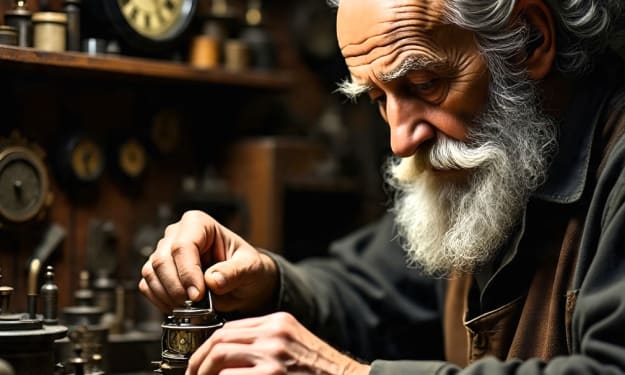
In the quiet village of Windmere, nestled between green hills and silver lakes, there lived an old clockmaker named Elias Greaves. His shop sat at the corner of the cobbled main street, filled with the soft ticking of countless timepieces, from tiny pocket watches to grand floor clocks that boomed on the hour.
By Hamdan Khanabout a year ago in Writers
Top 5 Essential Gadgets for Writers in 2024
Top 5 Essential Gadgets for Writers in 2024 Modern writing demands more than just talent and discipline. As technology evolves, writers can leverage specialized gadgets to enhance productivity, reduce physical strain, and streamline their creative process. The right tools can transform a challenging writing session into a seamless flow of ideas, allowing writers to focus on content rather than wrestling with outdated equipment or uncomfortable setups. This guide explores five essential gadgets that address common writing challenges and help writers produce their best work in 2024. 1. reMarkable 2: Digital Paper for Distraction-Free Writing
By Tawseef Azizabout a year ago in Writers
The woman who wrote through silence . AI-Generated.
Do you see this woman? She was mocked, dismissed, humiliated, and cast aside… simply because she was born a woman. Her name was Grazia Deledda. Born in the rugged hills of Nuoro, Sardinia — a land where girls were taught to sew, not to dream. At just nine years old, she was pulled out of school. Education, they said, was unnecessary for a girl. But Grazia didn’t agree. She studied in secret — feeding her mind with borrowed books and filling her soul with unwritten stories. In the dusty hills of Nuoro, a small Sardinian village surrounded by stone paths and ancient traditions, a girl named Grazia was born — quiet, curious, and already too different for comfort From the moment she could hold a pencil, Grazia began scribbling onscraps of paper. Her world wasn’t made for dreamers, especially not female ones. Here, girls were taught to cook, clean, and marry — never to think too deeply or speak too loudly. Writing was for men. Dreams were for boys By age nine, Grazia’s formal education ended. Her parents pulled her from school, like most girls, believing that reading and writing were a waste of time for someone destined to be a wife. But Grazia disagreed — quietly. When her family thought she was sewing, she was reading. When they thought she was asleep, she was writing by candlelight. She borrowed books from anyone who’d lend them — dusty novels, forgotten poems, even newspapers — anything with words. Her first story was published in a magazine while she was still a teenager. She should’ve been proud. But in Nuoro, it was a scandal. “A girl? Writing in public?” the neighbors hissed. “She’ll bring shame,” the priest warned. Her family, once proud, grew distant Grazia walked through her village with whispers behind her and disapproval in front. Yet every evening, she returned home, picked up her pen, and kept writing. Because writing wasn’t a choice for Grazia — it was breath. Years passed. The rejections came fast, followed by letters from editors who told her to “write about more feminine things,” or worse, “stop altogether.” Still, she wrote. Her stories were not soft. They were rugged like the Sardinian mountains — full of strong women, flawed men, wild weather, and emotions too deep to name. Her writing was different because *she* was different. And that difference, at first mocked, became her power. In her late twenties, she married a man named Palmiro Madesani — a customs officer from the mainland. He was unlike the men of Nuoro. Where others dismissed her, he admired her. Where others tried to silence her, he urged her on. Together, they moved to Rome — a world away from her childhood home. There, Grazia finally had the space, support, and freedom to become who she truly was. She wrote tirelessly. Novels, short stories, essays. In every word, she poured her defiance, her dreams, her memories of a land that tried to cage her — and the fire inside that refused to be extinguished. Then, in 1926, the impossible happened. The Nobel Committee in Stockholm announced its newest laureate in literature *Grazia Deledda. The girl who was told she didn’t need an education. The woman who was mocked for picking up a pen. The soul who wrote through silence, shame, and solitude. Now, the world applauded. She stood on the Nobel stage in a modest dress, tears held back, pride not for herself — but for every girl who had been told “no.” At her side stood Palmiro, silent and proud. A man secure enough to let his wife shine. A partner who never feared her strength, but fueled it. The world had tried to write her story for her. She took the pen back. And rewrote everything. Even today, Grazia Deledda’s name doesn’t echo as loudly as others — not because her words were weaker, but because she was a woman in a world that wasn’t ready. But those who know her story — remember. They remember a girl who read in secret. A woman who wrote through rejection. A soul who turned silence into sentences that would live forever. And now, her story belongs not just to Sardinia, not just to Italy, but to every girl who’s ever been told she couldn’t. Because Grazia proved something powerful: *Being born a woman is not a weakness.* *It’s a different kind of strength. One that whispers first… then changes the world.*
By Muhammad sufyanabout a year ago in Writers
Rosie O'Donnell
When Power Becomes Personal: The Trump vs. Rosie O’Donnell Saga Write By: Said Idrees Sadat --- Introduction Can a president truly revoke the citizenship of someone born in the United States simply because of personal hatred? Can a celebrity feud become a national constitutional issue? These are no longer hypothetical questions. In July 2025, Donald Trump publicly declared that Rosie O’Donnell—a comedian, television host, and long-time critic—should have her citizenship taken away and be sent to Ireland. What began as a decades-long public spat between two media giants has now reached unprecedented legal and political dimensions.
By king pokhtoonabout a year ago in Writers
Why I write in the middle of the Night
Because silence has a language only the heart understands I never meant to become a midnight writer. In fact, for most of my life, I feared the night. It held too many shadows, too many memories that scratched at the door of my mind when the world quieted down. But over time, I learned that silence is not an enemy — it’s an invitation. And now, when the world sleeps, I wake up to write.
By Hanif Ullah about a year ago in Writers