
I Turned 100 Codex Prompts Into a Writing System. Here’s the Exact Process.
Most writers collect prompts. This workflow turns them into a repeatable sequence you can use from topic search to final publish check.
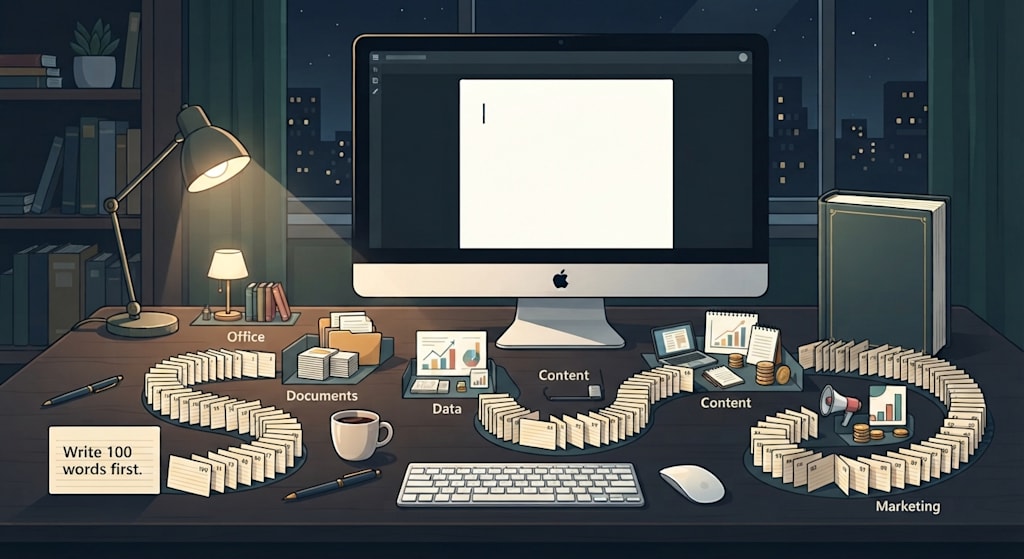
You saved 100 prompts. When you sit down to write, you still open a blank document. The cursor blinks. Your mind is empty.
The problem is not a shortage of prompts. The prompts have not been fused into a set of actions.
This article follows a skill fusion process. The main frame is deconstruction, conflict decisions, transposition, real-time self-check, and closing verification. The language and texture constraints come from the writing prompts in the 100 Codex prompts: role, execution requirements, output format, banned words, information density, and concrete actions.
You can follow it directly and write.
I. Deconstruction: Don’t Write Yet. First Answer Two Sets of Questions
From the Primary Skill, Extract
What events must happen in writing?
Anchor list:
Find a topic.
Break down viral articles.
Do competitor analysis.
Generate topics in batches.
Schedule a content calendar.
Write an outline.
Produce a first draft.
Remove AI flavor.
Create titles, summaries, and golden lines.
Rewrite for multiple platforms.
Write short-video scripts.
Plan a series of articles.
Collect and organize material.
Prepare comment-section replies.
Write closing guidance.
Optimize titles and openings.
Run a pre-publication checklist.
What is the underlying logic of the relationship between the characters?
You and the reader. Why must the reader read you and no one else? He must know within three seconds: this is relevant to me, and I can take away one action.
How does the emotional curve go?
From the anxiety of “I can’t write” to the control of “I know the next step.” The curve moves from low to high. It needs three small peaks: finding a topic, writing a first draft, and editing out the human flavor.
Which paragraphs cannot be deleted?
Topic card, outline, first draft, removing AI flavor, pre-publication checklist. Missing one, and the article falls apart.
From the Constraint Skill, Extract
Which words cannot be used?
Truly, indeed, it must be said, worth pondering, marks.
Which sentence patterns must be avoided?
Pseudo-dialectical structures, empty summaries, template openings.
What should the flesh and blood of the content look like?
Concrete actions, detail objects, dialogue. Don’t write “he felt anxious.” Write “he closed the document three times and opened it three times.”
What counts as “written well”?
Delete this paragraph. Can the surrounding text connect without a break? If yes, this paragraph is redundant. Replace the author name with another author. Does this paragraph still hold? If yes, it’s too generic. Is it said or shown? If said, go back to the action layer.
II. Conflict Decisions: The Primary Skill Sets the Position, the Constraint Skill Sets the Form
Writing will definitely crash.
Primary skill requires: every section must have a golden line.
Constraint skill forbids: elevation and exclamation.
Ruling: The golden line must appear, but it cannot be a slogan. Write it as an action. For example: “Write 100 words first, then talk about inspiration.”
Primary skill requires: the article must have emotional peaks.
Constraint skill forbids: clichés.
Ruling: Put emotional peaks in concrete scenes. Write “You delete the 8th version of the title, go back to the 1st version, and change only one verb.”
Primary skill requires: the character has a core fear.
Constraint skill forbids: naming the fear.
Ruling: Don’t write “you are afraid of failure.” Write “you open the document and first scroll your phone for 20 minutes.”
If you cannot find a way to satisfy both, don’t start writing. Go back to the transposition table and find that concrete action again.
III. Transposition: Turning 17 Writing Prompts into Actions
1. Today’s Trending Topics
Don’t search for hot words. Search for “who is arguing about what today.”
Action: Open three platforms. Write down 5 titles from each. Mark the sources. Pick one that you can catch with your own experience. Write 3 opening angles. Delete two. Keep the one that hurts most.
Output: Markdown list.
2. Viral Article Breakdown
Don’t summarize the strengths. Copy the skeleton.
Action: Write the title formula, opening hook, structural frame, and closing interaction separately on a piece of paper. Imitate the opening in 3 sentences. Each sentence no more than 20 characters.
Output: Markdown analysis report.
3. Competitor Topic Differentiation Analysis
Don’t look at what he writes. Look at what he doesn’t write.
Action: List the competitor’s last 10 posts. Mark the angles they repeatedly use. Cross them out. Find the opposite. Give 3 topics, each with one sentence: “Why he doesn’t write this.”
Output: Markdown comparison report.
4. Batch-Generate Topics
Don’t try to think of 20. First write 1 formula, then swap 20 variables.
Action: Write the formula as “audience + pain point + action + result.” Swap audience, swap pain point, swap action, swap result. After 20 topics come out, sort by viral potential.
Output: Markdown table.
5. Content Calendar Scheduling
Don’t fill it up. Leave blanks.
Action: 2-3 posts per week. Leave one day as buffer. Mark publication time. One day before publication, do only one thing: revise the title again.
Output: Markdown calendar.
6. Article Outline Generation
Don’t list titles. List actions.
Action: Under each subheading, write “what the reader should do after reading.” 5 subheadings, each with one action. Write 3 opening hook sentences, 1 closing call to action.
Output: Markdown outline.
7. Batch-Generate First Drafts
Don’t write 5 at once. Write 1 first, then copy the structure and swap the material.
Action: Write 1000 words according to the template. Opening has a hook, ending has an interactive question. Colloquial, like chatting with a friend. Don’t look back and edit right after finishing.
Output: Markdown article.
8. Remove AI Flavor
Don’t add filler words. Delete labels.
Action: Search for “he felt,” “she realized,” “he understood.” Each time one appears, replace it with “what he did.” Search for “truly, indeed, it must be said, worth pondering, marks.” If any appears, delete the entire sentence. Alternate long and short sentences.
Output: Markdown body text.
9. Title, Summary, and Golden Line Generation
Don’t think of 5 titles. First write 1 hook logic, then swap 5 ways of saying it.
Action: Write the hook logic as “whatever the reader fears, I give it to him.” 5 titles, each marked with hook logic. 1 summary paragraph, 3 golden lines. Golden lines don’t lift; they only write actions.
Output: Markdown list.
10. Multi-Platform Content Rewriting
Don’t copy and paste. Change person, rhythm, and opening.
Action: Xiaohongshu version 300 words, with emoji, first sentence is the pain point. Zhihu version has a rational tone, starts with the conclusion. Keep the core viewpoint, delete expressions the platform doesn’t eat.
Output: Text, by platform.
11. Short-Video Spoken Script
Don’t write an article. Write 3 actions that can be said within 60 seconds.
Action: Opening 5 seconds, body 45 seconds, ending 10 seconds. Mark visual suggestions. Each sentence no more than 15 words.
Output: Markdown script.
12. Series Article Planning
Don’t list 6 titles. Let the ending of article 1 grow article 2.
Action: Plan 6 articles. For each, write the core argument, publication order, and material needs. Article 1 ends with a question. Article 2 answers it.
Output: Markdown planning table.
13. Material Collection and Organization
Don’t pile up data. After each piece of material, write “which empty sentence of mine can it replace.”
Action: Collect 10 pieces of data, cases, or viewpoints, with sources. Sort by credibility. For each, write one sentence: “Where it will be used.”
Output: Markdown material library document.
14. Comment-Section Reply Scripts
Don’t prepare 10. Prepare 3 categories: agreement, doubt, question.
Action: Write 3 for each category. Agreement: don’t flatter. Doubt: don’t argue. Question: give an action. Tone should be warm and natural.
Output: Text.
15. Article Closing Guidance Copy
Don’t beg for follows. Give the next action.
Action: Write 3 follow-guidance copy options. Style consistent with the body. Highlight the value of following. For example: “After following, reply ‘template’ to take today’s outline.”
Output: Text.
16. Title and Opening Optimization
Don’t swap words. Swap the order of information.
Action: Optimize the title and the first 3 sentences of the opening. Give 5 titles + 5 openings. Mark the logic for each. Recommend the best combination.
Output: Markdown list.
17. Pre-Publication Checklist
Don’t just look for typos. Check whether any sentence could be put into another story.
Action: Generate a checklist: title, cover, summary, original declaration, AI declaration, typos, link validity. Confirm item by item. Mark pending items.
Output: Markdown checklist.
About the Creator
Jin
Writer of reamstories
https://reamstories.com/jin
Enjoyed the story? Support the Creator.
Subscribe for free to receive all their stories in your feed. You could also become a paid subscriber, letting them know you appreciate their work.
Comments
There are no comments for this story
Be the first to respond and start the conversation.