
Great Literature Doesn’t Need a Thesis. It Needs a Cup on a Desk.
A defense of beauty, surface, and the sensory world in writing.
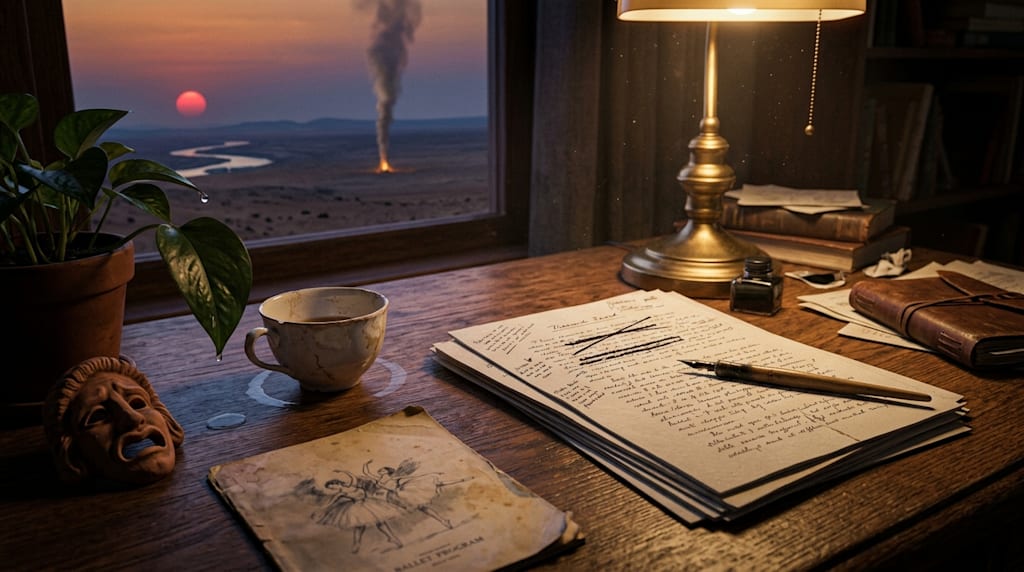
She moved the cup from the edge of the desk to the center, then back again. A ring of water stayed on the wood, pale as a scar. Downstairs someone called a name three times. No one answered.
We ask what a book means too early. The question sounds serious. Often it pulls the book away from where it lives. Literature starts with a person, a wind, a face, a street, a silence, rain. A reader is struck by an image before agreeing with an idea: an eye, a line of dialogue, a hand on a door, a landscape, a tone that resists summary.
Literature is an art of images. Scholarship turns the world into concepts. Literature gives concepts back to the senses. It cannot only say that loneliness is universal. It has to put a person under a lamp, listening to footsteps in the room above. It cannot only announce that time destroys everything. It has to let a house move from abundance to emptiness, let the dishes stand after the guests leave, let a person find an old face in the mirror. The force of literature lies in whether it creates a perceptible world, full of detail, warm to the touch, alive in the nose and ear. It does not lie in how many correct propositions it can produce.
That world can be unreasonable and still move us. It can be immoral and still strike with aesthetic force. It can resist analysis and summary. It can hit the reader directly, massively, before defense. We call that subjective shock beauty. Beauty is the destination a writer must reach. A writer may have opinions, anger, compassion, research. If those do not become images, if they do not condense into a world the reader can see and hear, they stay outside literature.
The first question is what we have been made to see, hear, and touch.
Beauty Is the Body of Thought
Thought enters literature through image. It cannot be pasted on the surface like a slogan. It cannot arrive as an outline before the people and scenes exist. It has to be absorbed by image, digested by detail, remade by language. In literature, thought grows.
Homer has thought. He writes war, honor, fate, the relation between gods and men, the way Achilles’ rage destroys him and others, the knot of glory and cruelty. He does not discuss these matters in abstract terms. He writes the spearhead entering the body. He writes horses screaming. He writes fire on a shield. He writes a dying man calling his mother’s name. The thought sits inside the image. It does not float above it.
Shakespeare has thought. Power, desire, jealousy, love, betrayal, death. Almost every human proposition rolls through his plays. We remember Macbeth’s wife’s hand. We remember Hamlet’s delay. We remember Lear shouting into the storm. The idea arrives as a body in a room.
Tolstoy has thought. His strength does not lie in a system of history. It lies in the light at a ball, fog on a battlefield, a woman at the edge of a platform. The reader sees first. The reader is disturbed first. Then the reader may think.
Thought separated from image turns into paper, sermon, slogan. Image crushed by thought loses the direct force that belongs to literature. Great writing often has depth. Its depth sits on the surface. Meaning shines on the image.
The Height of Tang Poetry: The Victory of the Sensory World
Why has Tang poetry so often been ranked above Song poetry? The question cannot be reduced to “Tang good, Song bad.” Still, if we look for a difference in literary feeling, Tang poetry more often trusts the sensory world.
The best Tang poems present scenes and skip the lecture. Wang Wei writes:
Great desert: one column of smoke goes straight up.
Long river: the setting sun is round.
There is almost no abstract comment here. The lines push the vastness, dryness, silence, and splendor of the frontier into the reader’s eye. From ordinary physics, a column of smoke does not always go straight up. A setting sun is always round. The lines do not care about the full natural history of things. They care about the impression things leave when they enter human perception. The handling is minimal, close to Impressionist painting. It skips rational analysis and speaks to intuition. That direct shock is aesthetic pleasure.
Li Bai writes:
Clouds want her clothes; flowers want her face.
Spring wind brushes the railing; dew is thick on the blossoms.
What deep philosophy is here? Almost none. The lines describe a beautiful woman. In historical context, they belong to a poem written for imperial favor. Knowing that, we still have to admit the lines work. They do not describe Yang Guifei’s body in detail. They let beauty appear through clouds, flowers, spring wind, dew. The writing is oblique. It asks the senses and imagination to complete the picture. The effect is literary.
Homer does something similar with Helen. He does not spend pages describing her face. He puts the old men of Troy on the wall. They see Helen coming. They say to one another: no wonder Trojans and Achaeans suffer so long for such a woman. The side view does more than any frontal description. Li Bai writes Yang Guifei the same way. He does not list her beauty. He lets the world around her respond. Such writing may lack deep meaning. It may even lack moral dignity. It is still good literature. The language works. The effect is beauty.
The height of Tang poetry lies in its trust in the image. It lets the world appear as world. The reader sees, feels, is struck, and only then begins to think. That order belongs to literature.
The Bent of Song Poetry: When Argument Overwhelms Image
To call Song poetry bent is not to deny its value. Su Shi, Yang Wanli, Lu You, Wang Anshi, Huang Tingjian: each has large achievements. Song poetry opened language, structure, daily experience, literati wit, and philosophical play. Yet in overall aesthetic feel, it more often shows a tendency. The poet wants to explain, wants to extract a lesson, wants to believe that having a point is enough for a poem.
The problem is whether reason has been absorbed by image. In many Song poems, wit becomes the main event and image becomes evidence. The reader meets the poet’s intelligence, insight, argument, and verbal play. The sensory world does not exist before the argument. Such poems can be good. They move farther from the source of literature. They sound like a literary man talking in a poem. The world does not appear on its own.
Tang poetry hides reason inside image. Song poetry sometimes makes image serve reason. The first stays closer to the source of literature. The second can drift. Literature can think. Literature cannot let thinking replace seeing. When a poet hurries to tell the reader what everything means, the poet may lose the ability to let things speak.
The Image-Power of Western Literature
Western literature follows the same law. Homer, Shakespeare, and Tolstoy are masters of sensory detail. None is known for abstract philosophy. If we rank philosophical power, Dostoevsky may surpass Tolstoy, and Plato certainly surpasses Homer. Plato criticized Homer for making images too beautiful while failing to convey correct and respectable morality. The criticism has a point. It also misses why readers return.
We do not return to Homer for his morality. Achilles’ rage, Telemachus’ hanging of the maids, the heroes of Outlaws of the Marsh: placed under modern ethical judgment, these are suspect. We are drawn to Homer’s flawed heroes because they possess beauty on the image level, a beauty that does not ask permission from doctrine or morality. That beauty comes from heroic confidence, the cruelty of war, the shadow of fate, the rhythm of language, the carving of scene. We are drawn to Outlaws of the Marsh for the same reason. We do not approve of its misogyny and violence. We are held by the aesthetic of the outlaw world, by the language, style, structure, and craft the author uses to present that world.
Aesthetic attraction and ethical critique can coexist. Neither cancels the other. Literature first lets us see a world. Then we ask what that world means. If we begin with moral correctness as a tribunal, we may miss the first force of literature. If we drown in aesthetic shock and refuse reflection, we may lose awareness of how that shock was built. The best reading admits the image-level force first. Then it asks what craft, ideology, and historical experience constructed that force. This does not damage beauty. It makes beauty more conscious.
Dream of the Red Chamber and Anna Karenina: The Depth of Worldly Surface
Why do we love Dream of the Red Chamber and Anna Karenina? Their protagonists do not embody sublime abstract philosophy or sacred theology. They are worldly to the bone. They linger over food, clothes, poetry, banquets, jokes, tears, illness, dreams, wind in the garden. They linger over the pleasures of the red dust and sometimes ruin themselves by lingering. We love the delicate beauty of that worldly life as it is written. We love it the way we love the curve on the surface of a work of art.
Dream of the Red Chamber writes eating, dressing, housing, poetry clubs, banquets, jokes, tears, illness, dreams, wind in the garden. Its depth sits in the abundance of surface. How a person drinks tea, how a person speaks, how a person falls silent in a crowd, how a person feels cold in the middle of noise: these surface details form the texture of the novel. Cao Xueqin does not begin with the argument “a feudal family declines” and then make characters illustrate it. He creates countless perceptible moments. Meaning seeps out of them later.
Anna Karenina works the same way. Ballrooms, carriages, fields, races, dinners, family quarrels, station platforms. Tolstoy’s pen rarely leaves the perceptible surface of life. Anna’s beauty, Vronsky’s infatuation, Karenin’s stiffness, Levin’s land and household are not allegorical containers. They are people in rooms, under lights, among sounds. The depth of the novel is not announced in a paragraph. The reader receives it through countless surface details.
Learn to linger over the passing beauty of things. Do not hurry toward abstract depth. Learn to recognize that the deep meaning of some things is their beautiful surface. Surface is not shallowness. This is the hardest lesson literature can teach.
Surface Is Not Shallowness
We distrust surface because we have learned to think of depth as something behind it. In literature, depth sometimes sits on the surface. A face, a pause in a sentence, the texture of a sleeve, the light in a room: these details are the world literature exists to present. Literature is not a riddle. It does not use images as wrappers for ideas. It asks us to believe that the gloss, grain, temperature, smell, and sound of the world are worth writing.
Good surface requires craft. Writing that a person is beautiful is easy. Writing how that beauty changes the surrounding world is hard. Writing a banquet is easy. Writing how seating, light, glasses, and talk distribute power at the banquet is hard. Writing that a person is sad is easy. Writing how sadness changes the way he looks at an old cup is hard. Literary surface is carved by language, structure, rhythm, point of view, and detail. It is reality refined by art.
A writer can trust surface. The danger is incapable surface: empty ornament, meaningless detail, piled sensation. Good surface carries tension. It appears to present. It has already selected, organized, emphasized, omitted. It appears to avoid argument. It lets argument grow inside the image.
Beauty Must Withstand Form and Ethical Questioning
To say beauty is the destination does not mean beauty is exempt from questioning. Great beauty can be looked at and asked. We can admire the violence aesthetic of Outlaws of the Marsh and still reflect on its gender violence. We can be drawn to Homeric masculinity and still ask what that masculinity costs. We can be absorbed by the refined life of Dream of the Red Chamber and still see the institutional shadow behind that refinement. Reading does not flatten beauty with morality. Reading does not cancel morality with beauty. The two illuminate each other.
A more careful statement of the thesis would be this: literature does not aim at abstract argument; it creates beauty through perceptible image. Meaning is generated in image, language, structure, and sensory detail. Beauty does not have to be reasonable. Great beauty withstands formal analysis and ethical questioning.
This makes beauty stronger. Great beauty does not fear being seen. It does not fear being asked. It survives rereading, formal analysis, ethical reflection. It is the way the world is born again in language.
The Writer Must Trust the Image
A writer can have thoughts, positions, anger, compassion. A writer cannot trust only those. A writer has to trust the image. Trust that a character, once written, has weight. Trust that a landscape, once seen, can speak. Trust that an accurate detail may come closer to truth than an argument.
Literature does not tell the reader a lesson. It lets the reader experience the world again inside a perceptible world. Beauty is the threshold and the destination. Without beauty, literature can be correct, profound, useful, and still fail. Readers remember the light at night, the silence of a character, the smoke over the desert, the round sun on the long river.
Surface is not shallowness. Learn to recognize that the deep meaning of some things is their beautiful surface. A writer must reach beauty. Beauty does not replace everything. Only beauty lets everything happen in literature.
On the last page of the manuscript he crossed out the title. The paper furred under the pen. He wrote: On the windowsill, a drop of water hangs from the tip of a pothos leaf. He read it twice and did not change it. Downstairs someone called a name three times. This time someone answered.
About the Creator
Jin
Writer of reamstories
https://reamstories.com/jin
Enjoyed the story? Support the Creator.
Subscribe for free to receive all their stories in your feed. You could also become a paid subscriber, letting them know you appreciate their work.
Comments
There are no comments for this story
Be the first to respond and start the conversation.