
From Inspection Logs to Quality Intelligence
A Data-Driven Work Inspection Request Analytics Framework for Infrastructure Project Assurance


Abstract
Work Inspection Requests (WIRs) sit at the interface between field verification, construction quality assurance, and controlled project information, yet their registers are commonly treated as administrative logs. This study asks how routine WIR metadata can be transformed into quality intelligence for workflow visibility and evidence-based closeout. A retrospective descriptive analysis was conducted on 1,364 anonymized WIR records from a major infrastructure project in the Philippines, covering 24 December 2025 to 4 November 2026. The analysis examined status, discipline, open-item aging, document-to-submission lag, revision behavior, monthly intake, and metadata integrity. Although 1,218 records (89.3%) were submitted on the document date or the following day, 1,015 (74.4%) remained open at the snapshot; 499 had aged at least 31 days and 241 at least 61 days. October intake reached 512 records, 81.6% above September, while civil works accounted for 88.4% of the register. Revised issues recorded materially longer lags than initial issues, and duplicate identifiers, missing status data, negative date intervals, and absent closure dates constrained traceability. The paper therefore distinguishes fast front-end capture from controlled end-to-end closure. Its principal contribution is an integrated WIR quality-intelligence framework that combines a multi-state workflow taxonomy, minimum metadata requirements, explicit accountability, evidence-linked closure, and actionable performance indicators. The framework extends construction quality management by treating document-control metadata as an operational assurance resource and offers a replicable, low-cost pathway from passive registers to auditable decision support.
Index Terms—construction analytics, construction quality assurance, document control, information management, infrastructure, traceability, work inspection request
I. INTRODUCTION
Construction inspections generate information that is both operational and evidentiary. A WIR communicates that an activity is ready for inspection or testing, links the activity to governing requirements, and records the disposition needed for acceptance and closeout. The register is therefore not merely a submission list; it is a control surface joining site quality and project information management.
The empirical source for this study is an anonymized project WIR register containing 1,364 records [1]. Conventional registers can confirm volume and broad status, but a binary OPEN/CLOSED field may not reveal whether an item is newly received, scheduled, under review, accepted with comments, awaiting a test result, rejected for resubmission, or physically complete but documentarily incomplete. ISO 9001 and ISO 10013 emphasize controlled documented information and evidence that processes were performed as planned [2], [3]. ISO 19650 similarly stresses defined information requirements, responsibilities, revision control, status, and structured exchange across organizational interfaces [4], [5].
This paper reframes routine WIR metadata as a source of quality intelligence. It contributes (1) an empirical separation of front-end submission performance from downstream closure visibility; (2) a register-based analytical model spanning intake, age, revision, ownership, and information quality; and (3) a practical governance framework that connects inspection decisions to evidence-complete closeout. The study is deliberately process-focused: party names are anonymized as CONTRACTOR and CONSULTANT, and no individual performance is assessed.
II. RESEARCH PROBLEM AND OBJECTIVES
A high-volume WIR register can appear administratively complete while remaining weak as a management-control system. The research question is: How can register-level analytics improve workflow visibility, traceability, and evidence-based closure in construction quality assurance? The objectives are to:
quantify WIR volume, current state, aging, discipline concentration, submission timing, and revision behavior;
identify metadata limitations affecting interpretation and auditability;
distinguish observable register conditions from contractual compliance; and
propose a controlled workflow, minimum metadata schema, and management indicators.
III. CONCEPTUAL BASIS
A. Quality Assurance as an Information Process
Inspection effectiveness depends on reliable information about location, governing requirements, planned timing, technical outcome, corrective action, evidence, and final disposition. Construction quality-management guidance treats inspection, testing, corrective action, and records as connected control functions [6]. Digital project-delivery research likewise shows that information creates value when it supports coordinated decisions rather than merely accumulating as project data [7], [8].
B. Scholarly Proposition
The study proposes that WIR performance should be evaluated as a sequence of distinct information states: controlled receipt, validation, inspection, technical disposition, corrective action or resubmission, evidence verification, and closure. Collapsing these states into a single OPEN/CLOSED variable obscures queue composition and can misattribute responsibility. Register analytics become managerially useful only when temporal measures are paired with state, owner, and evidence completeness.
IV. METHODOLOGY
A. Design and Data
A retrospective, single-case descriptive design was applied to the updated WIR register [1]. The dataset comprised 1,364 populated entries with actual submission dates from 24 December 2025 through 4 November 2026. Available fields included document and submission dates, receipt time, originating and receiving party, discipline, reference identifier, revision, subject, current status, and ball-in-court.
B. Analytical Procedures
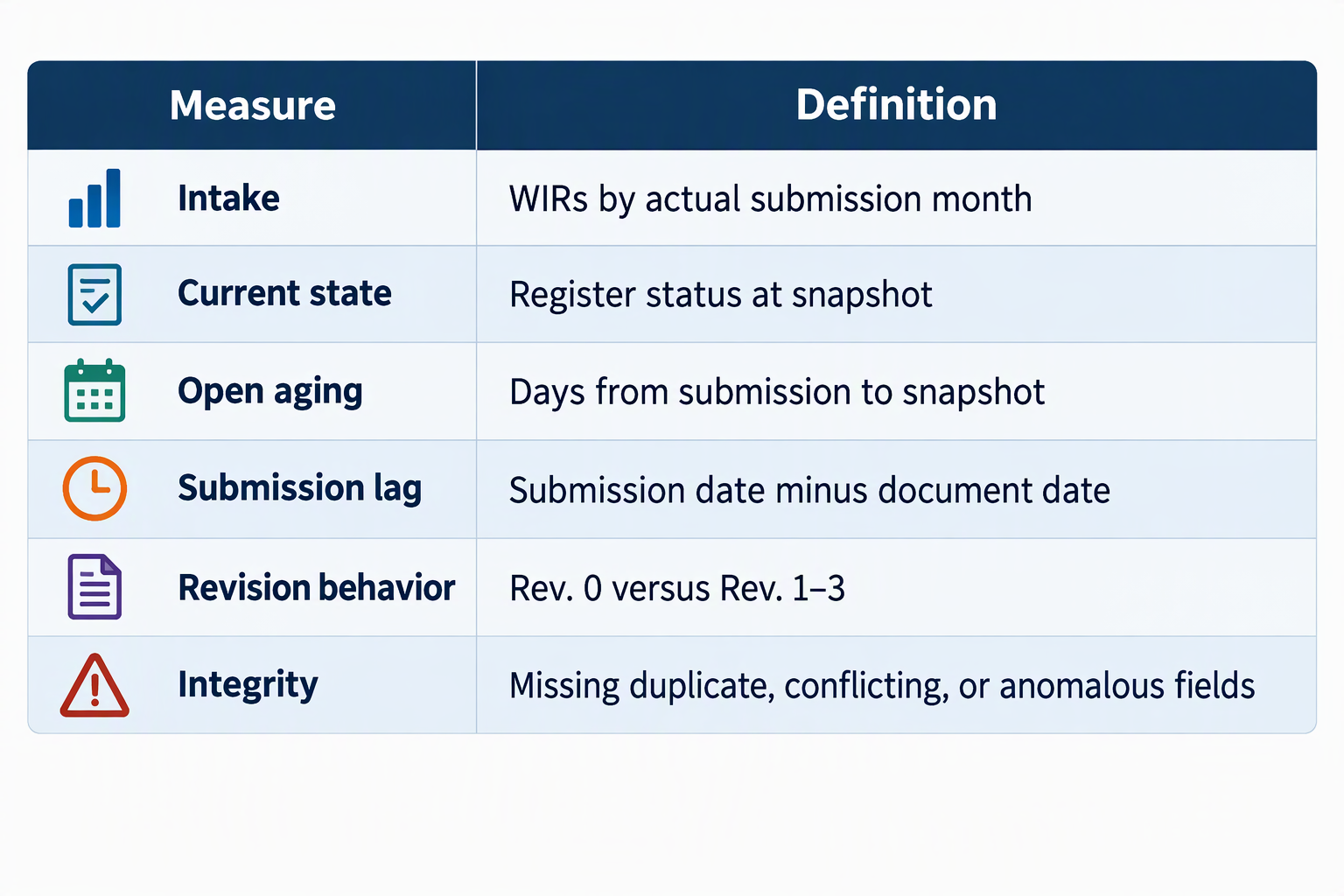
Dates and categories were normalized. Document-to-submission lag equaled actual submission date minus document date. Open-item age was measured from actual submission date to 5 November 2026. Records were summarized by month, discipline, status, aging band, and revision group. Integrity checks covered missing values, duplicate identifiers, conflicting states, and negative date intervals.
TABLE I
ANALYTICAL MEASURES
C. Interpretation Boundaries
The analysis is descriptive. An open item is not automatically late, rejected, nonconforming, or attributable to either party. No verified contractual response target, inspection outcome date, planned inspection date, reviewer capacity measure, or closure date was available. The paper therefore reports aging and queue exposure, not contractual overdue performance.
V. RESULTS
A. Register Profile and Aging
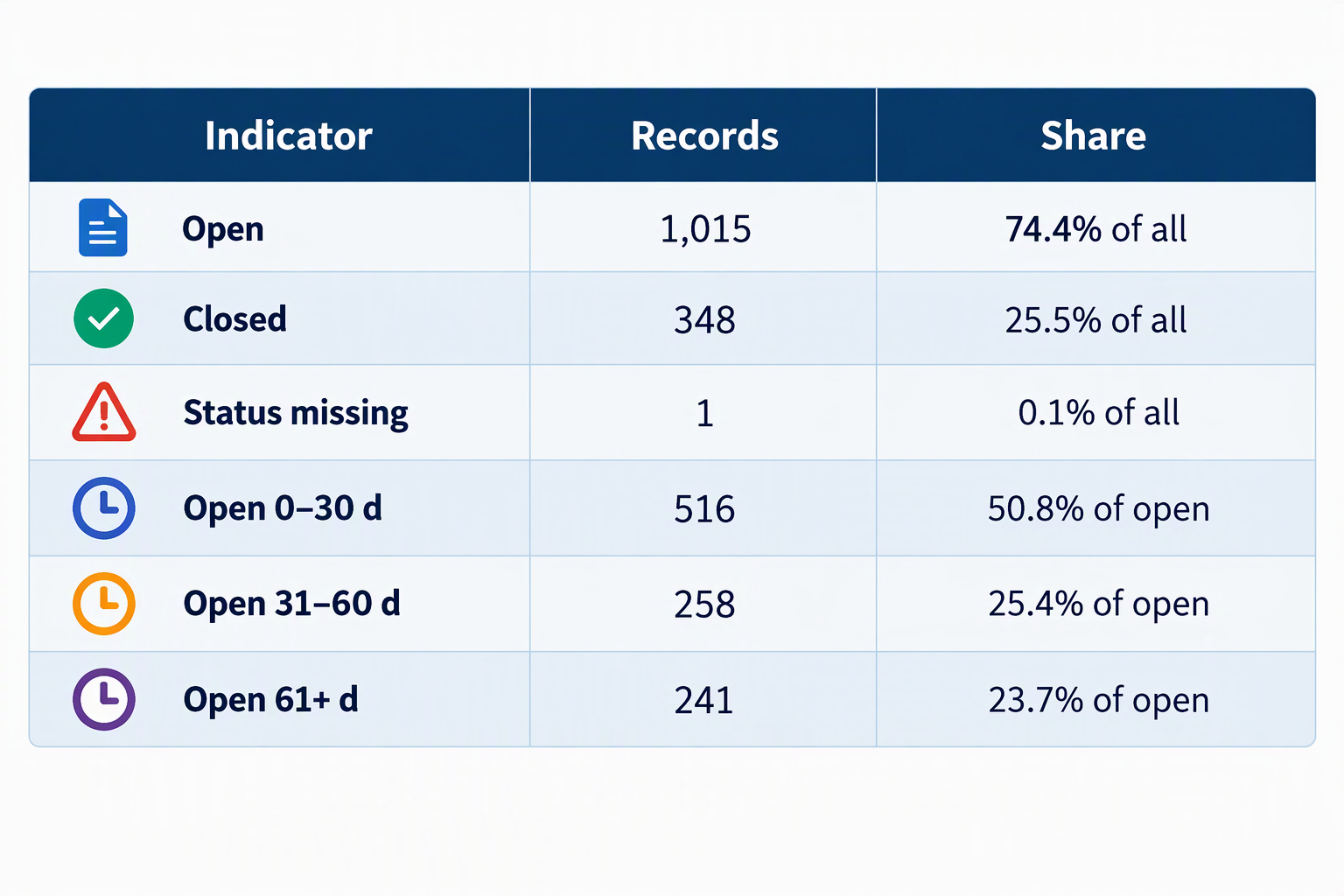
At the snapshot, 1,015 entries were open (74.4%), 348 were closed (25.5%), and one lacked status. Of the open population, 499 (49.2%) had aged at least 31 days and 241 (23.7%) at least 61 days. The largest band was 31–60 days with 258 records.
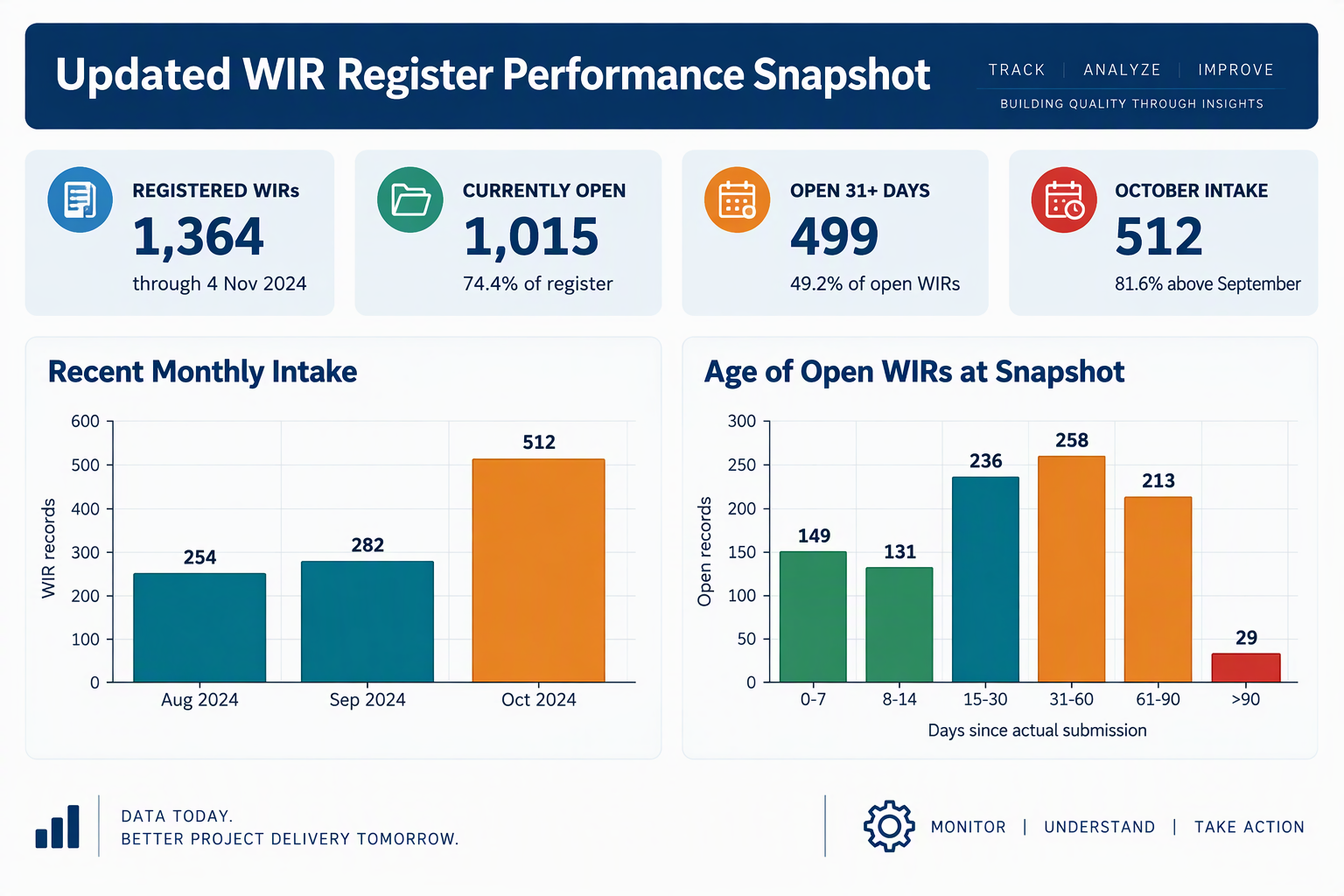
TABLE II
CURRENT STATE AND OPEN-ITEM AGING
B. Discipline Concentration and Intake
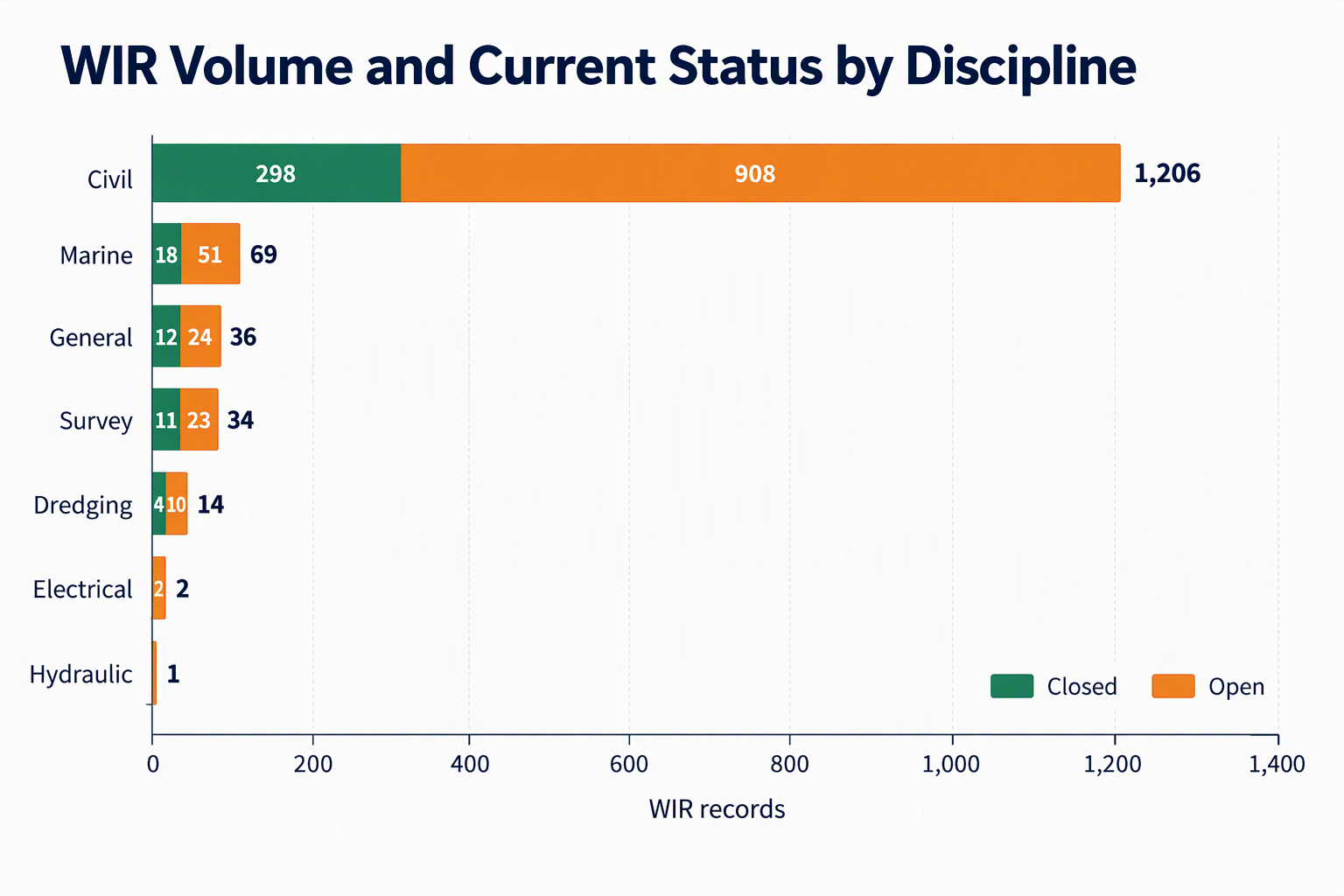
Civil WIRs represented 1,206 records (88.4%) and 898 of the open population. Marine comprised 69 entries, 68 of which were open; this proportion requires caution because many marine entries were submitted late in the observation period. Monthly intake rose from 256 in August to 282 in September and 512 in October 2026. October was 81.6% above September and twice August volume, indicating a material increase in review demand.
C. Submission Timing and Revisions
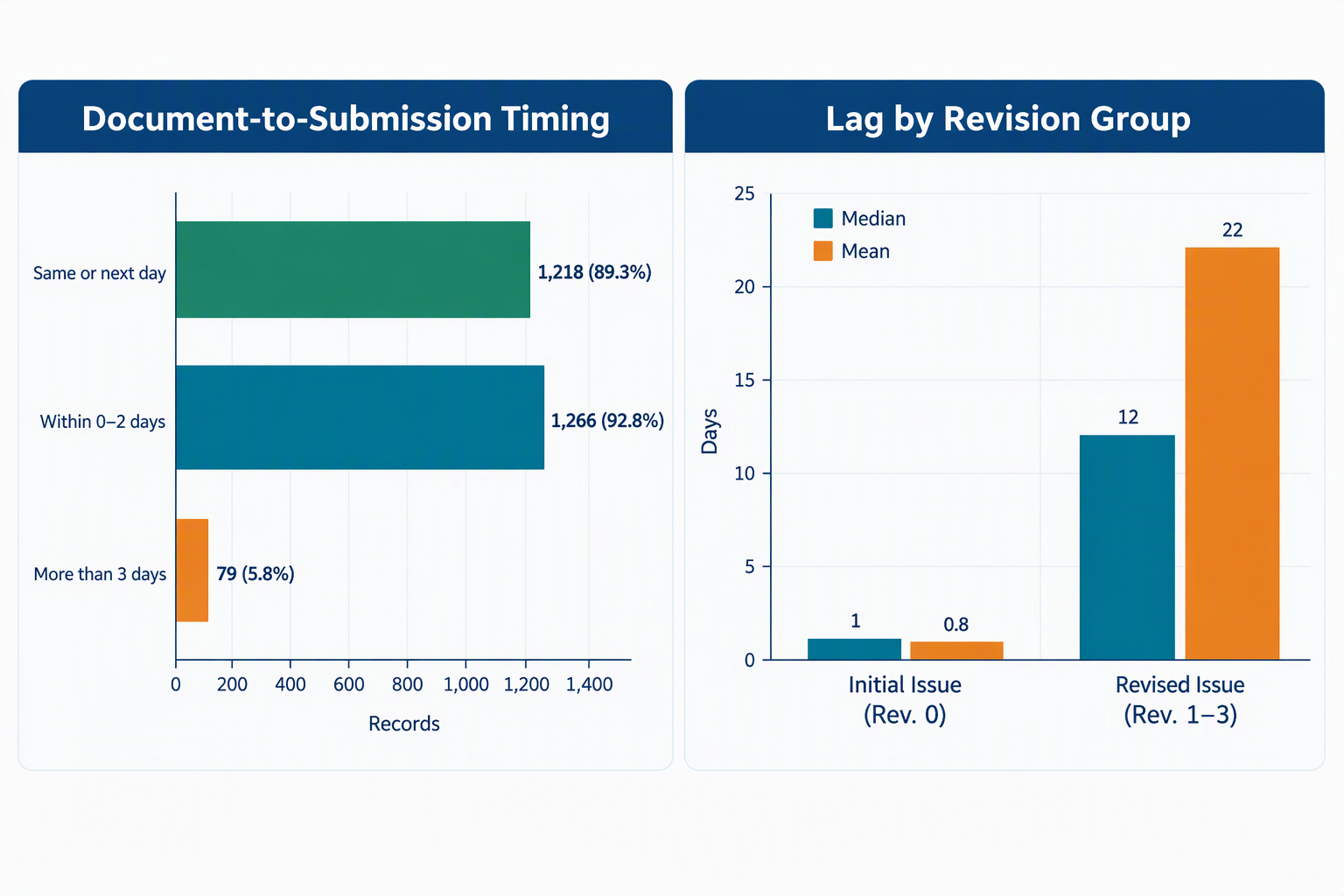
Initial registration was generally prompt. The median lag was one day; 1,218 records (89.3%) were submitted on the document date or the following day, and 1,266 (92.8%) fell within zero to two days. Seventy-nine records had lags exceeding three days. Nine negative intervals indicate date-entry or source-sequence anomalies.
The 1,248 initial issues had a median lag of one day and mean of 0.7 day. The 116 revised issues had a median of 11.5 days and mean of 22.1 days. This contrast is analytically important but is not a direct measure of CONTRACTOR correction performance because the register lacks comment-return, correction-start, due, and resubmission-cycle dates.
D. Information-Quality Risks
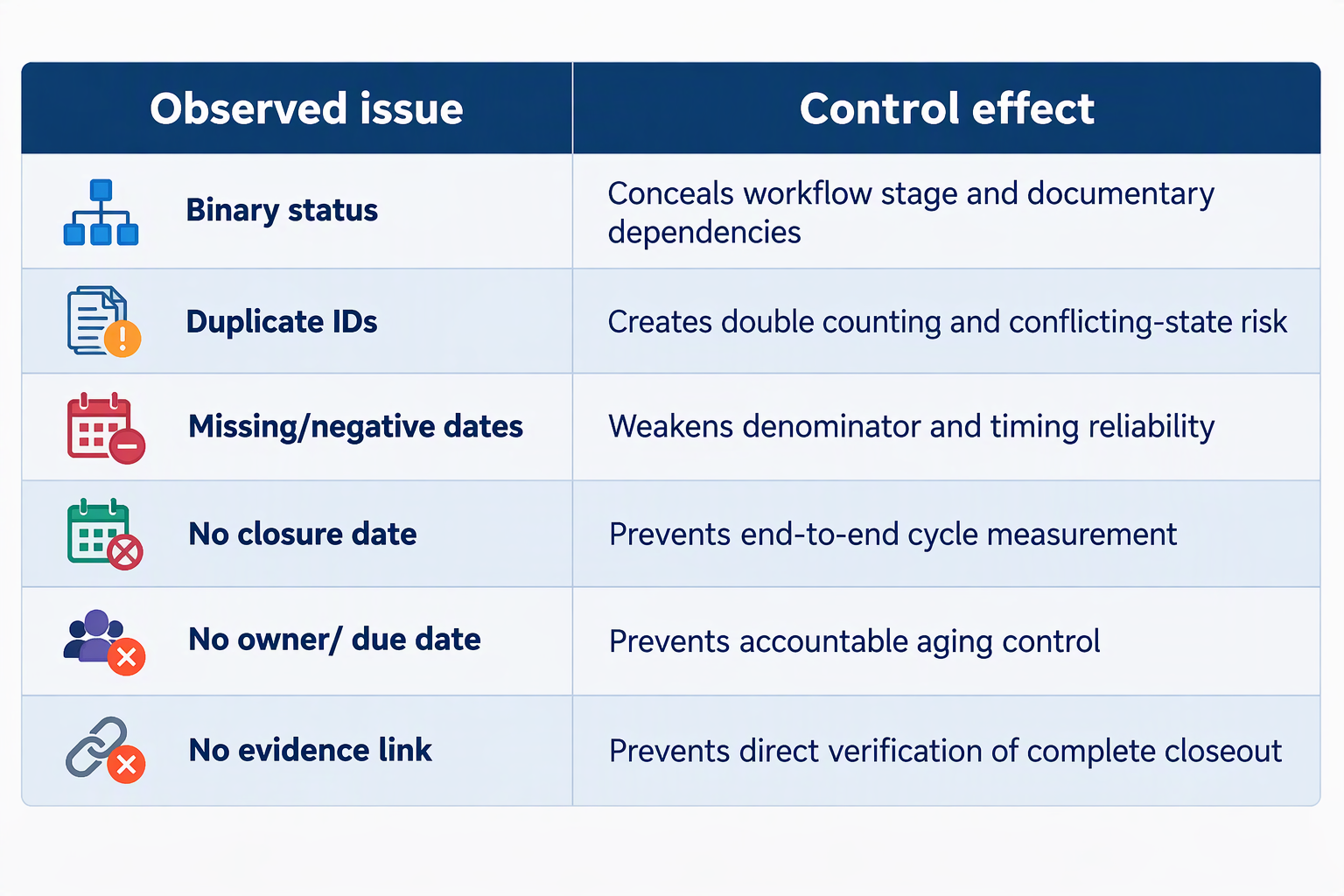
The review identified one missing status, three duplicated identifiers affecting six rows, at least one duplicated identifier with conflicting current states, and nine negative date intervals. Closure dates, inspection outcomes, assigned reviewers, action due dates, locations, and evidence links were absent. These gaps limit traceability and prevent defensible calculation of inspection turnaround, closure-cycle time, first-pass acceptance, and evidence-complete closure.
TABLE III
PRINCIPAL CONTROL LIMITATIONS
VI. DISCUSSION
A. Fast Capture Does Not Equal Controlled Closure
The central empirical finding is the divergence between front-end capture and downstream visibility. Same- or next-day submission for nearly nine of every ten records indicates prompt registration, yet three-quarters of entries remained open at the snapshot. This is not evidence of contractual delay; it is evidence that submission speed alone cannot represent end-to-end assurance performance.
B. State Granularity Is a Management Control
A WIR received yesterday, a rejected WIR awaiting resubmission, and an accepted inspection awaiting a 28-day test result may all appear OPEN. These conditions require different owners, due dates, and interventions. A controlled multi-state taxonomy improves operational interpretation, while historical state transitions enable cycle-time research that a static snapshot cannot support.
C. Queue Exposure Is Concentrated
Civil works dominate both volume and open population. The 499 open items aged 31 days or more form a practical reconciliation population. The appropriate intervention is classification—not mass closure—by current state, owner, next action, required evidence, and expected completion date. This converts aging from a descriptive statistic into an exception-management tool.
VII. PROPOSED WIR QUALITY-INTELLIGENCE FRAMEWORK
A. Governance Cycle
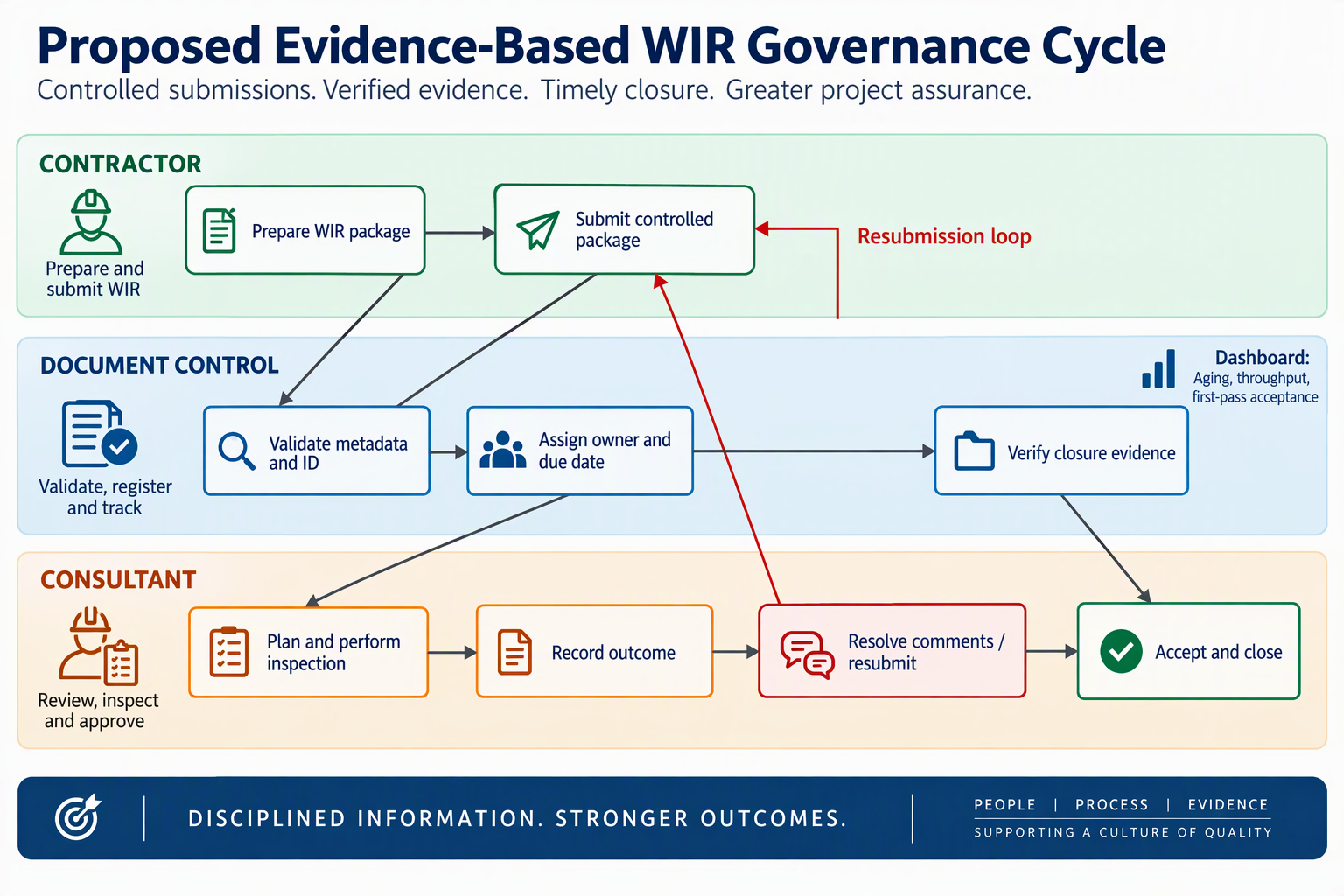
The proposed cycle preserves one traceable record across organizational handoffs. The CONTRACTOR prepares and submits the controlled package. Document Control validates identity, metadata, owner, and evidence links. The CONSULTANT plans the inspection and records the technical disposition. Comments or rejection initiate a controlled resubmission loop. Closure occurs only after the required evidence is verified and the final state is recorded.
B. Controlled States and Minimum Metadata
Recommended states are: Received; Metadata Validation; Scheduled for Inspection; Under Technical Review; Accepted; Accepted with Comments; Rejected—Resubmission Required; Awaiting CONTRACTOR Documentation; Awaiting Test Result; Physically Complete—Documentation Pending; Closed; and Cancelled/Superseded. Each state requires an owner, entry date, next action, and exit condition.
Minimum metadata should include unique identifier and revision; controlled-channel reference; discipline and location; activity, drawing, specification, and inspection/test-plan reference; receipt, planned inspection, actual inspection, outcome, resubmission, and closure dates; current state; accountable role; due date; outcome; superseding reference; and links to the signed WIR, tests, photographs, surveys, as-built data, and corrective-action evidence.
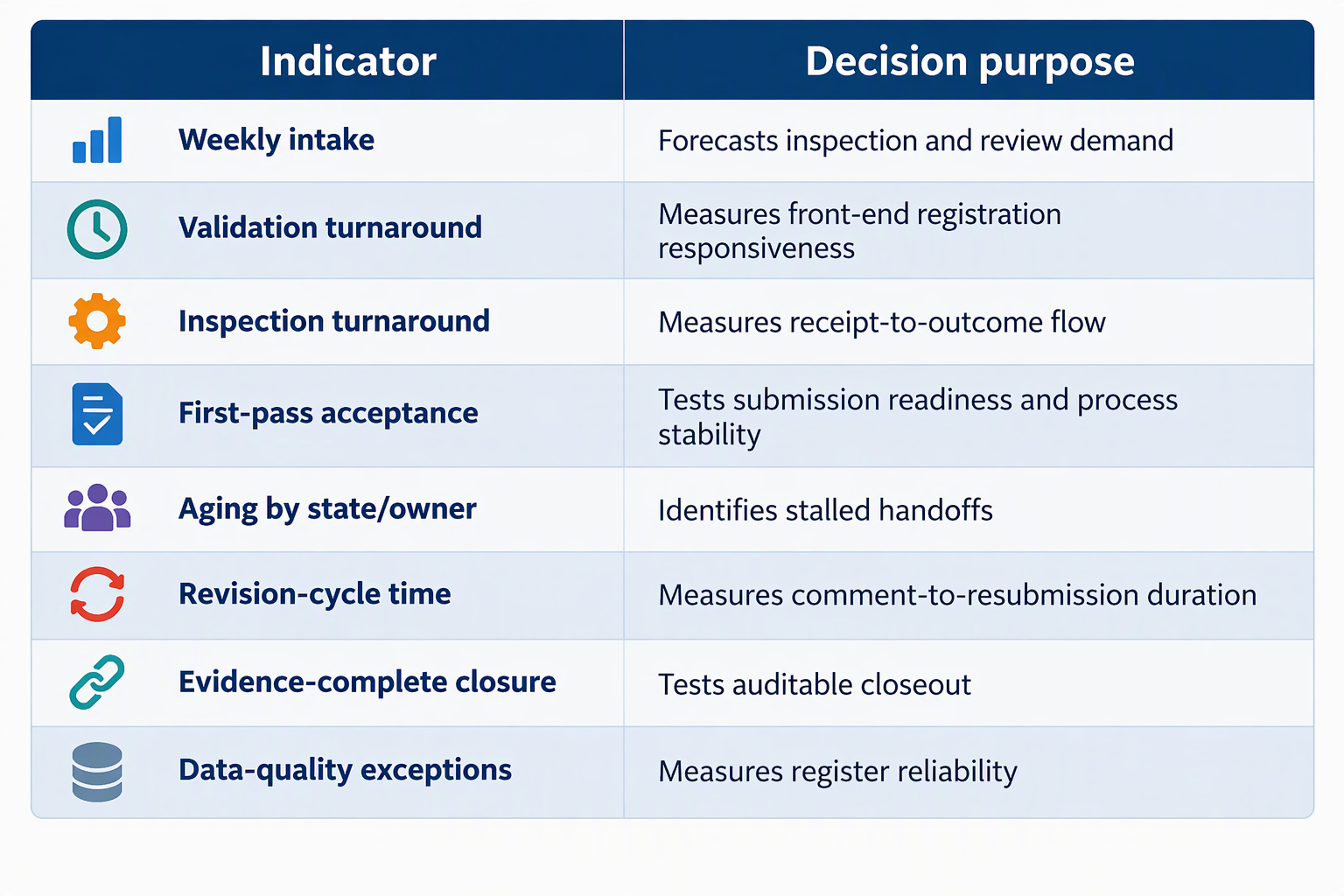
C. Performance Indicators
TABLE IV
RECOMMENDED WIR INDICATORS
VIII. PRACTICAL AND SCHOLARLY IMPLICATIONS
For practice, the framework offers a low-cost path from spreadsheet administration to active assurance. Document controllers can identify exceptions; quality teams can separate technical and documentary constraints; and managers can allocate attention according to inflow, age, discipline, state, and ownership.
The scholarly contribution is threefold. First, the paper conceptualizes WIR management as an information-state system rather than a binary document log. Second, it shows empirically that strong receipt performance can coexist with weak closure visibility, establishing the need to separate capture, inspection, disposition, and evidence-complete closure as distinct temporal constructs. Third, it operationalizes these constructs through a replicable register schema and KPI set suitable for future cross-project comparison. The framework thus connects construction quality assurance with information governance and offers testable propositions for longitudinal research.
IX. LIMITATIONS AND FUTURE WORK
The analysis concerns one project and one snapshot; it does not claim statistical generalizability. Historical state transitions, verified contractual targets, inspection dates, outcomes, reviewer capacity, work locations, and closure evidence were unavailable. Revision lag is therefore not equivalent to correction-cycle duration. Future studies should validate the taxonomy across projects, capture state-transition histories, test relationships among intake, reviewer capacity, aging, and closure, and evaluate whether evidence-linked workflows improve first-pass acceptance and audit readiness.
X. CONCLUSION
The updated register reveals generally prompt front-end submission but limited downstream state visibility. Of 1,364 entries, 89.3% were submitted on the document date or the next day, while 1,015 were open and 499 had aged at least 31 days. The evidence does not establish contractual delay or technical underperformance. It demonstrates that a binary register cannot explain a high-volume quality workflow.
The proposed quality-intelligence framework makes each handoff visible and measurable: receipt, validation, scheduling, inspection, disposition, correction, evidence verification, and closure. Its practical and scholarly message is direct: routine document-control metadata can become an assurance resource when identifiers, states, ownership, dates, and evidence are governed as an integrated information system.
ACKNOWLEDGMENT
The author acknowledges the project teams whose routine quality and document-control records made the anonymized analysis possible. No organization or individual is evaluated in this study.
REFERENCES
[1] Anonymized Project WIR Register, “Work inspection request register,” unpublished project dataset, analytical cut-off Nov. 4, 2026.
[2] International Organization for Standardization, Quality Management Systems—Requirements, ISO 9001:2015, Geneva, Switzerland, 2015.
[3] International Organization for Standardization, Quality Management Systems—Guidance for Documented Information, ISO 10013:2021, Geneva, Switzerland, 2021.
[4] International Organization for Standardization, Organization and Digitization of Information about Buildings and Civil Engineering Works, Including Building Information Modelling—Information Management Using Building Information Modelling—Part 1: Concepts and Principles, ISO 19650-1:2018, Geneva, Switzerland, 2018.
[5] International Organization for Standardization, Organization and Digitization of Information about Buildings and Civil Engineering Works, Including Building Information Modelling—Information Management Using Building Information Modelling—Part 2: Delivery Phase of the Assets, ISO 19650-2:2018, Geneva, Switzerland, 2018.
[6] U.S. Army Corps of Engineers, Construction Quality Management for Contractors: Student Study Guide. Washington, DC, USA: USACE, 2018.
[7] J. Whyte, “How digital information transforms project delivery models,” Project Management Journal, vol. 50, no. 2, pp. 177–194, 2019, doi: 10.1177/8756972818823304.
[8] R. Sacks, C. Eastman, G. Lee, and P. Teicholz, BIM Handbook: A Guide to Building Information Modeling for Owners, Designers, Engineers, Contractors, and Facility Managers, 3rd ed. Hoboken, NJ, USA: Wiley, 2018.
APPENDIX A
CONCISE AUTHOR RESPONSE
This manuscript was strengthened by clarifying its original contribution, separating descriptive register evidence from contractual compliance, and applying a standard IEEE conference structure. The revised paper positions WIR analytics at the intersection of construction quality assurance and information management. It preserves project confidentiality through generic party designations, adds explicit interpretation boundaries, converts citations and references to IEEE numeric style, and proposes a testable state-based governance framework. The central revision is the distinction between prompt front-end capture and downstream evidence-complete closure.
APPENDIX B
PRESENTATION SUMMARY
The presentation explains how a routine WIR register can become a quality-intelligence system. Analysis of 1,364 records found prompt initial submission—89.3% on the document date or the next day—alongside 1,015 open items, including 499 aged at least 31 days. The key implication is that OPEN/CLOSED status cannot distinguish inspection, review, resubmission, evidence, and closure states. The proposed framework adds controlled states, accountable ownership, milestone dates, evidence links, and management indicators. The presentation’s takeaway is: better quality decisions can begin with better-governed inspection metadata.
About the Creator
Domingo Añasco-Gaces Samontina, Jr.
.Professional Member of the Mechatronics and Robotics Society of the Philippines
.Certified Documented Information Controller with TUV Rheinland Qualifications
.Master of Science in Engineering (on-going) with Professional Teacher Certificate
Enjoyed the story? Support the Creator.
Subscribe for free to receive all their stories in your feed.
Comments
There are no comments for this story
Be the first to respond and start the conversation.