
Comparative Analysis of Incoming and Outgoing Document Flows
An Anonymized Registry-Based Case Study of Information Exchange, Workflow Balance, and Document-Control Governance


Research design: Descriptive comparative case study
Unit of analysis: Anonymized incoming and outgoing registry records
Observation period: March 2025 to September 2026 for valid chart dates; anomalous dates outside 2025–2026 are excluded from time-series figures.
Prepared for: Professional document-control and information-management use
Confidentiality note: This article reports only aggregated workflow measures. Document titles, references, individual names, transmittal identifiers, folder locations, and project-specific record details are intentionally excluded.
List of Figures
Figure 1. Monthly comparison of incoming and outgoing registry volumes.
Figure 2. Distribution of the leading document types in incoming and outgoing flows.
Figure 3. Status distribution for incoming and outgoing records.
Figure 4. Cumulative incoming and outgoing records over the observation period.
Abstract
This study compares incoming and outgoing document flows using an anonymized operational registry. The updated analysis covers 3,094 incoming and 1,680 outgoing records and evaluates volume, monthly movement, document-type concentration, workflow status, cumulative balance, review responsiveness, and the wider importance of controlled inward and outward records throughout the documentation lifecycle. The results show a net flow difference of 1,414 records, equivalent to an incoming-to-outgoing ratio of 1.84:1. This difference should not automatically be interpreted as underperformance because one outgoing response may close, consolidate, acknowledge, or reroute several incoming items. Instead, the imbalance identifies where workload, response bundling, information-only correspondence, review cycles, and register completeness should be examined. The paper also establishes that incoming and outgoing controls are foundational to traceability, accountability, quality assurance, contractual administration, regulatory compliance, knowledge continuity, and reliable decision-making. It proposes a practical control framework based on volume balance, closure rate, turnaround time, aging, and traceability.
Keywords: document control, records management, incoming correspondence, outgoing correspondence, information governance, transmittal register, workflow performance, construction documentation
1. Introduction
Controlled information exchange is central to technical and construction projects. Incoming records create obligations for receipt, classification, distribution, review, response, and retention, while outgoing records provide evidence of decisions, comments, approvals, instructions, submissions, and formal communication. A master registry therefore functions not only as an archive index but also as an operational dataset that can reveal workload, bottlenecks, response behavior, and governance risk.
A simple comparison of totals is insufficient. Incoming and outgoing flows have different purposes, and they are not necessarily matched one-for-one. Some incoming records require no response, some generate multiple outgoing records, and some are consolidated into a single formal communication. This study therefore compares both directions at aggregate level and interprets the results as workflow indicators rather than as a direct productivity score.
For consistency, this article uses “incoming record” to mean a controlled item received by the organization and “outgoing record” to mean a controlled item formally issued by the organization. “Disposition” refers to the documented outcome of an incoming item, including response, approval, rejection, information-only classification, supersession, or another authorized closure route. These definitions support consistent interpretation across document types without assuming a one-to-one relationship between receipt and issue.
1.1 Contemporary Standards and Evidence Base
The contemporary evidence base also extends beyond routine capture. AS 5393:2025 addresses controlled migration of authoritative data, information, and records between systems, while ARMA International’s Information Governance Implementation Model links policy, technology, lifecycle management, architecture, and cross-functional oversight. These developments support the study’s position that incoming and outgoing registers should operate as governance controls rather than simple transaction logs (ARMA International, n.d.; Records and Information Management Practitioners Alliance [RIMPA], 2025).
Recent evidence reinforces the operational importance of these controls. The National Academies’ 2025 guide for digital model-based project delivery emphasizes versioning, traceability, accessibility, retention, preservation, data rights, and cybersecurity as records-management concerns. Recent construction-industry guidance similarly stresses standardized workflows, naming, version control, controlled access, automated routing, and audit mechanisms (National Academies of Sciences, Engineering, and Medicine [NASEM], 2025; Procore Technologies, 2025).
For built assets, ISO 19650-1 provides a whole-life information-management framework covering information exchange, recording, versioning, and organization. The 2018 edition was confirmed in 2024 and remains published while a replacement edition is under development (ISO, 2018).
International records-management guidance treats records as evidence that must be created, captured, managed, and supported by metadata, assigned responsibilities, monitoring, and records controls. ISO 15489-1 remains the current principles standard, while ISO 23081-1 remains current for records metadata (International Organization for Standardization [ISO], 2016, 2017).
2. Research Objectives
Quantify and compare incoming and outgoing registry volumes.
Examine monthly flow patterns and cumulative balance.
Compare the concentration of document types and workflow statuses.
Assess available incoming review-turnaround indicators.
Develop practical performance measures for document-control monitoring.
Explain the importance of incoming and outgoing controls across the complete documentation lifecycle.
3. Research Questions
How large is the difference between recorded incoming and outgoing document volumes?
Do the two flows move together over time, or does an accumulating imbalance appear?
Which document categories account for most traffic in each direction?
What does the status distribution indicate about closure and pending workload?
Which controls are needed to make incoming-to-outgoing comparison operationally meaningful?
Why are complete incoming and outgoing records essential to governance, compliance, coordination, and organizational memory?
4. Importance of Incoming and Outgoing Records in Documentation
4.1 Foundation of the Document Lifecycle
Incoming and outgoing records form the two controlled boundaries of a documentation system. This lifecycle view is consistent with ISO 15489-1 and ARMA’s information-governance model, which connect creation or receipt, management, use, retention, and disposition (ARMA International, n.d.; ISO, 2016). Incoming control establishes what the organization received, when it was received, who issued it, what action was required, who became responsible, and where the authoritative copy was stored. Outgoing control establishes what the organization formally issued, when it was transmitted, to whom it was sent, for what purpose, under which revision, and with what approval or authorization. Together, these records create a continuous chain of custody from receipt through review, decision, response, issue, closure, retention, and eventual retrieval.
Without both sides of the record, a documentation system becomes incomplete. An incoming register without a corresponding disposition may show demand but not resolution. An outgoing register without the originating request, review history, or approval evidence may show transmission but not the basis for the decision. Effective information governance therefore depends on preserving the relationship between what entered the organization and what formally left it.
4.2 Traceability and Auditability
Controlled incoming and outgoing registers provide the audit trail needed to reconstruct events. Current guidance for digital project delivery likewise identifies versioning, traceability, accessibility, retention, and preservation as core records-management concerns (NASEM, 2025). They allow reviewers, auditors, project managers, and document controllers to verify the sequence of submissions, comments, revisions, approvals, instructions, and responses. This is particularly important where several versions of the same document circulate simultaneously. Accurate dates, references, revision identifiers, recipients, status values, and linked transmittals help demonstrate which information was current and authorized at a particular point in time.
Traceability also reduces reliance on personal memory, email searches, or informal file storage. When records are consistently registered and linked, the organization can retrieve evidence even after personnel, responsibilities, software platforms, or project phases change. The register therefore acts as an institutional memory rather than merely a list of files.
4.3 Accountability, Ownership, and Timely Action
Incoming control converts received information into accountable work. Classification fields such as response requirement, responsible reviewer, due date, status, and ball in court identify who must act and by when. Outgoing control confirms whether the required action was completed and formally communicated. This connection prevents documents from remaining unattended, being reviewed by the wrong discipline, or being treated as complete without evidence of disposition.
For high-volume documentation environments, the registers also support workload planning. Aging reports, overdue-item lists, and monthly flow trends allow managers to identify review congestion before it becomes a delivery or compliance issue. The purpose is not to force a one-to-one incoming-to-outgoing ratio, but to ensure that every response-required item has a visible owner, target date, status, and closure path.
4.4 Quality and Revision Control
Incoming and outgoing controls protect document quality by distinguishing drafts, revisions, superseded information, approved versions, and formally issued records. This is aligned with ISO 19650-1’s whole-life approach to exchanging, recording, versioning, and organizing built-asset information (ISO, 2018). A reliable register helps prevent obsolete drawings, specifications, procedures, instructions, and reports from being used for current work. It also supports confirmation that reviews were completed, comments were incorporated or dispositioned, and the correct revision was transmitted to the intended recipients.
This function is essential beyond engineering drawings. It applies to contracts, correspondence, reports, procedures, inspection records, requests for information, meeting records, safety documentation, financial records, human-resources files, procurement documents, regulatory submissions, and operational manuals. Although the metadata and approval routes differ, the control principle is the same: the organization must know what was received, what was issued, which version governs, and what evidence supports the action taken.
4.5 Contractual, Regulatory, and Legal Evidence
Formal communications may establish instructions, approvals, notices, commitments, review outcomes, agreed dates, and changes in scope. Complete incoming and outgoing records support contractual administration by showing when information became available, when a response was due, what was communicated, and whether the communication reached the intended party. Missing or inconsistent records can weaken the organization’s ability to demonstrate compliance, defend a decision, assess delay, or resolve a disagreement.
The same principle applies to regulatory and legal obligations. Retention periods and specific evidentiary requirements vary by document type, contract, industry, and jurisdiction, so the records-management plan should define mandatory metadata, access restrictions, approval authorities, retention rules, and final disposition. Registers should support compliance, but they do not replace the authoritative controlled document or the applicable contractual and legal requirements.
4.6 Coordination, Transparency, and Decision Support
A shared and current view of incoming and outgoing activity improves coordination among document control, engineering, construction, commercial, quality, safety, procurement, and management teams. It makes dependencies visible, reduces duplicate follow-up, and clarifies whether an item is awaiting review, correction, approval, transmission, or acknowledgement. Reliable status data also supports management decisions on staffing, priorities, escalation, and recovery actions.
At portfolio level, aggregated flow data can reveal recurring document types, seasonal peaks, discipline-specific bottlenecks, long review intervals, incomplete metadata, and weak response linkage. These patterns provide evidence for process improvement, system configuration, training, and resource planning. The value of the register therefore extends from daily transaction control to strategic information-management insight.
4.7 Consequences of Weak Incoming and Outgoing Control
Loss of traceability, including inability to prove receipt, issue, approval, or acknowledgement.
Use of superseded or unauthorized information, potentially causing rework, delay, quality defects, or unsafe execution.
Missed response dates and unresolved actions because ownership, status, or due dates are unclear.
Duplicate submissions and inconsistent filing because documents are not registered against authoritative references.
Weak contractual or regulatory evidence when communications, decisions, or revisions cannot be reconstructed.
Reduced organizational memory when knowledge remains in individual mailboxes, local folders, or personal recollection.
These risks demonstrate why incoming and outgoing control should be treated as an integrated governance process. Registration alone is insufficient; records must be classified, assigned, reviewed, linked, updated, closed with evidence, protected, retained, and made retrievable according to approved procedures.
4.8 Practical Examples Across Documentation Types
The following examples show how the same incoming-to-outgoing control principle applies across common documentation categories. They are generic workflow examples and do not reproduce project-specific records from the source registry.
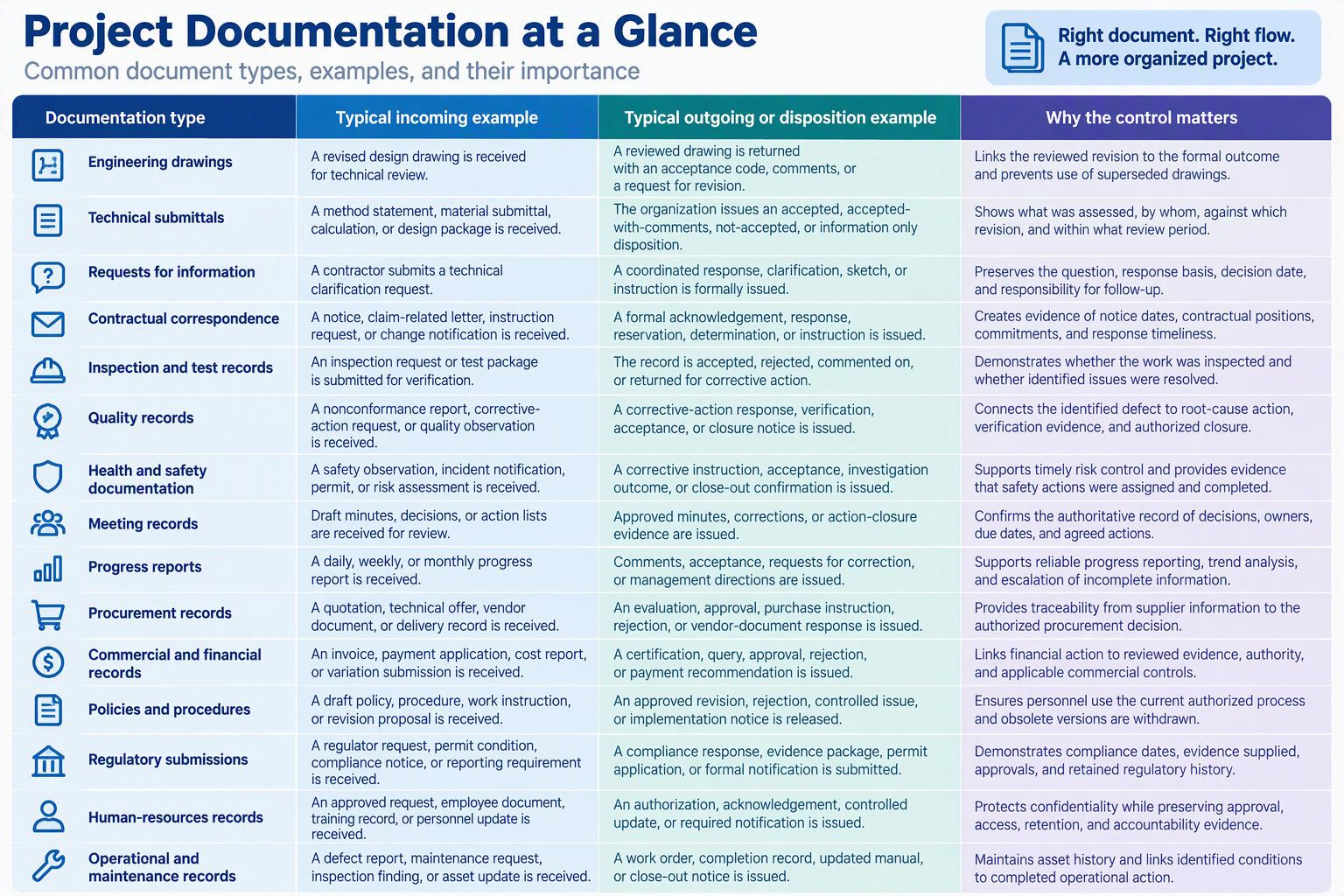
Across these categories, the minimum control logic remains receipt, registration, classification, assignment, review, authorized disposition, formal issue, closure, retention, and retrieval. The metadata may vary, but closure should always be supported by evidence appropriate to the record type.
5. Methodology
5.1 Research Design
The study uses a descriptive comparative case-study design. Registry rows were treated as operational observations. The Incoming and Outgoing worksheets were analyzed independently and then compared using common fields, including recorded date, document type, discipline, document status, and ball-in-court classification. Incoming review fields were additionally used for turnaround analysis when valid paired dates were available.
5.2 Data Protection and Exclusions
The source workbook was used only as a structured dataset. No document reference, subject, transmittal number, individual name, folder directory, or item-level record is reproduced. Blank and structurally empty rows were excluded. Aggregate categories are retained because they are necessary to explain workflow composition.
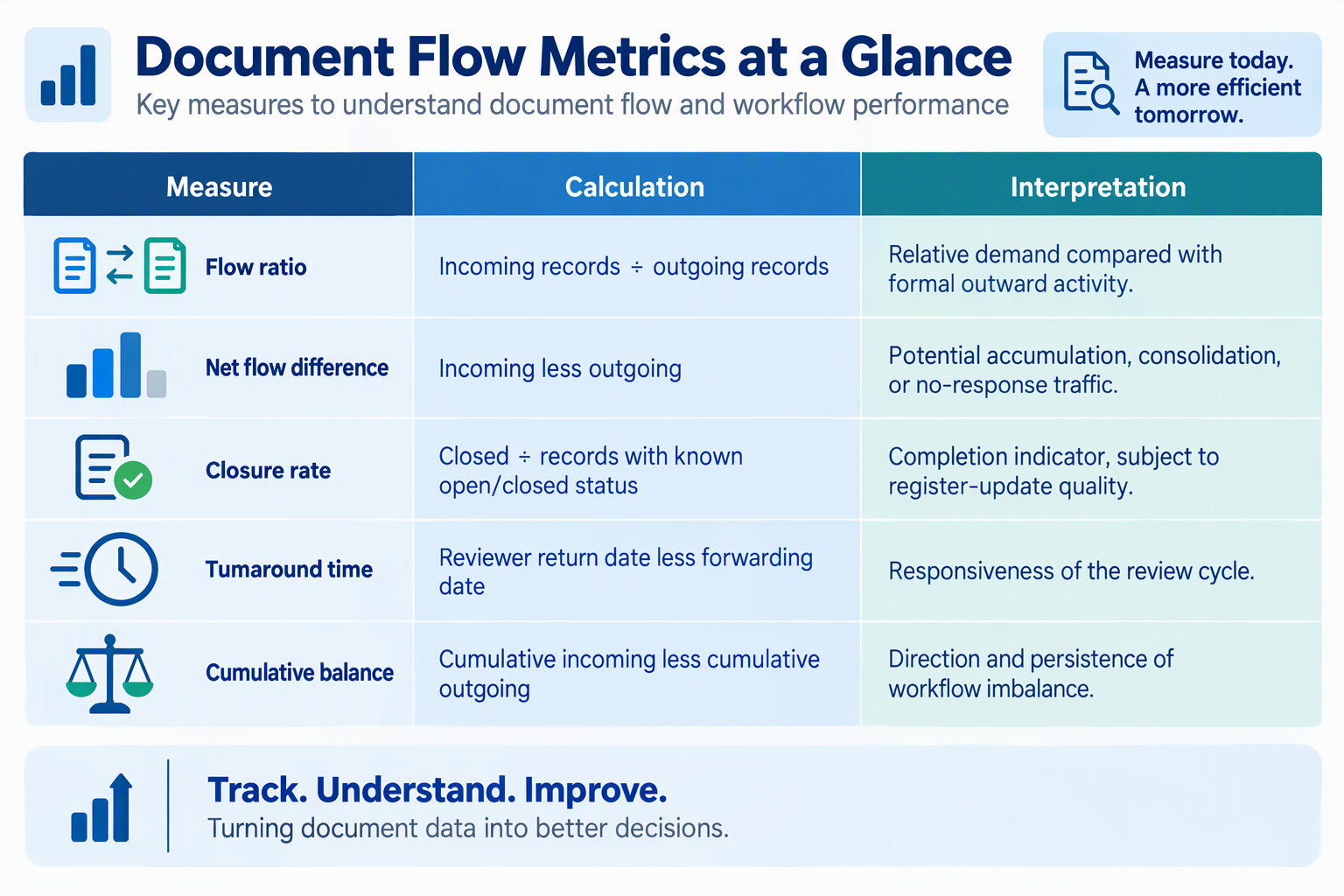
5.3 Measures
5.4 Operational Definitions and Analytical Assumptions
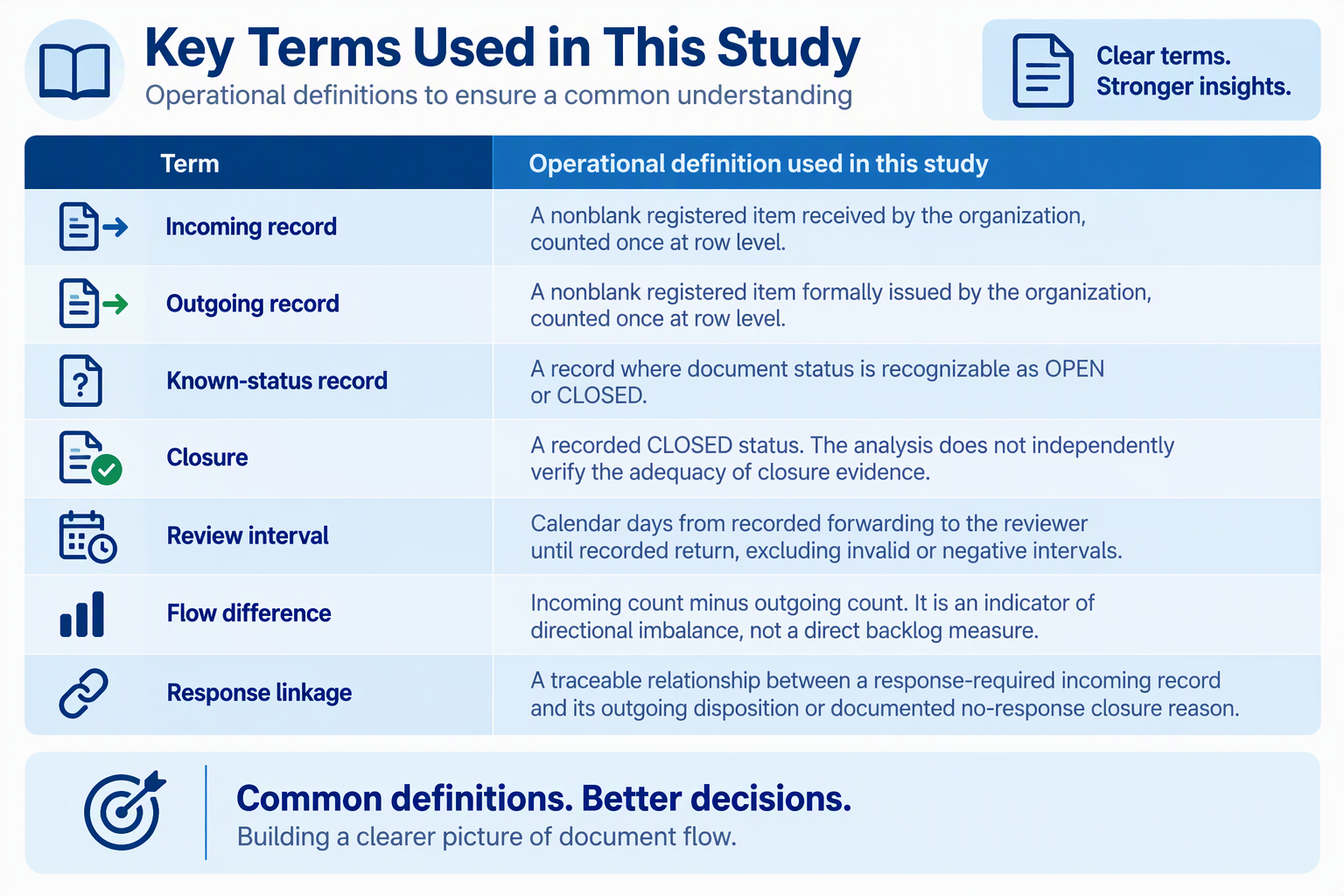
The study assumes that registry rows represent distinct operational records and that recorded dates and statuses are sufficiently reliable for aggregate analysis. Because registration practices may differ between incoming and outgoing workflows, results are interpreted as diagnostic indicators rather than causal or individual-performance measures.
6. Results
The four graphs below provide the visual representation of the registry analysis. Each graph is embedded directly in the document, followed by its figure number, caption, and interpretation.
6.1 Overall Flow Profile
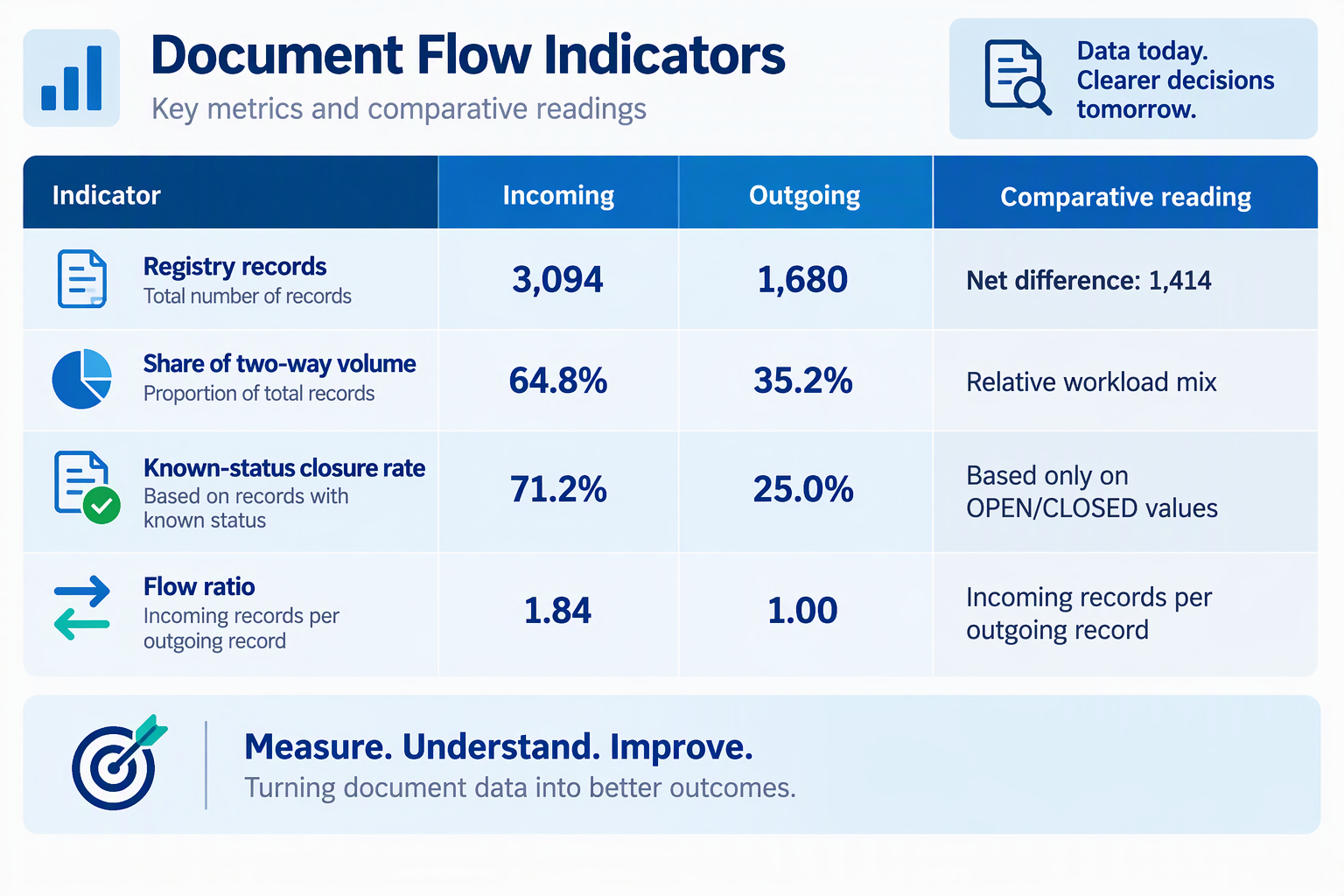
The registry contains more incoming than outgoing records. The observed ratio is 1.84 incoming records for every outgoing record. This demonstrates that recorded inward volume is larger than recorded outward volume in the analyzed population, but it does not establish a response backlog or a causal performance deficiency. The difference may include information-only items, acknowledgements not separately registered, grouped responses, duplicated or revised submissions, and differences in the completeness of the two registers.
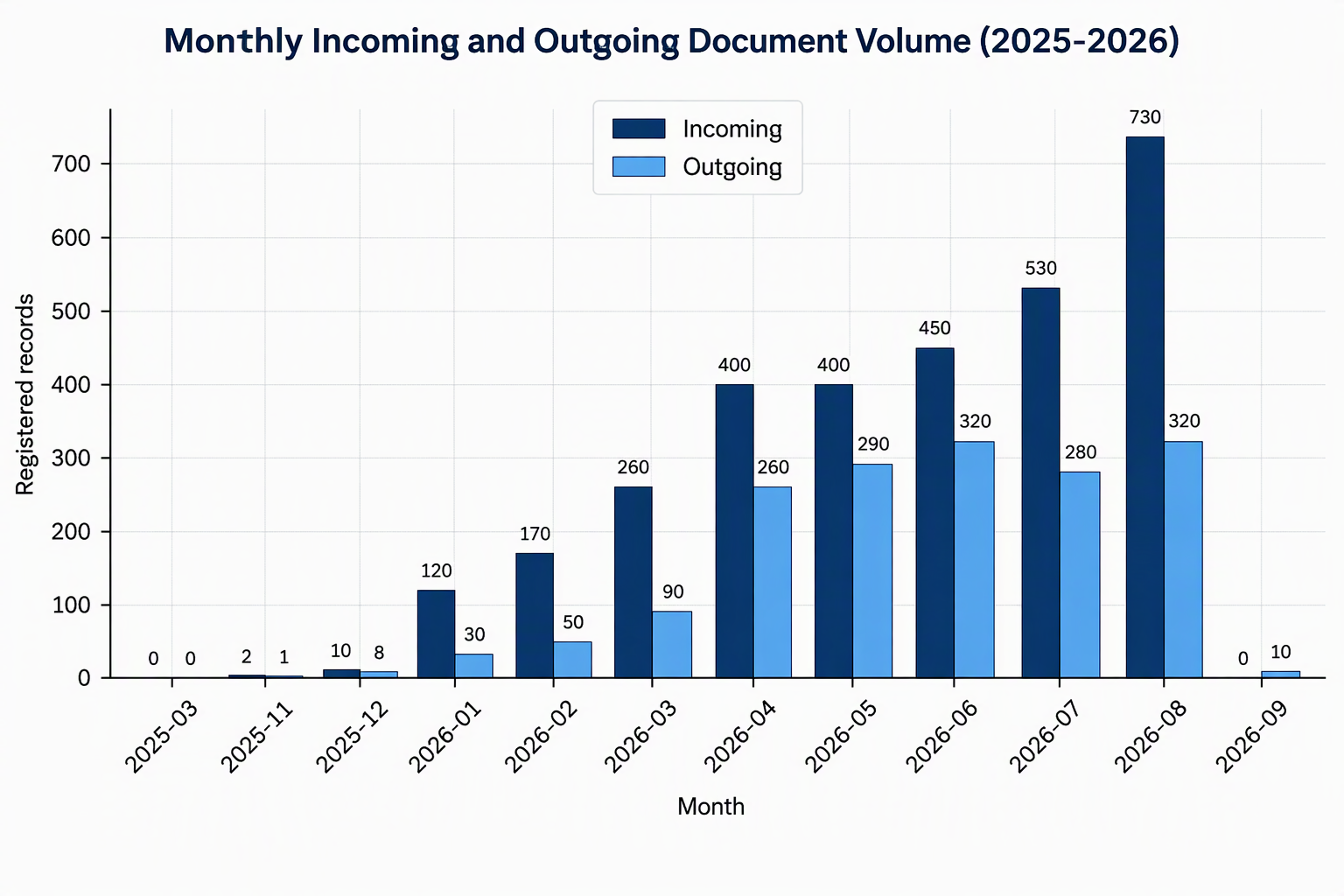
Monthly comparison is more useful than a single total because it shows whether high incoming periods are followed by corresponding outward activity. Peaks should be reviewed against staffing, review deadlines, planned submission cycles, and major project milestones. Persistent divergence over several months is a stronger control signal than a short-term monthly gap.
6.2 Document-Type Composition
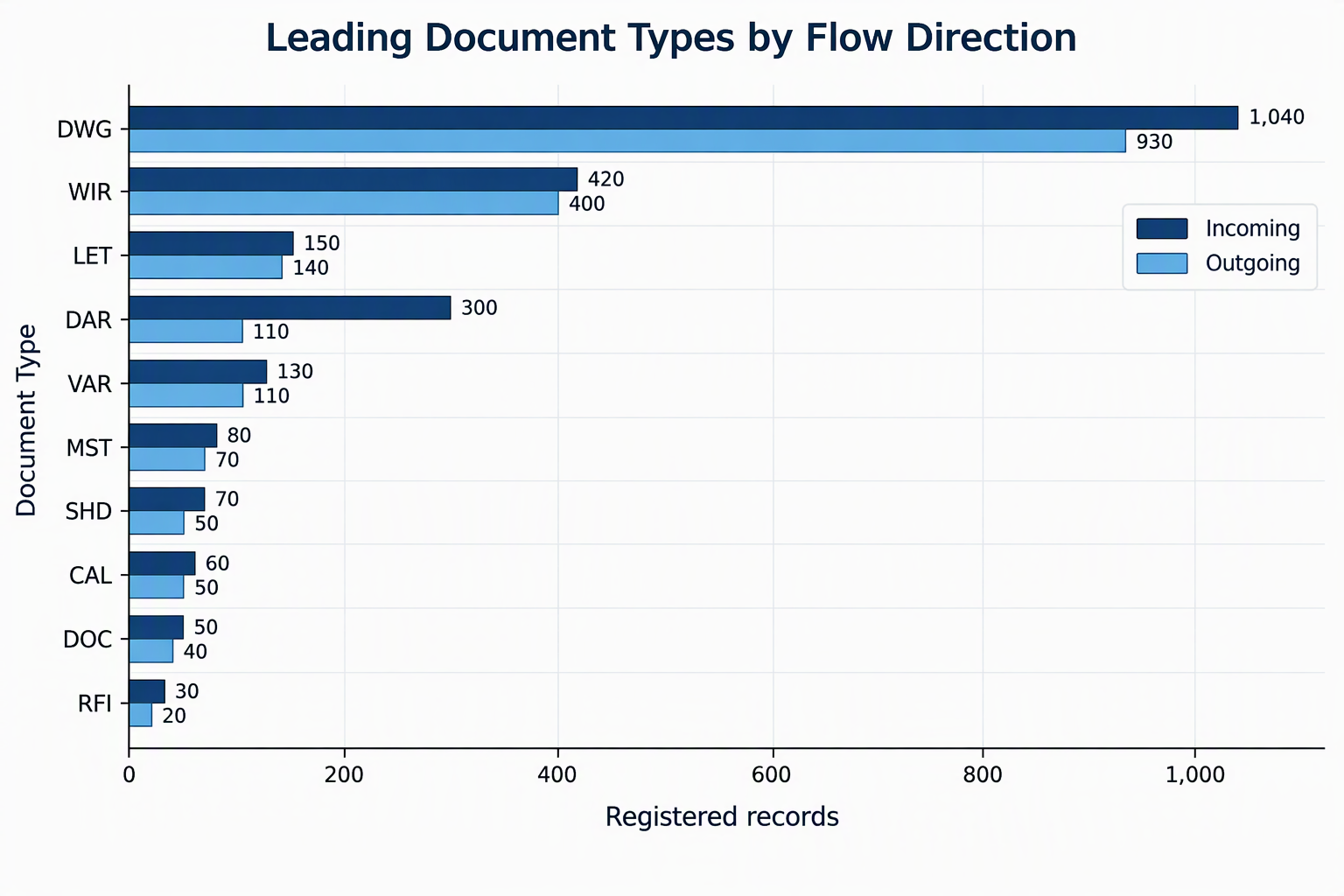
The mix of document types explains why the two flows are not symmetrical. High-volume inward categories typically generate review, routing, or recordkeeping work, whereas outward categories represent formal responses, return transmittals, instructions, or submissions. A category-level comparison is therefore recommended before concluding that a volume gap represents delayed action.
6.3 Workflow Status and Closure
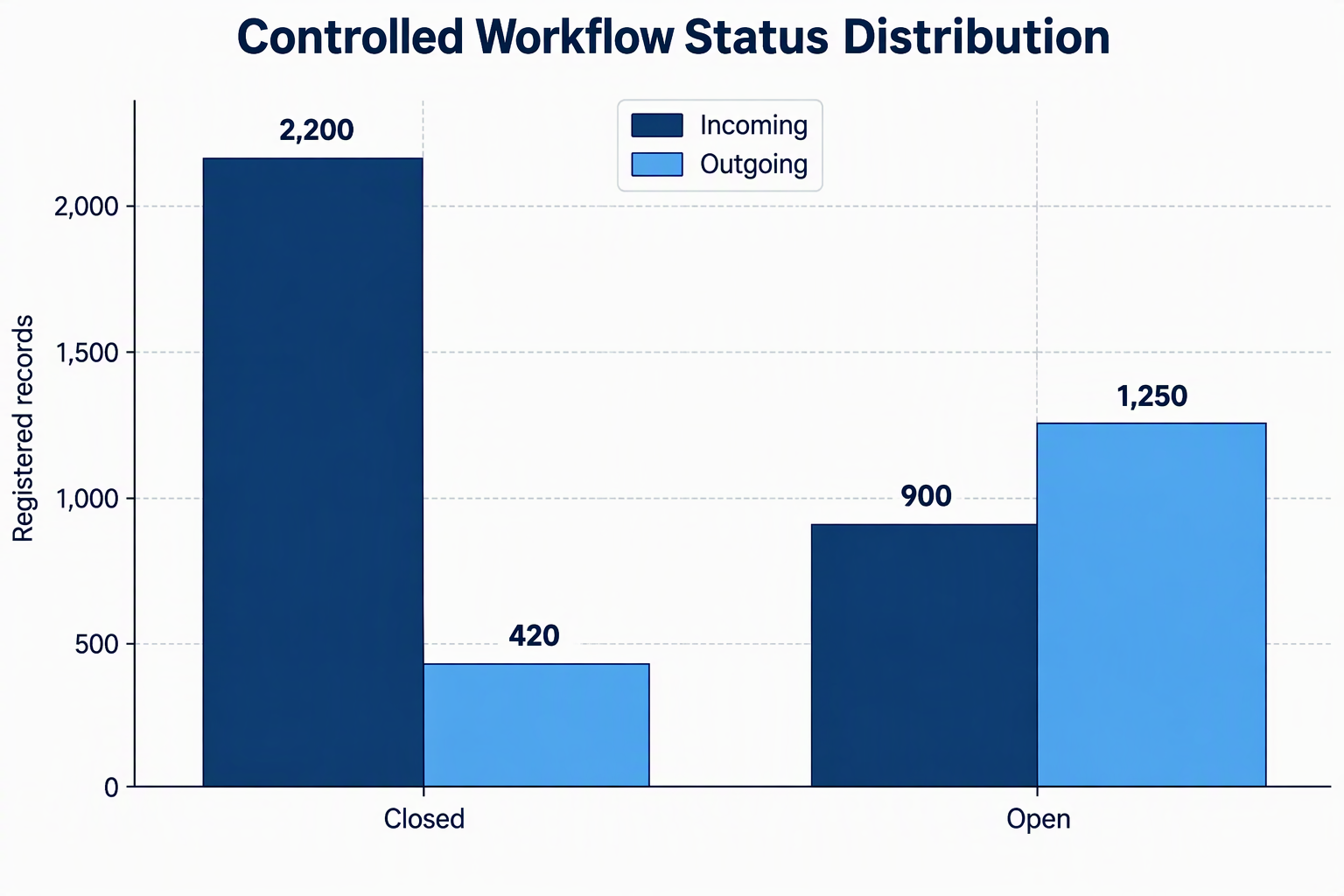
Among records carrying a recognizable OPEN or CLOSED value, the incoming closure rate is 71.2% and the outgoing closure rate is 25.0%. These figures should be interpreted cautiously. A high closure rate can reflect effective processing, but it can also reflect delayed status updating, inconsistent definitions, or automatic closure conventions. A robust register should define when a record becomes closed and should preserve a clear link to the evidence supporting closure. The revised figure intentionally excludes 8 record(s) with nonstandard status entries so that organization names or other uncontrolled values are not presented as workflow statuses.
6.4 Cumulative Flow Balance
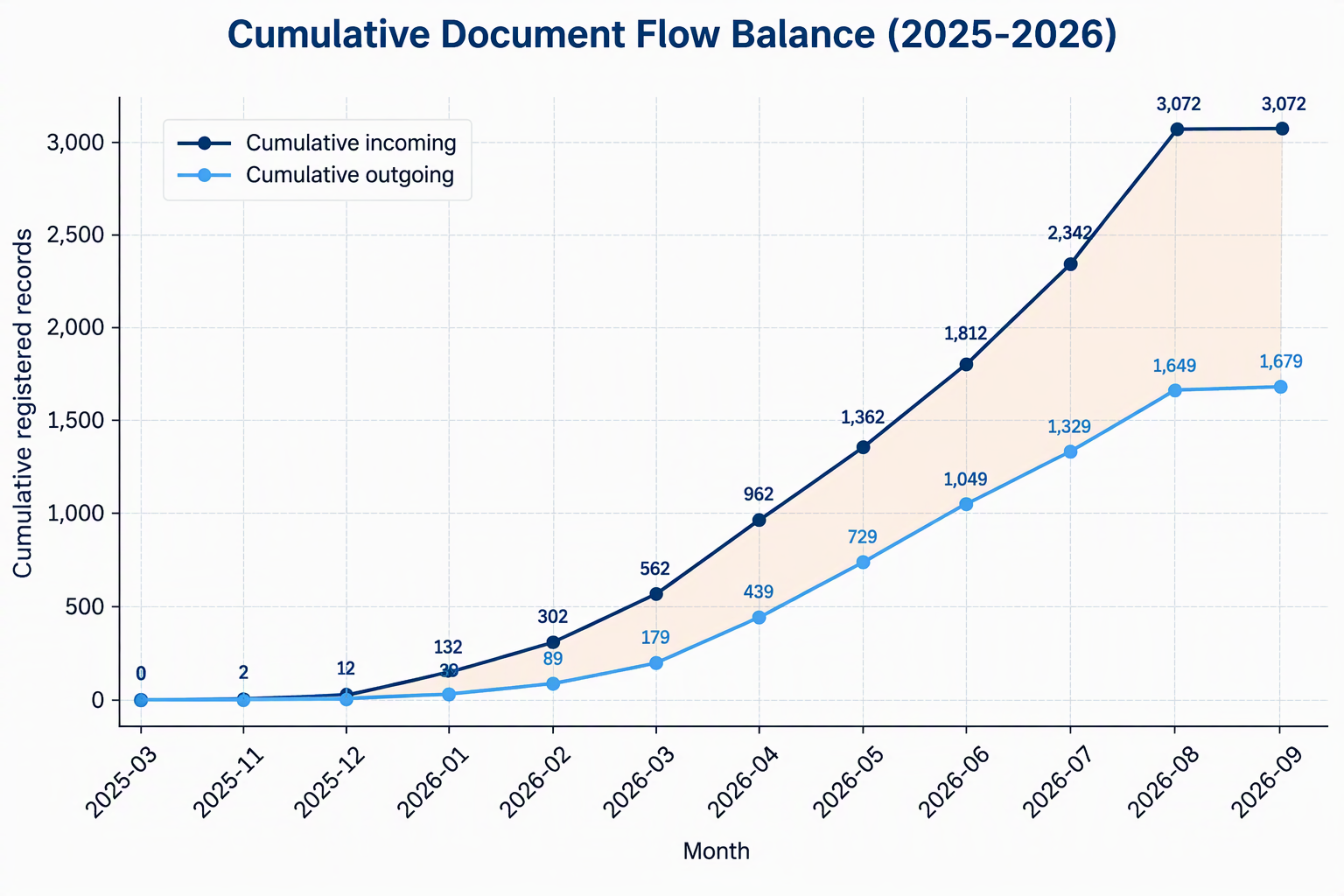
The cumulative curves show whether the difference between inward and outward traffic expands, narrows, or remains stable. A widening gap warrants targeted review of categories requiring response, not a blanket assumption that every incoming item should have an outgoing counterpart. The controlling question is whether each response-required item has an owner, due date, current status, and traceable disposition.
6.5 Incoming Review Responsiveness
Valid forwarding-to-return date pairs were available for 1,567 incoming records. The average observed review interval was 12.2 calendar days, the median was 11 days, and 72.1% were returned within 14 calendar days. The median is particularly useful because it is less distorted by exceptionally long cases. These indicators should be supplemented by aging bands for currently open items and by an agreed rule on calendar versus working days.
7. Discussion
7.1 Meaning of the Incoming-to-Outgoing Difference
The central finding is that registry traffic is directionally unbalanced. In document control, however, balance does not mean equal totals. The appropriate target is controlled disposition. Each incoming record should be classified as response required, information only, superseded, duplicate, internally actioned, or linked to an outgoing response. This relationship allows management to separate legitimate non-response traffic from unresolved obligations.
7.2 Operational Risks
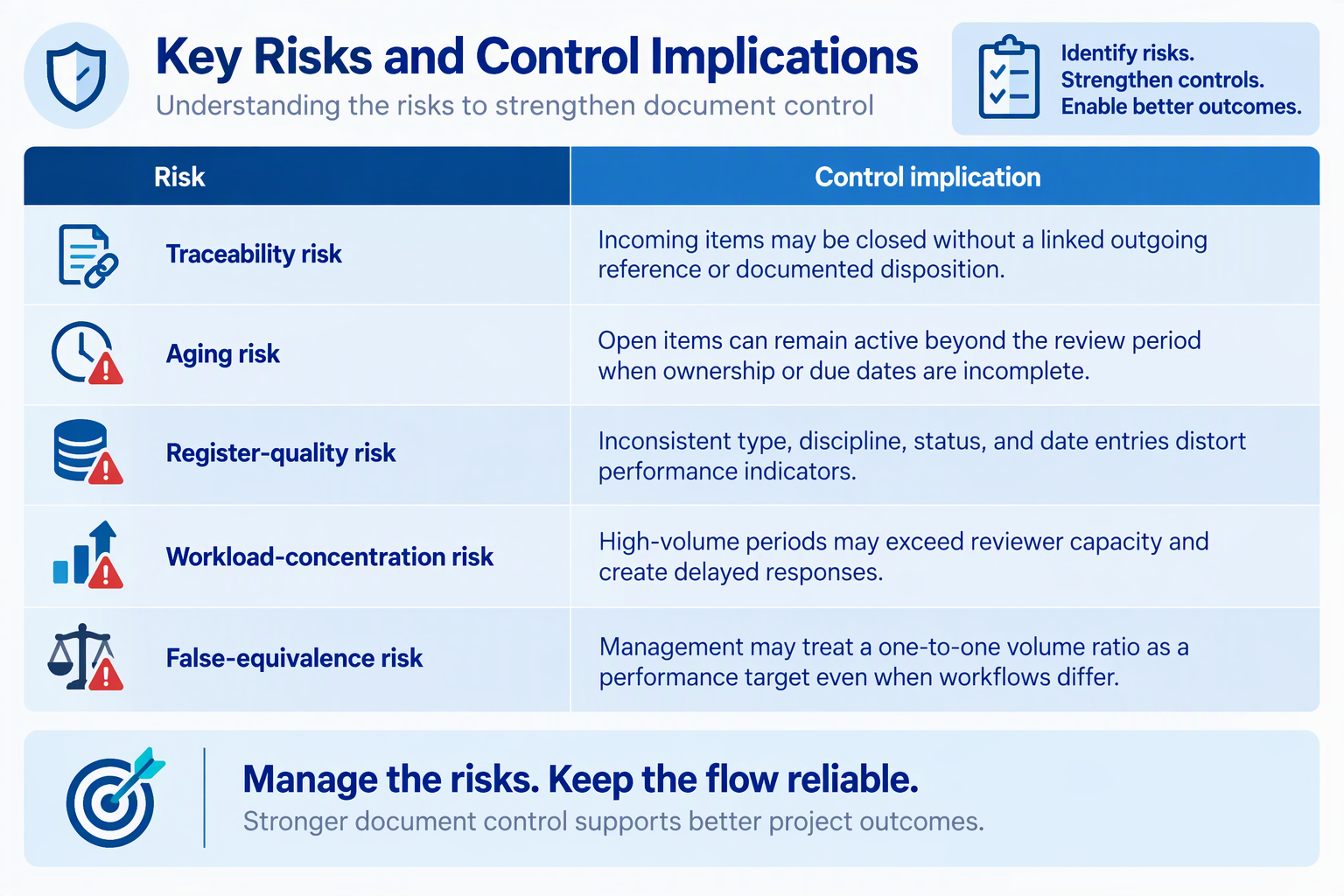
7.3 Data-Quality Considerations
Registry analysis depends on disciplined data entry. Metadata principles are essential because the reliability, context, structure, and retrievability of records depend on controlled metadata throughout the records lifecycle (ISO, 2017). Formula-filled ranges, blanks, inconsistent dates, nonstandard status values, and records without final disposition can inflate or weaken indicators. Monthly governance should therefore include duplicate checks, mandatory-field checks, date-sequence validation, vocabulary control, and reconciliation between the register and the document-management platform.
7.4 Documentation-Wide Significance
The study confirms that incoming and outgoing control is not limited to correspondence administration. Recent practice literature describes information governance as an organization-wide responsibility that joins policy, process, technology, risk, compliance, and lifecycle management (ARMA International, n.d.; NASEM, 2025). It is a cross-functional control mechanism that supports the authenticity, reliability, integrity, and usability of documentation. Incoming records establish the source and obligation; internal review records establish the evaluation and decision path; outgoing records establish the authorized response or issue. When these elements are connected, the organization can demonstrate not only that a document exists, but also why it was acted upon, who authorized the action, and how the result was communicated.
This wider significance explains why document-control performance should not be measured only by transaction counts. A mature system measures completeness of metadata, response linkage, timeliness, revision accuracy, approval evidence, retrieval capability, access control, and defensible closure. These measures protect operational continuity and improve confidence in the documentary record across the full life of a project or business process.
8. Recommended Control Framework
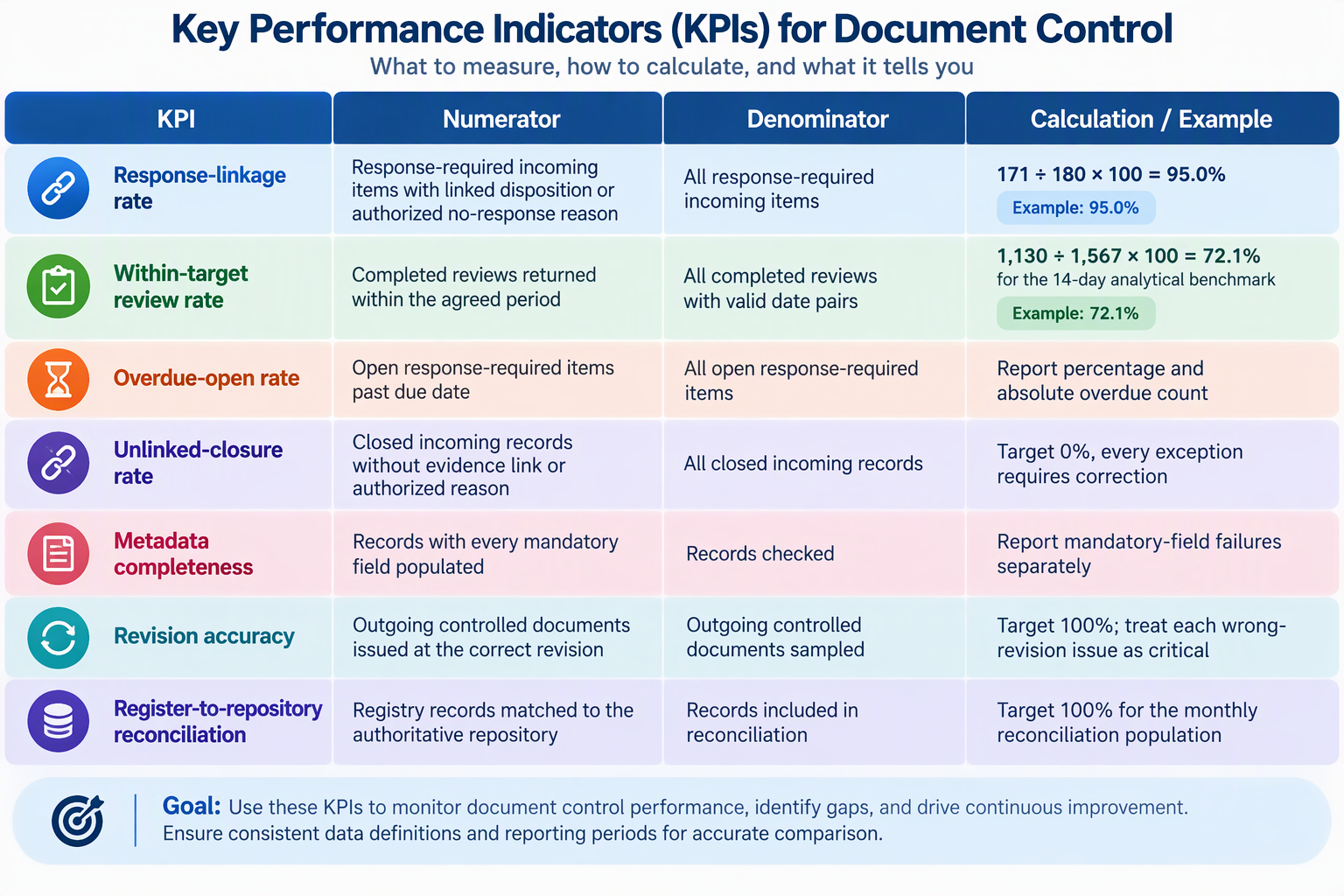
1. Establish response linkage. Require “Response Required?”, “Disposition Category,” and “Linked Outgoing Reference” fields. Measure the response-linkage rate monthly as linked response-required incoming items divided by all response-required incoming items. Set an internal control target of 100%, with every exception supported by an authorized no-response reason.
2. Monitor aging and overdue exposure. Group open response-required items into 0–7, 8–14, 15–30, and more-than-30-day bands. Measure the overdue-open rate as overdue response-required items divided by all open response-required items. Use a default internal trigger of not more than 5%, subject to contractual review periods, and require a named recovery owner and date for every overdue item.
3. Use a balanced monthly dashboard. Report incoming volume, outgoing volume, net flow difference, response-linkage rate, median review time, within-target review rate, overdue-open rate, unlinked-closure rate, metadata-completeness rate, and revision-error rate. Show three-month trends so that sustained deterioration is distinguishable from a temporary peak.
4. Standardize statuses and closure rules. Use controlled definitions for OPEN, CLOSED, response required, information only, superseded, duplicate, and withdrawn. Measure status-validity monthly as records using approved values divided by all active records, with a target of at least 99%. Treat closure without a disposition category or evidence link as an exception.
5. Perform documented monthly reconciliation. Reconcile the register against the common data environment, transmittal platform, or authoritative repository. Where systems are upgraded, integrated, decommissioned, or replaced, treat migration as a governed records process consistent with AS 5393:2025 (RIMPA, 2025). Reconcile the register against the common data environment, transmittal platform, or authoritative repository. Measure reconciliation completion at 100% each month and track unresolved exceptions as a separate count, with zero exceptions carried beyond the next reporting cycle unless formally accepted.
6. Review capacity before forecast peaks. Use rolling three-month volume, median turnaround, 90th-percentile turnaround, and reviewer workload to identify congestion. Trigger a capacity review when within-target performance falls below 90% for two consecutive months or when the over-30-day aging count increases for two consecutive reporting periods.
9. Measurable KPI and Management Dashboard Framework
The proposed thresholds below are internal governance benchmarks for management adoption, not universal standards. They should be approved against contractual requirements, organizational risk appetite, regulatory obligations, and the capabilities of the selected document-management system.
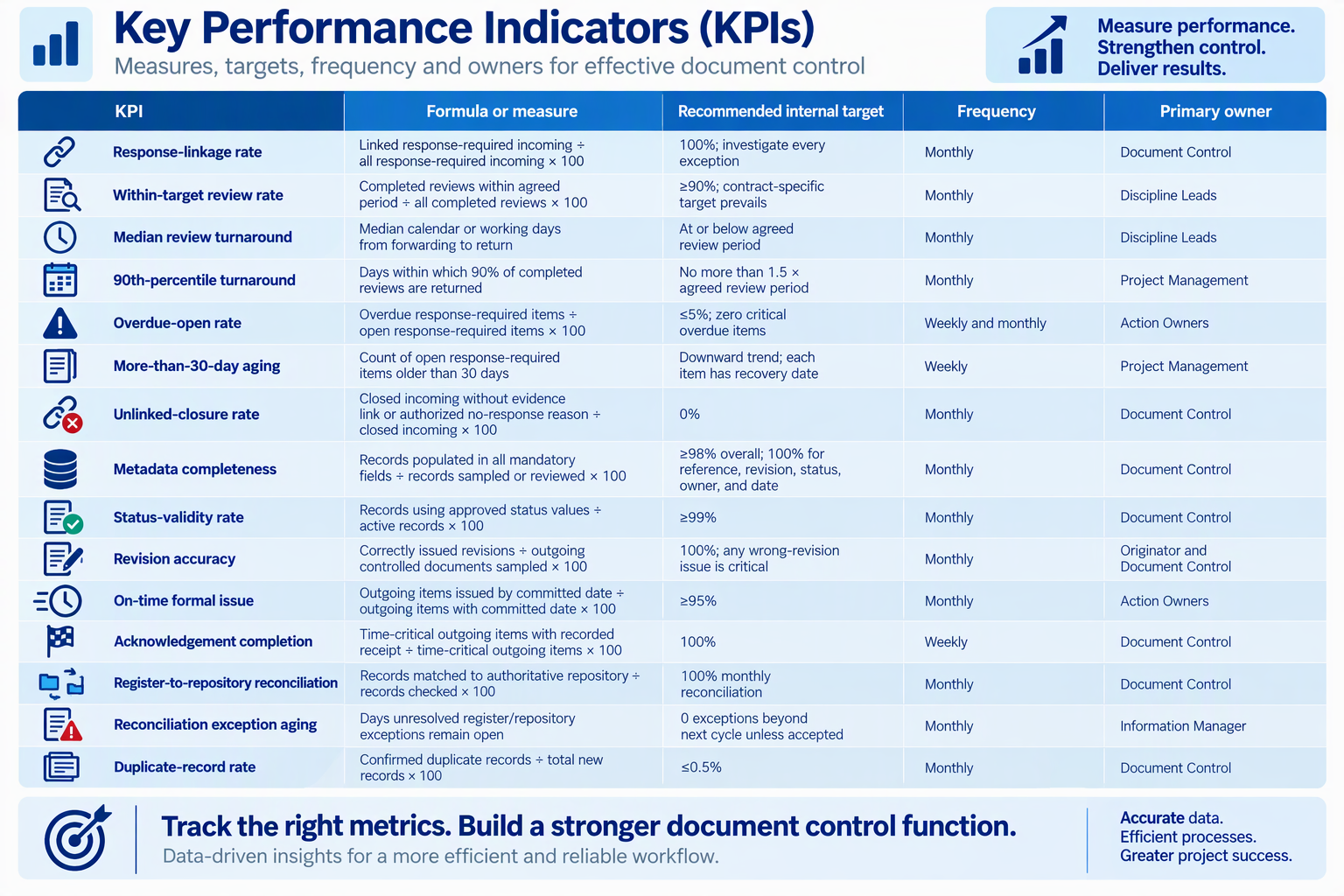
A KPI should be reported with its numerator, denominator, data cut-off date, excluded records, and agreed time basis. Calendar-day and working-day measures must not be combined in the same trend. Where the population is small, the absolute exception count should be reported beside the percentage to avoid misleading interpretation.
9.1 Example of KPI Interpretation
If 180 incoming records are classified as response required and 171 have either a linked outgoing disposition or an authorized no-response closure reason, the response-linkage rate is 171 ÷ 180 × 100 = 95.0%. Against a 100% target, the nine exceptions should be listed with an owner, reason, and correction date. The result should not be described as a 5% productivity deficit because the KPI measures traceability completeness rather than staff output.
9.2 Standards-Currentness Note
References were checked against publicly available source pages in November 2026. ISO 15489-1:2016 and ISO 23081-1:2017 remain current confirmed standards. ISO 19650-1:2018 and ISO 30301:2019 remain published but are under revision; ISO 30301 also has a 2024 climate-action amendment. Draft or proof editions were not treated as final normative requirements in this study (ISO, 2016, 2017, 2018, 2019, 2024).
10. Limitations
This registry-based study evaluates recorded workflow activity rather than the substantive technical quality of documents or decisions. It does not control for document complexity, reviewer availability, contractual entitlement, staffing levels, or differences in registration practice between incoming and outgoing workflows. Recorded CLOSED status was not independently tested against closure evidence. The findings therefore support process diagnosis and governance improvement, but they should not be used in isolation for contractual determinations, causal claims, staffing decisions, or assessments of individual performance. Future research should validate response linkage at item level, test data quality through sampling, and compare results across reporting periods or projects using harmonized definitions. The external references support the governance rationale and recommended controls; they do not independently validate the registry counts or establish that the proposed internal KPI thresholds are universal standards.
11. Conclusion
The updated analysis identifies 3,094 incoming and 1,680 outgoing registry records, producing a net recorded difference of 1,414 and an incoming-to-outgoing ratio of 1.84:1. This directional imbalance is operationally significant but does not, by itself, establish backlog or underperformance. Effective document control is demonstrated through complete classification, accountable ownership, timely review, revision accuracy, authorized disposition, defensible closure, and reliable linkage between response-required incoming items and their outcomes. Across engineering, contractual, quality, safety, commercial, regulatory, administrative, and operational documentation, integrated incoming and outgoing controls preserve chain of custody, auditability, compliance evidence, coordination, and organizational memory. The proposed KPI framework converts these principles into measurable governance controls while preserving the study’s central caution: transaction counts must be interpreted together with document purpose, linkage, timeliness, and data quality.
References
ARMA International. (n.d.). Information Governance Implementation Model (IGIM). https://arma.org/igim
International Organization for Standardization. (2016). ISO 15489-1:2016, Information and documentation: Records management, Part 1: Concepts and principles. https://www.iso.org/standard/62542.html
International Organization for Standardization. (2017). ISO 23081-1:2017, Information and documentation: Records management processes, Metadata for records, Part 1: Principles. https://www.iso.org/standard/73172.html
International Organization for Standardization. (2018). ISO 19650-1:2018, Organization and digitization of information about buildings and civil engineering works, including building information modelling (BIM): Information management using building information modelling, Part 1: Concepts and principles. https://www.iso.org/standard/68078.html
International Organization for Standardization. (2019). ISO 30301:2019, Information and documentation: Management systems for records, Requirements. https://www.iso.org/standard/74292.html
International Organization for Standardization. (2024). ISO 30301:2019/Amd 1:2024, Information and documentation: Management systems for records, Requirements, Amendment 1: Climate action changes. https://www.iso.org/standard/88415.html
National Academies of Sciences, Engineering, and Medicine. (2025). Digital model-based project development and delivery: A guide for quality management. The National Academies Press. https://doi.org/10.17226/29171
Procore Technologies. (2025, September 10). Control the chaos: Standardising construction project document workflows. https://www.procore.com/en-au/library/construction-document-control-workflows
Records and Information Management Practitioners Alliance. (2025, August 6). New standard launched for records and document management systems: AS 5393:2025. https://www.rimpa.com.au/resource/new-standard-launched-for-records-and-document.html
Zhang, Y., et al. (2025). Construction regulatory document digitalization with layout knowledge-informed object detection and semantic text recognition. Advanced Engineering Informatics. https://www.sciencedirect.com/science/article/pii/S1474034625001715
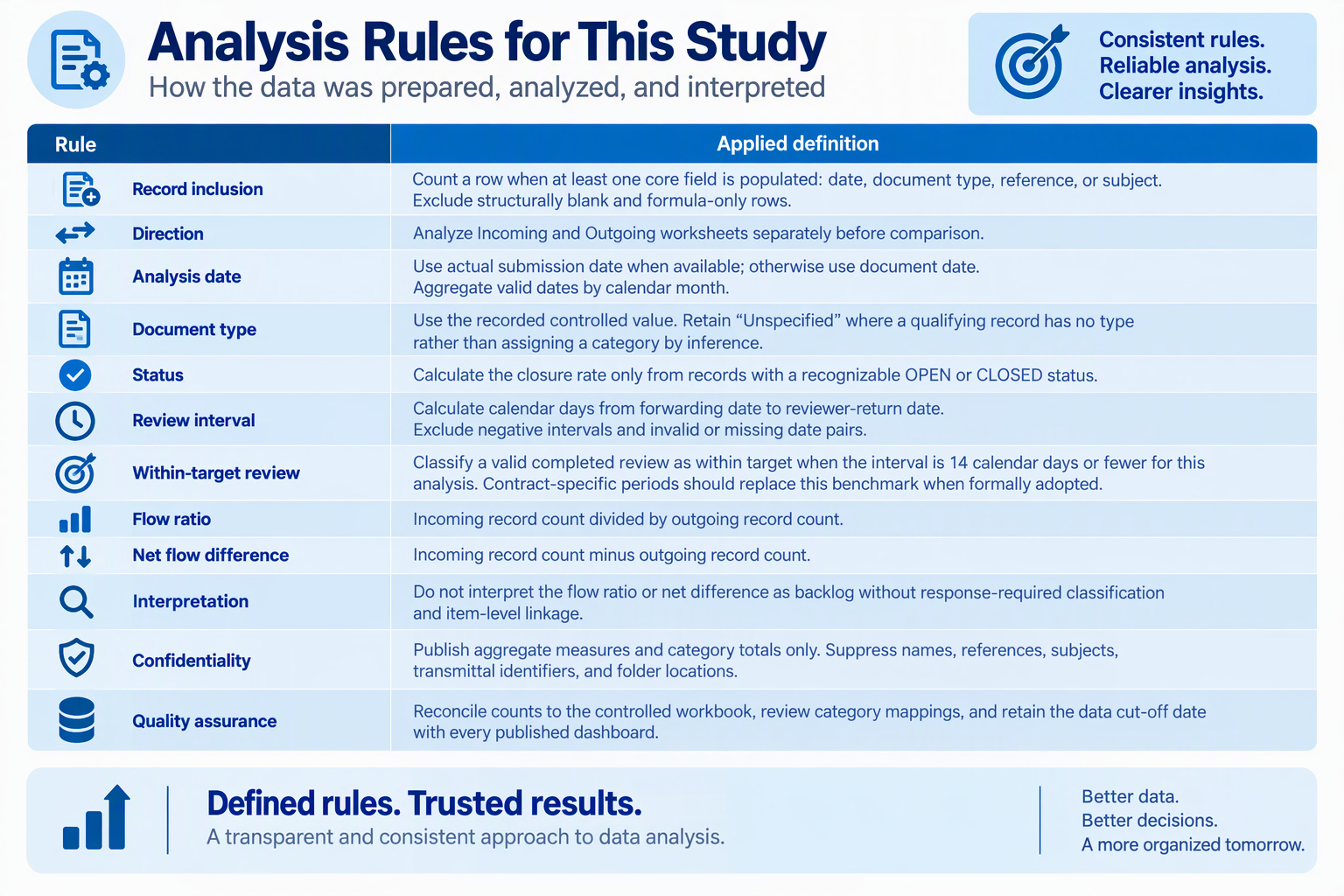
Appendix A. Reproducible Analytical Rules
This appendix documents the rules used to produce the aggregate analysis and figures. The rules are intended to support repeatability without disclosing item-level project information.
Appendix B. Figure Construction and Interpretation Guide
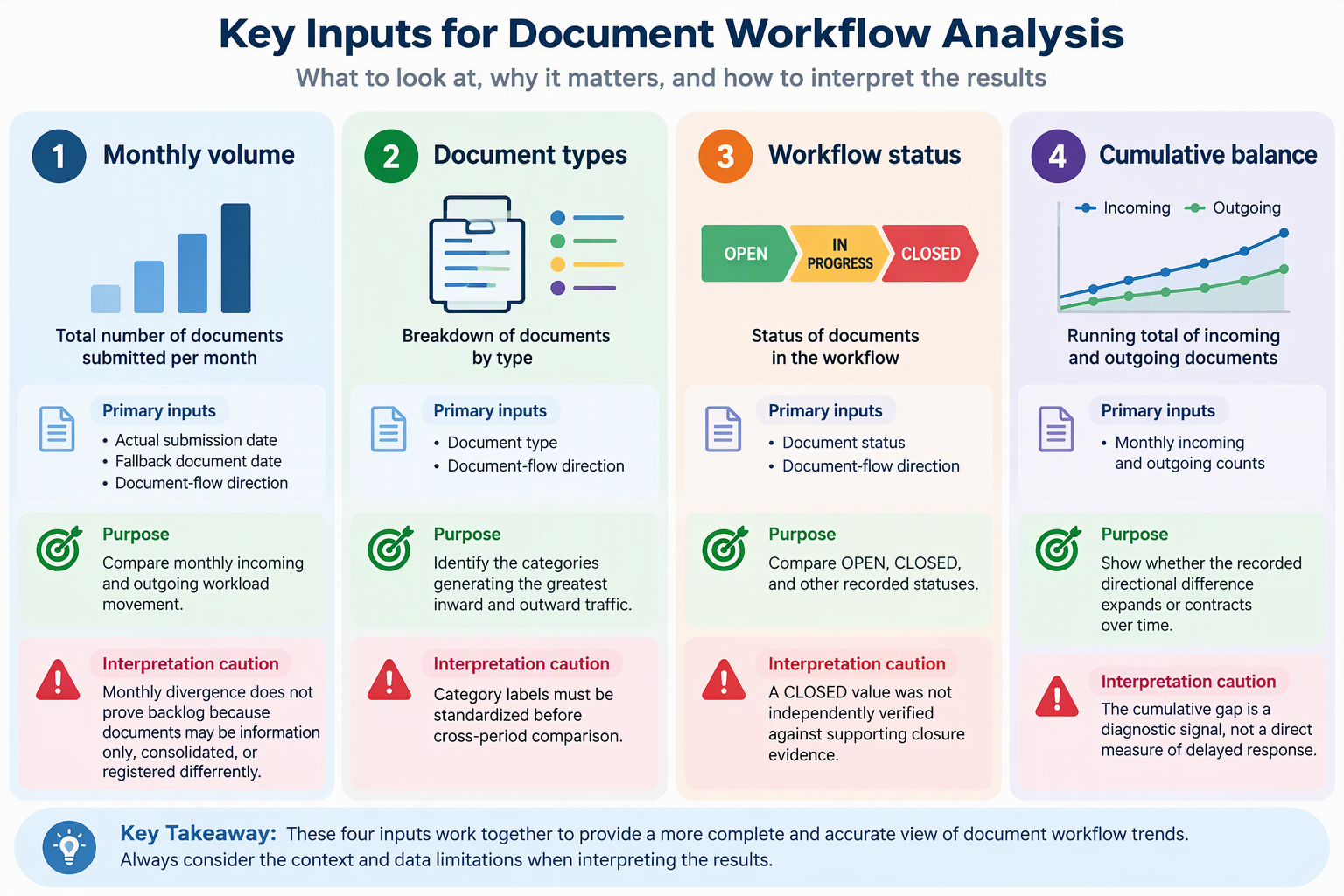
The four figures are embedded in Section 6. This appendix records their analytical purpose, input fields, and interpretation limits.
Appendix C. KPI Data Dictionary and Calculation Examples
The KPI framework in Section 9 should be implemented with controlled definitions. Suggested targets are internal governance benchmarks and should be aligned with contractual and organizational requirements.
Appendix D. Monthly Document-Control Review Checklist
☐ Reconcile Incoming and Outgoing registers to the authoritative repository or common data environment.
☐ Confirm that every response-required incoming item has an owner, due date, and disposition route.
☐ Review all overdue items and record a recovery owner and forecast closure date.
☐ Check closed incoming items for linked outgoing evidence or an authorized no-response reason.
☐ Validate document reference, revision, status, responsible party, date, and repository link.
☐ Investigate duplicate records, invalid date sequences, and nonstandard status values.
☐ Review monthly volume, median turnaround, 90th-percentile turnaround, and aging trends.
☐ Confirm acknowledgement evidence for time-critical outgoing communications.
☐ Record reconciliation exceptions and close them before the next reporting cycle unless formally accepted.
☐ Archive the approved dashboard with its data cut-off date, exclusions, and calculation basis.
About the Creator
Domingo Añasco-Gaces Samontina, Jr.
.Professional Member of the Mechatronics and Robotics Society of the Philippines
.Certified Documented Information Controller with TUV Rheinland Qualifications
.Master of Science in Engineering (on-going) with Professional Teacher Certificate
Enjoyed the story? Support the Creator.
Subscribe for free to receive all their stories in your feed.
Comments
There are no comments for this story
Be the first to respond and start the conversation.