
144 Million People Use This App. Its Readers Are Gone.
Fanqie Novel’s daily active users keep growing. Its authors are dying. That is not a bug. It is the business model.
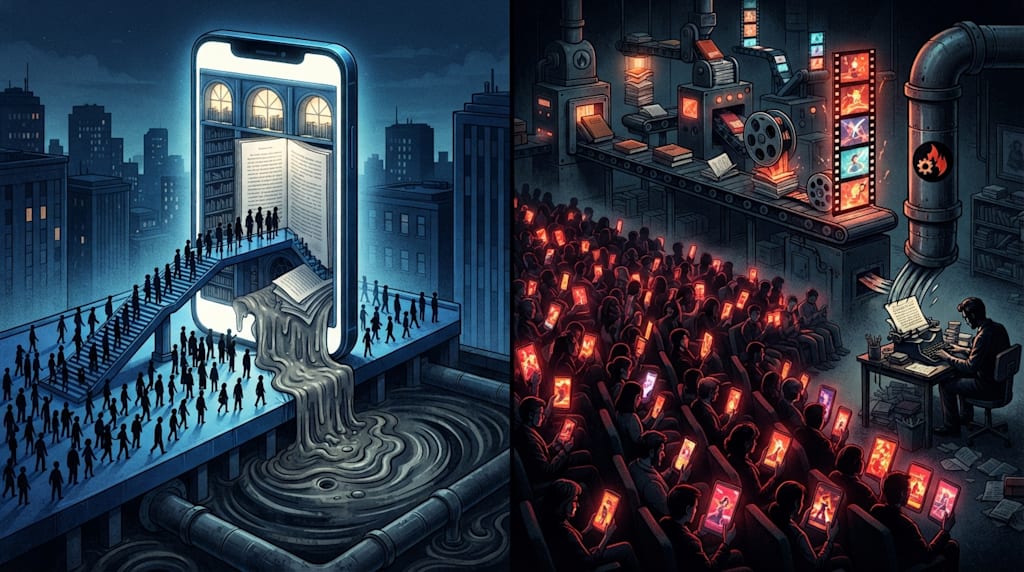
In July 2026, Fanqie Novel had 144 million daily active users, up 6% year over year. Its monthly active users held at 200 million.
If you look only at the headline numbers, the platform looks fine.
Open an author’s backend and the picture changes. The top book in the Chuanxuan category had 760,000 readers in September 2024. By December 2025, fewer than 100,000 readers could make the list. One author wrote in a group chat: “Yesterday the bookstore traffic was six or seven thousand. The next day it refreshed to double digits.”
The market is rising. Individuals are dying. Traffic has not disappeared. It is being redistributed. The direction points to an ambition much larger than running a reading platform.
Where did the traffic go
The reader’s sense that “no one reads Fanqie anymore” comes from three structures working at once.
First, head siphon. In May 2026, Fanqie launched the Shenqi Plan. It concentrated the site’s resources on one or two novels. The chosen books, Shi Ting Qi Shou and Mao Xing Langya, were pushed to more than a million readers in a week. The cost was that “most mid- and lower-tier authors saw traffic fall without exception.” Tian Can Tu Dou’s The Divine broke one million readers in three days. By August 20 it passed ten million. A top star takes a huge share of recommendation resources. Fanqie’s algorithm already tilts hard toward the top. Top single books take more than 60% of the site’s core recommendation traffic and splash-screen exposure.
Second, internal circulation. Fanqie’s traffic no longer depends entirely on public lists. More of it sits in personalized private recommendations, book lists, and private traffic from short videos. That traffic does not enter list data. So “users are still there, but the lists do not rise.” The lists no longer work as a public traffic barometer. Authors still feel the change: exposure is shrinking.
Third, ByteDance ecosystem diversion. Hongguo Short Drama and Hongguo Animated Drama offer stronger entertainment stimulation than text. Users still count in Fanqie’s DAU. Their reading time and page turns fall. Readers have not left ByteDance. They have gone from reading to watching.
The three structures stack. The platform’s total traffic has not fallen. The traffic allocated to writing novels is being compressed.
This was not an operational mistake. It was a strategic choice.
What the AI swill drowned
In 2026, Fanqie’s daily new-book intake rose above 5,000 titles. One platform claimed it could produce a five-million-word novel in 48 hours. A Zhihu discussion post cited data saying AI-generated content made up 74.5% of Fanqie’s catalog. Qidian’s comparable share was about 10%.
A reader opens a book. The first half looks decent. Then the plot falls apart. In the previous chapter, the hero sharpens a knife to fight the boss. In the next chapter, the boss disappears. No explanation. In 2026, 62% of new-book openings used the same three moves: broken engagement, rebirth, system. One reader wrote in the comments: “It is like pre-made food. No human flavor.”
The platform has acted. In February 2026 it handled 855 AI-violating accounts. In May it refused to sign more than 110,000 low-quality books. In June another 100,000. The loop is stranger than the numbers. There are too many works. Editors cannot read them all. The platform uses AI to check whether books were written by AI. Using AI to fight AI has no end.
What got drowned out were human authors who type every word. The traffic pool is fixed. AI books flood it. Human exposure and income fall. Readers vote with their feet faster than the platform can govern AI.
Data shows that articles with 70% AI content get one-third the readership of articles with 20% AI content. Readers can tell. They no longer want to spend time testing.
The two-hour war
In February 2026, Hongguo Short Drama’s monthly active users passed 300 million. Users averaged 125 minutes a day. Hongguo Animated Drama reached 24.04 million monthly active users. Average daily use passed 90 minutes, close to long-video platforms. In March 2026, Hongguo Animated Drama’s total audio-visual time hit 6.61 billion minutes. That was up 1,789% from November 2025, when it was renamed.
The competition is unequal.
Web fiction is pure text. It asks for active cognitive effort. Short dramas and animated dramas are audiovisual. They are passively received. They give instant dopamine. Users have limited entertainment time. Hongguo products offer stronger instant feedback at lower cognitive cost. Text reading’s disadvantage is structural.
The content source makes it worse. Hongguo Animated Drama draws heavily from Fanqie Novel itself. In 2025, China’s animated-drama market reached 18.98 billion yuan. AI cut the cost of traditional animation. ByteDance opened more than 60,000 Fanqie original IPs to partners for animated adaptation. All went the free route. The focus was high-emotion, fast-paced shuangwen.
A short story takes 35 minutes to read. The animated version runs 74 episodes. For a user chasing fast entertainment, watching is more cost-effective than reading.
Fanqie Novel’s content is being digested by its own sister products at higher efficiency.
IP factory
Ask a ByteDance executive what Fanqie Novel is. They will not say “a reading platform.” In ByteDance’s strategy, Fanqie is an upstream IP reservoir.
In March 2026, Douyin Group’s short-drama copyright center launched an animated-drama IP adaptation library. It opened more than 500,000 Fanqie original IPs to partners. In May, Fanqie began pushing AI animation toward theatrical release. It planned to open top-tier IP adaptation rights. 36Kr reported that ByteDance set an internal influence goal for Fanqie IP: “to make people inside and outside the industry feel that Fanqie’s output is premium and positive.”
ByteDance has built a full conversion chain. Fanqie Novel supplies the IP. The Seedance model lowers production cost. Douyin amplifies traffic. Hongguo Animated Drama carries the conversion. A story proves itself in text. Then it becomes a short drama, an AI animated drama, or a film. Hongguo carries continuous viewing. Douyin spreads it further.
In this framework, reader experience is not the key metric. The platform needs enough stories, fast updates, and strong emotional impact. It needs IP that can be adapted to video. Whether humans or AI wrote the stories matters less. If downstream conversion is efficient, the difference is small.
This explains Fanqie’s AI dilemma. It must govern low-quality AI content to protect reading. It cannot kill AI capacity. AI is a key variable in the IP factory’s efficiency.
In September 2026, Fanqie introduced a completed-work signing model and raised the signing threshold. The full-attendance bonus rose from 4,000 words a day to 5,000. From the third month, authors needed 200,000 words a month and 1,500 yuan in listen-read revenue. The new rules look like a quality push. They also raise the bar for authors who can produce steadily and adapt well, whether they are human or AI-assisted.
Two paths
To understand Fanqie’s trouble, compare it with China Literature.
In the first half of 2026, China Literature’s monthly paying users fell 10.9% year over year to 8.2 million. New writers fell from a 2021 peak to 240,000, a halving. But China Literature’s short-drama and AI animated-drama revenue was 430 million yuan, up 230% year over year. It was the only profitable listed web-fiction company.
China Literature chose few but fine. Qidian removed 27 AI web novels with average subscriptions above 10,000. The web-fiction world called it the Qidian 818 Incident. China Literature’s CEO said at an earnings conference that 2026 would bring no fewer than 200 short dramas. It would also crack down on AI writing. The logic is clear. Paying readers filter good IP with real money. Those IPs are China Literature’s core assets. Mass AI production cheapens content. It threatens the uniqueness and scarcity of those assets.
Fanqie chose another path. A free model that worships traffic needs a huge content supply to fill fragmented time. AI provides industrialized capacity. When supply far exceeds demand, traffic distribution becomes zero-sum. Give it to AI swill, and nothing is left for human work.
China Literature protects existing IP value. Fanqie bets on incremental conversion efficiency. Neither path is simply right or wrong. Fanqie’s cost is clear. Shallow readers have low loyalty. When a more efficient entertainment substitute appears, churn is almost certain.
The ignored costs
Several costs got ignored.
Fanqie has more than 700,000 signed authors. Only 1.56% earn more than 2,500 yuan a month. Under the new full-attendance rules, 500,000 words earn 2,700 yuan. The same month on Qidian is about 4,500 yuan. Authors type more and earn less. For mid- and lower-tier authors without copyright monetization, betting on copyright is the only path with imagination. Copyright adaptation opportunities belong to a very few top works.
Readers can form the belief that Fanqie’s books are all AI swill. Reversing that belief is expensive. Readers can tell AI content. They no longer want to spend time testing.
Fanqie is the largest free reading platform. Its content strategy has a demonstration effect. If traffic-is-king plus AI mass production works, other platforms will follow. The damage lands on the industry’s content quality and reader trust.
Reading itself
“Piracy creates big IP” was a product of an economic upswing, the blue-ocean period of web fiction, and a scarcity of entertainment. After 3G licenses in 2009, web fiction became the version’s child. It was cheap. It used little data. It filled fragmented time. Free reading and piracy helped expand the market. The model traded traffic for scale. Growth let everyone take a slice.
Now the economy is down. Non-essential entertainment spending is compressed. The blue ocean is gone. Reader thresholds are high. In the 4G and 5G era, mobile data exploded. Entertainment options exploded. Pure text reading is structurally disadvantaged against mobile games and short videos.
Fanqie’s problem is not that it did badly. It chose not to be a reading platform. It chose to be an IP factory. Readers are in Fanqie’s DAU. They are not in Fanqie’s pages. They become audiences for Hongguo Animated Drama. They are diverted into ByteDance’s visual entertainment ecosystem.
Fanqie Novel will not go bankrupt. It will grow. It will produce IP. It will supply ammunition for Hongguo Animated Drama and AI animation. But it is losing deep readers who spend hours inside a good story. It is losing writers who type out human flavor one word at a time. Those are exactly what a literary platform should least lose.
The 200 million MAU market is still there. The era of inclusive traffic is over. Free web fiction has entered a period of intense competition, strong Matthew effect, and quality-heavy stock competition. In this era, the biggest loser may not be a platform. It may be reading itself.
About the Creator
Jin
Writer of reamstories
https://reamstories.com/jin
Enjoyed the story? Support the Creator.
Subscribe for free to receive all their stories in your feed. You could also become a paid subscriber, letting them know you appreciate their work.
Comments
There are no comments for this story
Be the first to respond and start the conversation.