
The File Tesla Never Wanted You to Read: “Radar Saves Us”
Inside the six-year battle over whether cameras alone can drive us—and why the answer might cost Tesla more than a sensor.
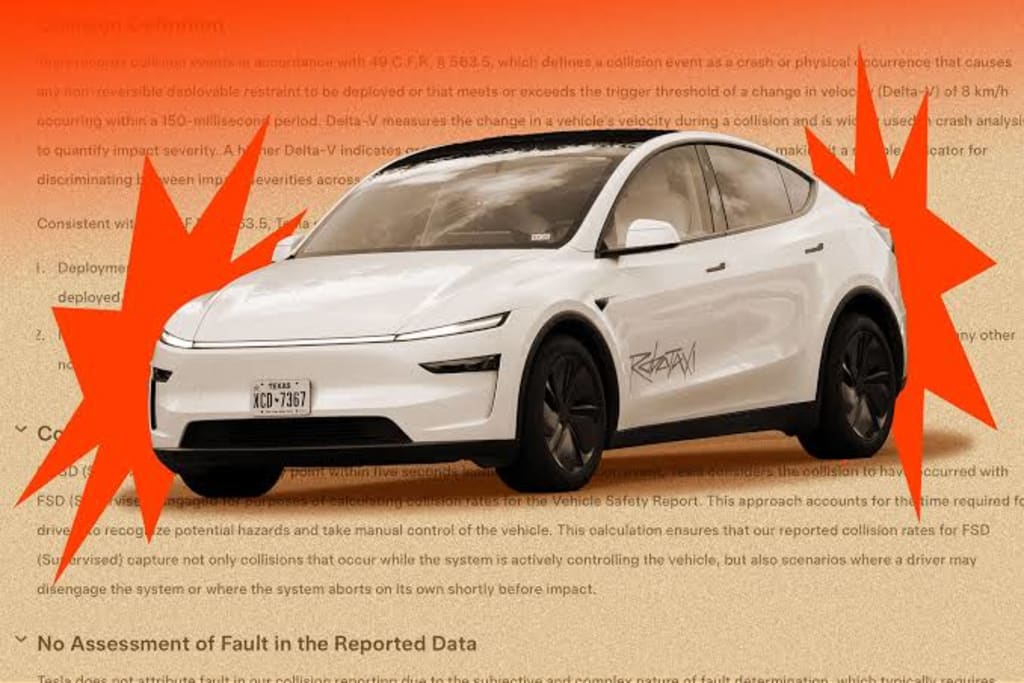
In July, a regulatory letter reached Tesla. While investigating FSD crashes in low-visibility conditions, NHTSA specifically demanded a document titled “Radar Saves Us.” Emails, meeting minutes, and internal discussions were to be handed over as well. Tesla had already submitted the document privately earlier. The regulator now wants it because it may reflect Tesla’s own understanding of the shortcomings of a vision-only system: fog, glare, dust, the things cameras fear most.
The document is titled “Radar Saves Us.” A company that removed radar has an internal file with that title. That alone is worth a paragraph.
1. In 2016, Tesla did have radar
Starting in 2016, Tesla vehicles came standard with eight cameras, one forward millimeter-wave radar, and twelve ultrasonic sensors. The radar was supplied by Bosch. It measured distance and speed accurately and was largely unaffected by rain or fog. Tesla’s website once specifically promoted it: it could penetrate fog, dust, rain, and snow, and could even “see” the car ahead of the car ahead by looking under the vehicle in front.
Its old problem was low resolution. It could not tell how tall something was or what it looked like.
In September 2016, Tesla wrote a blog post titled “Upgrading Autopilot: Seeing the World in Radar.” It put things bluntly: in radar’s eyes, the world looks strange. Concave metal objects amplify echoes to several times their actual size. When a car drives toward an overhead gantry sign at the top of a slope, or when the road dips under a bridge, radar sees what looks like an imminent collision.
That forces the system to choose between two options for stationary objects. Trust radar completely, and the car will brake abruptly under bridges and in front of road signs. That is the phantom braking owners complained about for years. Trust it less, and you have to filter out large numbers of stationary targets as background. The cost is that a car stopped in the lane, or a truck across the road, may also be filtered out.
That blog post was published in September 2016, a few months after a fatal Autopilot crash. Tesla’s solution was to have the fleet quietly record the locations of road signs, bridges, and other stationary objects, building a whitelist. Once the data proved false braking was rare enough, radar would be allowed to lightly brake when cameras did not see an obstacle.
Put plainly, this fusion approach was patching things together with handwritten rules. The whitelist grew longer, the rules grew more detailed, and behind every rule was a false braking event or a missed detection. The engineering team was wrestling with radar’s physical characteristics, not with the algorithm.
2. In 2021, the radar was removed
In April 2021, Musk tweeted something that has been quoted countless times: when radar and vision disagree, which do you trust? His answer was that vision is much more accurate, so he would rather double down on vision than pursue sensor fusion.
Starting in May 2021, North American Model 3 and Model Y deliveries dropped millimeter-wave radar. In October 2022, ultrasonic sensors began to be removed as well.
The tweet was blunt. But the tweet did not mention that the Bosch radar of that era had low resolution and that fusion rules were too hard to write, dragging down engineering resources. A more accurate description is this: the radar Tesla had was too weak, fusion was too difficult, and it simply bet all its engineering resources on vision.
This is not a case of radar being useless. It is a case of this radar plus this fusion approach not being worth it. Musk later tweeted that only very high-resolution radar makes sense. The HW4 versions of Model S and Model X did get a high-resolution radar codenamed Phoenix. But early teardown reports and owner reports both indicated that FSD was not calling on it, and Tesla never officially announced that it had been enabled. The HW4 Model Y did not get one at all.
Putting it back and actually using it are two different things.
3. Removing radar did not make phantom braking disappear
In February 2022, NHTSA opened an investigation into phantom braking in about 416,000 Model 3 and Model Y vehicles from the 2021 and 2022 model years, based on 354 complaints. By June of that year, related complaints had risen to more than 750. These vehicles covered exactly the models that had just switched to vision-only. At the time, some media pointed out that the surge in complaints almost coincided with the removal of radar.
What does this data show? It shows that removing radar did not automatically solve phantom braking. But it cannot simply prove that removing radar caused phantom braking. Complaints are affected by fleet size, owner expectations, software versions, and willingness to report. Correlation is not causation.
A more reasonable interpretation is this: phantom braking is not a single-variable problem of “with radar” or “without radar.” It is a problem across the entire chain of perception, fusion, and decision-making. The radar and handwritten fusion rules of that era were not good enough. When the system switched to vision-only, the problem persisted in a different form.
Vision-only does not mean “no fusion problem.” It simply changes the fusion problem from “cameras and radar fighting” to “how the neural network reliably infers depth and obstacles from images.” The latter can work very well in common road conditions. But in glare, dust, dense fog, or when a camera is covered in mud, the shortcomings are very concrete.
4. The price argument against LiDAR no longer holds
At Tesla’s Autonomy Day in 2019, Musk said: LiDAR is a fool’s errand, and anyone relying on it is doomed. He also called it an “expensive appendix.” The main reasons at the time were cost, and the fact that humans drive with only two eyes.
The cost argument is hard to sustain today. Hesai shipped 477,000 units in the first quarter of this year, with an average unit price of about 1,441 yuan, down 45% year over year. According to Haitun Research, its main product ATX has an average price of about $150 this year, and the dedicated versions supplied to BYD and Geely cost only about 800 yuan. LiDAR has already reached cars priced between 80,000 and 100,000 yuan. A LiDAR unit costing just over 1,000 yuan on a 200,000-yuan car accounts for about 0.5% of the vehicle price.
So when asking why Tesla does not install LiDAR today, price is only the surface reason. The harder constraints are data and the existing fleet.
Starting with FSD V12, Tesla switched to an end-to-end architecture. Camera images go directly into a neural network, and out come steering, throttle, and brake commands. Ashok Elluswamy, Tesla’s head of Autopilot software, described it at this year’s second-quarter earnings call as “photons in, controls out.” This architecture is data-hungry, and the training data has to match the sensor configuration on the cars.
As of the second quarter of this year, Tesla had delivered about 9.7 million vehicles, and FSD Supervised had accumulated nearly 12 billion miles of driving. Almost all of that data comes from cameras only. If new cars added LiDAR, the model would have to accumulate data all over again for a new configuration, and the data value of the existing fleet would shrink as well.
Changing sensors is not changing a part. It is changing the track for the data flywheel.
The existing fleet also involves a promise. Since 2016, Tesla has said that these cars’ hardware is sufficient for full autonomy and that a software upgrade is all that is needed. Even HW3 cars from 2019 onward received a simplified version of FSD V14-Lite this year. Once the company officially admits that LiDAR or radar is necessary for driverless operation, the promise held by a large number of owners who already bought FSD cannot be fulfilled.
I suspect Tesla will be very reluctant to open that door.
For Robotaxi, the cost gap widens further. Waymo’s sixth-generation system uses 13 cameras, 4 LiDARs, 6 millimeter-wave radars, and a set of external audio receivers. According to Electrek’s estimate, the system costs less than $20,000 per vehicle, not including the car itself. Musk’s target price for the dedicated driverless vehicle Cybercab is under $30,000. That means Waymo’s sensor and compute suite alone is almost equal to Tesla’s target price for the entire vehicle.
Some Chinese automakers think the same way. XPeng first put LiDAR into mass production on the P5 in 2021, then began removing it from the P7+ and MONA M03 in 2024. In 2025, the G7, the new P7, the new G6, and the G9 all shifted to a camera-centric “AI Hawkeye” solution. XPeng’s senior director of autonomous driving products, Yuan Tingting, gave an explanation almost identical to Tesla’s: their large model is trained mainly on 10-to-30-second clips cut from owners’ driving footage, and LiDAR data is hard for that system to absorb. In May this year, after the launch of the XPeng GX, He Xiaopeng said directly that production cars no longer need LiDAR.
Vision-only is not a quirk unique to Tesla. When a company makes an end-to-end model and a data flywheel its core strategy, sensor configuration is not just a question of safety redundancy. It is also a question of the shape of the training data. No matter how cheap LiDAR gets, if the model cannot digest it, installing it may only add cost and maintenance complexity.
5. On the technical upper bound, vision plus radar would be better
The real question is whether it would be better. Looking purely at technology, the answer leans yes.
The reason is simple: with an additional sensor based on a different physical principle, the worst case is that you throw its readings away. Information can only increase, not decrease. Millimeter-wave radar can still measure distance and speed in fog and rain. LiDAR measures distance directly, without needing a neural network to infer depth from images the way cameras do. The so-called “sensors fighting” problem is really an engineering problem of deciding which one to trust. That is a software capability issue, not a law of physics.
On August 25, 2025, Musk tweeted that LiDAR and radar would actually reduce safety because the sensors would compete with each other. He was responding to Uber CEO Dara Khosrowshahi, who said solid-state LiDAR costs only $500, so why not install it in pursuit of superhuman safety. Electrek immediately dug up Musk’s 2021 private message, and the two statements indeed do not match. In the same round of remarks, he also said Waymo cannot handle highways, but Waymo is already running driverless on highways.
The argument that humans drive with only their eyes also has a hole. Humans do rely only on their eyes, but humans squint, lean forward, and actively slow down when they cannot see clearly. A camera hit by direct sunlight or covered in mud has no such abilities. Tesla’s vision degradation detection is one focus of this investigation.
Conversely, LiDAR has its own problems. In heavy rain and snow, point clouds get dirty. Waymo vehicles have also been recalled and have had accidents. Multiple sensors do not mean no mistakes.
A more accurate statement is this: vision plus radar raises the safety upper bound and redundancy, but it does not automatically make engineering easier. For L2 supervised driving, the person behind the steering wheel is the redundancy. When cameras cannot see clearly, a human can back up the system, and vision-only shortcomings are covered. For driverless operation with no one in the car, redundancy can only come from the vehicle itself. The gap in glare, dust, and dense fog will be amplified. The low-visibility problem NHTSA is now watching is exactly the problem where no one will be there to back up the car.
6. What regulators are watching is exactly what vision-only fears most
In October 2024, NHTSA opened a preliminary investigation into FSD crashes in low-visibility conditions, covering about 2.4 million vehicles. One trigger was a Model Y crash in Arizona that killed a pedestrian. On March 19, 2026, the investigation was upgraded to an engineering analysis, expanding to about 3.2 million vehicles and including nine crashes, one of which was fatal and two of which involved injuries.
NHTSA’s concern is specific: when common conditions such as glare and dust make cameras unable to see clearly, the system fails to detect the problem in time and fails to warn the driver in advance, often alerting only at the last moment before impact. Tesla’s later software update, according to NHTSA’s assessment, may have prevented only three of the nine crashes. The “Radar Saves Us” document mentioned at the beginning is exactly what this investigation demanded.
There is also a widely circulated experiment worth comparing, though its premises need to be clear. In March 2025, YouTube creator Mark Rober compared a Model Y with a Lexus equipped with Luminar LiDAR. In dense fog, behind a large water curtain, and against a foam wall painted to look like a road, the Model Y hit all of them, while the LiDAR car passed all of them. The problem is that he was using older Autopilot, not FSD.
Later, another creator retested the fake wall. He first tried a Model Y; the car recognized the wall only when very close, and he judged that this car would have crashed straight through it. Then he switched to a Cybertruck running FSD 13.2.8, and the car stopped. He did not reproduce the dense fog and water curtain tests.
This experiment can show that cameras have shortcomings under extreme occlusion. But it is not enough to draw a conclusion about FSD directly. In reality, who would put a wall painted like a road on the street? Dense fog and heavy rain are what ordinary people actually encounter. What is truly worth watching is the failure modes identified by regulators in real accidents, not the dramatic moments in a single video.
7. Tesla has also achieved real results, but the data must be read carefully
By the second quarter of 2026, Tesla’s unsupervised Robotaxi service was operating in seven major U.S. metropolitan areas, with about 2.5 million paid Robotaxi miles. FSD had 1.48 million active subscriptions, and more than 55% of new North American vehicles subscribed to FSD at the time of purchase.
Safety data is the most fiercely debated area. According to Electrek’s tally of NHTSA accident reports, Austin’s Robotaxi service reported 14 crashes from its launch in June 2025 to January 2026. Based on about 800,000 miles, that is one crash every 57,000 miles on average. In Tesla’s own vehicle safety report, the average U.S. driver has a minor accident about once every 229,000 miles. By that comparison, the rate is roughly four times higher.
But many of these crashes were low-speed scrapes, reversing into a tree, and one case in which a parked car was hit by a bus. Tesla also redacted large amounts of the crash descriptions in the reports, making it hard for outsiders to judge responsibility. Tesla’s statement at its second-quarter earnings call was that during 380,000 miles of unsupervised operation, there had been no accident worth mentioning.
Small samples, inconsistent definitions. For now, no one can use this data to pronounce a death sentence on vision-only, and no one can use it to prove that vision-only is already sufficient.
This is also the part of the debate that requires the most restraint: proponents of vision-only cannot use “nothing major happened” to prove it is already enough, and opponents cannot use a few crashes to prove it definitely does not work. What is truly informative is the failure modes, responsibility determinations, and hardware remediation requirements in the regulatory engineering analysis.
8. The industry is forking, but both sides are moving toward the middle
China’s overall environment is the opposite of Tesla’s. In March 2026, Hesai’s share of China’s passenger-car main LiDAR market reached 55%, and the top ten automakers by sales in China are all its customers. With LiDAR this cheap, most Chinese automakers see no reason not to install it. XPeng has instead become a minority.
Tesla’s FSD Supervised officially announced support for China in May this year, but it did not announce a domestic rollout date at the time. The CFO’s target at the April earnings call was to obtain more comprehensive approval in the third quarter. Whenever it does roll out on a large scale in China, vision-only and LiDAR can be compared directly on the same roads.
But both sides are actually moving toward the middle. Waymo’s sixth generation cut cameras from 29 to 13, and co-CEO Tekedra Mawakana has not ruled out further sensor simplification this year. Tesla at least tried putting radar back on the HW4 Model S and Model X.
The next thing to watch is the conclusion of NHTSA’s engineering analysis. If it ultimately requires hardware-level remediation, OTA cannot solve it. At that point, whether Tesla gives ground will matter far more than what Musk says on Twitter.
Closing
For Tesla as a company, vision-only is a very rational choice. Nearly ten million vehicles already on the road, an end-to-end data flywheel, promises to existing owners, and the per-vehicle cost of Robotaxi all bind it to cameras. The cost of changing course is far greater than the price of a LiDAR unit.
But “would it be better” asks about the technical upper bound. Looking purely at technology, the answer leans yes. In L2 supervised driving, the person behind the steering wheel is the redundancy, and vision-only shortcomings are covered. In driverless operation with no one in the car, redundancy can only come from the vehicle itself. The gap in glare, dust, and dense fog will be amplified.
So the safest conclusion is not “vision-only definitely works” or “LiDAR definitely wins.” It is this: vision plus radar or LiDAR is better in terms of the safety upper bound; Tesla’s current insistence on vision-only is a rational choice under its corporate path, not the technical optimum.
Nor is it a universal answer for the industry. In China, LiDAR is cheap enough that most automakers see no reason not to install it. Tesla is bound by its data flywheel and existing-owner promises. XPeng is bound by the shape of its end-to-end training data.
Two things are worth watching in the end: whether NHTSA’s engineering analysis requires hardware remediation, and how vision-only and LiDAR compare directly on the same roads after FSD rolls out on a large scale in China. At that point, the debate will shift from “who do you trust” to “show the data.”
And data is closer to the answer than anything said on Twitter.
About the Creator
Jin
Writer of reamstories
https://reamstories.com/jin
Enjoyed the story? Support the Creator.
Subscribe for free to receive all their stories in your feed. You could also become a paid subscriber, letting them know you appreciate their work.
Comments
There are no comments for this story
Be the first to respond and start the conversation.