
The EV Savings Myth: Why Your Gas Car Might Actually Be Cheaper
I ran the numbers for 8 years and 80,000 km — here’s where the math flips.
A calculation repeated many times, but rarely done right
The other day I had dinner with a friend who told me he wanted to switch cars. His budget was about 150,000 RMB, and he was torn between a Camry and a BYD.
“Everyone says EVs save money,” he said, “but when I ran the numbers, it didn’t seem like much of a difference.”
He pulled out his phone and showed me his Excel sheet. Fuel, electricity, insurance, maintenance – all lined up neatly. His conclusion: at 10,000 km per year, over eight years, the EV would save him only about 20,000 RMB.
I asked, “Did you factor in depreciation?”
He paused. “No.”
“Then go back, add depreciation, and recalculate.”
Three days later, he messaged me: “I recalculated. After including depreciation, the gas car actually comes out cheaper.”
There was a hint of “I’ve been misled” in his tone.
But the EV didn’t deceive him. The missing row in his spreadsheet did.
First bill: fuel and electricity. The EV wins, hands down.
Using the original assumptions: 10,000 km per year, 80,000 km over eight years. Gas at 7 RMB/L, electricity at 0.7 RMB/kWh.
Gas car: 7 L/100km → 39,200 RMB over eight years.
EV: 13 kWh/100km → 7,280 RMB over eight years.
That’s a gap of 32,000 RMB. On this line item, the EV wins without any suspense.
But note: that gap exists only if you actually pay 0.7 RMB per kWh. If you have a home charger, you can get that rate. But if you live in an older complex without a fixed parking spot and have to rely on public fast chargers – which often cost 1.5 RMB/kWh or more – then the eight‑year electricity bill jumps to about 15,600 RMB, and the advantage shrinks to about 23,000 RMB.
The EV’s energy advantage is clear on paper, but whether you can capture it depends on your charging setup.
Second bill: insurance. The EV gives back half of its edge.
Gas car insurance: 3,500 RMB/year → 28,000 over eight years.
EV insurance: 5,000 RMB/year → 40,000 over eight years.
The EV costs 12,000 RMB more over the period. Why? Because the battery pack sits under the floor – even a minor bottom impact can cost a fortune to repair. Insurers know this, so they charge higher premiums.
And the gap is widening. As more EVs hit the road, insurers are getting more cautious about battery degradation and repair costs. Some models are even rejected for renewal, forcing owners to turn to smaller, more expensive insurers with worse coverage.
Gas cars? Their insurance system has been stable for two decades – predictable and settled.
The 32,000 RMB saved on energy gets eaten into by 12,000 RMB in extra insurance, leaving only 20,000 RMB.
Third bill: maintenance. The difference is negligible.
Gas car: 400 RMB/year → 3,200 over eight years.
EV: 300 RMB/year → 2,400 over eight years.
A difference of only 800 RMB. Why so small? Because although an EV has no engine and doesn’t need oil changes, it still has gear oil, brake fluid, coolant, and cabin air filters. Dealerships routinely require “three‑electric‑system inspections” every 20,000 km, and the labour charges aren’t cheap.
Over eight years, the EV saves only 800 RMB in maintenance – barely enough to buy a nice dinner for the friend who helped with the spreadsheet.
Summing the three bills: energy saves 32,000, insurance costs an extra 12,000, maintenance saves 800 – the EV is ahead by 20,800 RMB in running costs.
If you stop here, the EV wins.
Fourth bill: depreciation. This is where the real difference lies.
That 20,800 RMB advantage looks thin when depreciation enters the picture.
A 150,000 RMB Camry, after eight years – what can you sell it for?
I checked used‑car platforms. A 2018 Camry 2.0E with around 80,000 km is listed at 70,000‑80,000 RMB. Call it 75,000.
What about a 150,000 RMB EV? Take the 2018 BYD Qin EV450 – after subsidies, it cost about 150,000 RMB new. Today, a similar‑age, similar‑mileage car is listed at around 30,000 RMB. And that’s the asking price – in a real sale, you’d probably get even less.
The gap is 45,000 RMB. When you sell the gas car, you get back 45,000 more than you would for the EV.
The 20,800 saved in running costs – does it fill that hole? No. You’re still short by about 24,000 RMB.
Flip the total cost calculation, and the picture reverses.
Now include the purchase price and see who actually spends more over eight years.
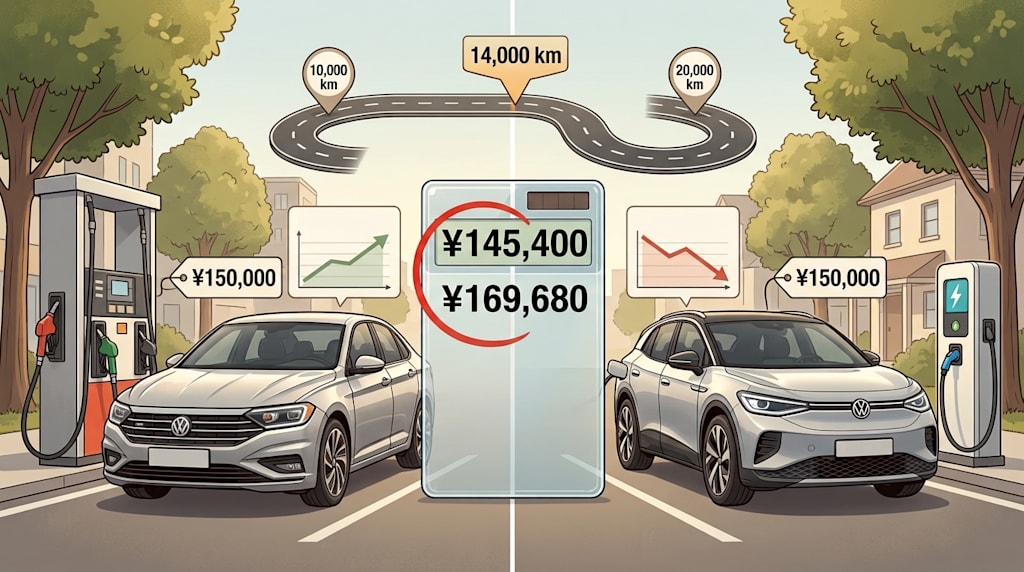
Gas car: buy for 150,000, running costs 70,400, sell for 75,000 → total cash out = 150,000 + 70,400 – 75,000 = 145,400 RMB.
EV: buy for 150,000, running costs 49,680, sell for 30,000 → total cash out = 150,000 + 49,680 – 30,000 = 169,680 RMB.
The EV costs about 24,000 RMB more over eight years.
That’s even bigger than what my friend calculated. He thought “not much difference” – we found the EV is actually more expensive by over 20,000.
The only difference? That one missing row – depreciation.
So when does an EV actually save you money? The answer lies in annual mileage.
Among running costs, only energy consumption varies with distance. Insurance and maintenance are roughly fixed regardless of how much you drive. Depreciation, too, is largely independent of mileage – selling a car with 50,000 km versus 80,000 km doesn’t change the resale price by a huge amount.
So the secret to EV savings is simple: the more you drive, the more fuel costs you save, and the easier it is to offset the depreciation hit.
Let’s find the break‑even point.
Assume you drive X ten‑thousand kilometres per year (i.e., 10,000X km). Over eight years, that’s 80,000X km.
Energy cost per 10,000 km for the gas car = (10000/100)×7×7 = 4,900 RMB.
For the EV = (10000/100)×13×0.7 = 910 RMB.
Annual saving = (4,900 – 910)X = 3,990X RMB.
Over eight years = 3,990X × 8 = 31,920X RMB.
To offset the 45,000 RMB depreciation gap: 31,920X > 45,000 → X > 1.41.
So: if you drive more than about 14,000 km per year, the EV starts to become cheaper overall.
What if you drive 20,000 km per year? Over eight years, you save 63,000 RMB on energy. Subtract the 45,000 depreciation gap, and you still have 18,000 left – plus the insurance/maintenance differences, the EV nets you about 20,000 in savings.
That’s where the EV really shines.
One more variable that makes the future harder to predict.
The depreciation numbers we used are based on “today’s eight‑year‑old” cars. But what about the next eight years?
Gas‑car depreciation may not hold up. The ongoing price war on new fuel vehicles is driving down sticker prices – and when new cars get cheaper, used prices follow. Will today’s Camry still be worth 75,000 eight years from now? Not certain.
On the EV side, technology is advancing at breakneck speed. Solid‑state batteries are on the horizon. If, eight years from now, a 1,000‑km‑range EV costs only 100,000 RMB, then today’s 600‑km BYD might be worth less than 20,000 RMB, let alone 30,000.
The depreciation gap could widen or shrink – but the direction is hard to call.
After all the math, three non‑financial factors matter more.
Numbers are one thing, but choosing a car isn’t only about the spreadsheet.
First, do you have a fixed parking spot with a home charger? If not, the EV’s convenience drops by half, and its cost advantage drops by half again. Living with nightly trips to public charging stations – you’ll regret it within a month.
Second, can you handle the psychological hit of rapid tech obsolescence? EVs are like smartphones – the latest when you buy them, outdated in three years, practically ancient in eight. Can you accept that a 150,000 RMB purchase ends up worth only 20‑30,000? If yes, go ahead. If not, think twice.
Third, how many kilometres do you actually drive per year? If it’s just a 20‑km daily commute with occasional weekend trips, you’re probably around 10‑12,000 km. At that usage, the answer about which is cheaper is already clear.
In the end
EVs save fuel, but they don’t necessarily save money. That phrase has been said to death, but only those who’ve actually crunched the numbers know it’s true.
People who choose EVs either drive more than 20,000 km per year – enough to make the fuel savings overwhelm every other cost – or they simply don’t care about a few tens of thousands in depreciation, valuing instead the quietness, smoothness, acceleration, and smart features.
But if you’re an average family, driving 10,000 km a year, without a home charger, and planning to keep the car for eight full years – then the gas car remains the answer that requires no spreadsheet at all.
About the Creator
Jin
Writer of reamstories
https://reamstories.com/jin
Enjoyed the story? Support the Creator.
Subscribe for free to receive all their stories in your feed. You could also become a paid subscriber, letting them know you appreciate their work.
Comments
There are no comments for this story
Be the first to respond and start the conversation.