
I Drove a Family EV for 3,800 km. Here’s What Mattered More Than the Spec Sheet.
A flat rear floor, a drained frunk, a child asleep through speed bumps, and two trade-offs to calculate before you sign.
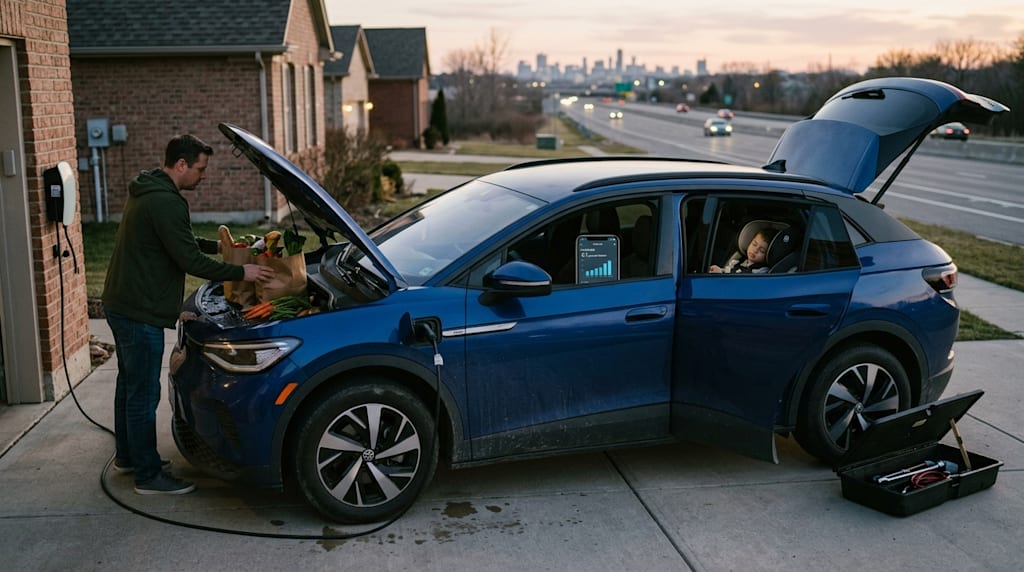
What a family EV solves, day after day
“Let’s wait a bit longer.”
That was what the owner “Enjiesuo” said most often before replacing his car. He used to drive a 2.0L gas car. Fuel cost nearly 2,000 yuan a month. He drove for work, visited clients. The car was a tool, not something to enjoy. After switching to the Shangjie H5, he wrote in an owner review: he installed a home charger. After 10 p.m., electricity costs a bit over 0.3 yuan per kWh. That works out to less than 0.1 yuan per kilometer. The H5 is rated at 655 km CLTC. He usually charges to 90%. City roads plus expressways, mixed. A steady 540 km.
The monthly bill tells the story better than the spec sheet. A tenth of a yuan per kilometer is unremarkable on any configuration sheet. In a monthly bill, it matters more than a 0–100 km/h time.
1. After you sit in, the first things you notice are the things nobody talks about
Many family-car marketing pitches start with seat adjustments, screen size, ambient lighting colors. But the person who drives the car every day often notices other things first.
The Shangjie H5’s front seat cushion is 505 mm long. The rear seat cushion area is 1,415 cm². Rear legroom is over 1 meter. On a spec sheet, these numbers do not say much. But one owner wrote about something specific: he used to drive a sedan. His wife often complained in the rear that her legs were cramped. After switching to the H5, they took his parents out for dinner on a weekend. In the back, they said it was spacious.
Another detail that is easy to miss: the rear floor is flat. A child can move across the rear seats. An older person can get in and out without stepping over a hump.
Sound insulation is another experience that does not come through in a feature name. The Shangjie H5 uses double-layer laminated glass for the front windshield and front doors. One owner who had driven 3,800 km wrote that most of the time the car is quiet. The double glass on the front windshield and front doors keeps outside noise low. Above 100 km/h, some wind noise comes in. Another owner said that above 110 km/h, wind noise around the A-pillars becomes a bit noticeable, and he turns the music up.
Put those two comments together. They are more useful than a single line saying “excellent NVH.” City commuting and highway cruising are two different noise environments. “Some wind noise after 100” and “quiet most of the time” do not contradict each other. They describe the same car at different speeds.
2. The logic of space: where things go
A family car has a practical problem: space is not for proving anything. It is for dividing things up. Groceries, a stroller, camping gear, luggage for a trip back home. If the car has no clear storage logic, even a big trunk will fill up one day.
The Shangjie H5 EV gives you a 124L frunk, a 601L trunk, and an 80L hidden compartment. The frunk has independent drainage and opens with a double tap. One owner described how this works day to day: a 200 km drive back home, one large suitcase, the kid’s bicycle, and several bags. The trunk swallowed it all easily. The hidden compartment under the trunk holds common tools. The frunk is for groceries. Double tap, drop them in. He could not be bothered to open the rear trunk.
“Could not be bothered to open the rear trunk.” That casual complaint is closer to daily life than any volume figure. When someone chooses the frunk over the trunk for groceries, the storage logic is being used.
Another owner often carries large cardboard boxes for work. He said the H5’s trunk height is “like a gas car,” unlike fastback SUVs where rear space gets squeezed badly when the seats are folded. Trunk height is not something you notice in a showroom. You feel it every time you move something.
3. The chassis does not need to create excitement. Not being uncomfortable is the standard.
A family SUV chassis faces a trade-off. Soft suspension: the body rolls over speed bumps, rear passengers get carsick. Hard suspension: road feel is too clear, long drives are tiring.
The Shangjie H5 takes a middle path. SAIC’s chassis development experience plus the HUAWEI XMotion Control digital chassis engine suppresses acceleration squat and brake dive. One media reviewer who tested the EV Max version described a Belgian block section: you can feel road vibration, but rear passengers are not tossed around. Another owner put it more directly: “Speed bumps or manhole covers, inside the car you do not feel much shaking or tossing.”
One owner review makes the point. He had been drinking, so he called a designated driver. Sitting in the rear, he did not feel like throwing up. “Acceleration and deceleration were very linear.” No chassis jargon. But it describes what a family car chassis should do: a passenger who does not ride often should not feel sick in the rear.
The Leapmotor C11 uses a double-wishbone front suspension and offers FSD variable dampers. Higher hardware specification. The Shangjie H5 uses MacPherson struts in front. Structurally, it is not an advantage. But chassis feel is not decided by suspension structure alone. Tuning and whole-vehicle integration matter just as much. On a test drive, ask the salesperson to take you over a continuous bumpy road. Feel the rear toss for yourself.
4. The value of ADAS is driving the stretch you do not want to drive
The Shangjie H5 Max has the Huawei Qiankun ADS system. Standard equipment includes a 192-line lidar, three 4D millimeter-wave radars, and twelve ultrasonic radars. Early versions ran ADS 4. In the summer of 2026, an OTA update brought ADS 5, with 19 experience upgrades. More urban scenarios became available. Unpainted narrow roads and open plazas can also activate.
But the length of a feature list and its value in real use are two different things.
One owner wrote this after 3,800 km: “When the light turns from green to yellow, it acts decisively, like my own habit. But when traffic is heavy, it chooses to stop steadily. The human-car logic feels very similar.”
The phrase to notice is “human-car logic feels very similar.” The system’s judgments match the owner’s driving habits. It does not feel like “the car is driving.” It feels like “the car is driving the part you would have driven that way yourself.”
Another owner on a long highway trip basically handed the drive to ADAS. “Following, lane changes, all clean. Arrived in one go. Still energetic.” “Still energetic when arriving.” Those words are more persuasive than any description of compute power.
Parking also matters. One owner said, “I haven’t parked myself in a long time. I drive to the elevator, get out, and leave.” His app showed his valet parking use exceeded 99.3% of other owners. High-frequency use is the best review.
5. The most overlooked part of safety: after the crash
The body safety numbers: 84% high-strength steel, 25% of it 1500MPa hot-formed steel, seven airbags standard.
One feature deserves its own paragraph: the CPM crash unlock redundancy module. This is the same system used in HarmonyOS Intelligent Mobility flagship models. In a crash that causes power loss, a mechanical structure can still automatically unlock the doors.
Whether the doors open after a crash is not something you can feel in a showroom. On a spec sheet, it is a few lines of small print. In an accident, whether the doors open directly affects whether people can get out. Bringing this system down to the 150,000 yuan class is more relevant to safety “equalization” than many comfort features.
6. Two accounts to calculate before buying
The Shangjie H5 uses a 400V platform across the line. No 800V high-voltage fast charging. At the same price, the Leapmotor C11, XPeng G6, and BYD Sea Lion 06 already offer 800V. The XPeng G6 with 800V can go from 10% to 80% in 12 minutes.
The impact of 400V depends on how you charge. If you have home charging, you plug in at night and leave with a full battery in the morning. In daily use, 400V and 800V make almost no difference. One owner put it plainly: “I use home charging. I do not feel it now.”
But if you often fast charge in public, the gap becomes concrete. One prospective owner recorded his test drive: at a partner charging station, 30% to 80% took 35 or 36 minutes. He waited in the car. Another owner said fast charging from 20% to 80% takes at least 40 minutes. A full charge takes at least 1 hour 15 minutes.
The second account: no heat pump. All trims lack a heat pump. Winter heating uses a PTC module. Owners report faster battery drain in winter. One northern owner said winter combined consumption is around 25 kWh/100 km, and range in practice is about 100 km. The EREV version does not require frequent charging, so the impact is more controllable. For the EV version in a northern winter, you need a clear expectation of range loss before buying.
These trade-offs are not hard to understand. The 400V platform and PTC heating are results of cost control. The money saved shows up in the price and the ADAS configuration. The question is whether those trade-offs match your use case.
7. Who it fits
You have a fixed parking spot and home charging. You mainly drive in the city and near suburbs. You value the Huawei ADAS and HarmonyOS Cockpit experience. The Shangjie H5’s trade-offs line up with your needs. A tenth of a yuan per kilometer, around 540 km of city range, ADAS sharing highway fatigue, Super Desktop moving phone navigation and music to the car screen. These happen often in daily use.
But if you do not have a fixed spot and rely on public fast charging, or you live in a cold northern winter area and have high requirements for EV winter range, think these through before signing. Book a winter test drive. Turn on the heat. Run a highway stretch. Watch the displayed consumption change.
After the test drive
The long-term experience of a family car is made of countless small moments. A child asleep in the rear is not woken by a speed bump. Groceries in the drained frunk do not dirty the trunk mat. Your wife touches up her makeup in the passenger vanity mirror. After a long trip, you still have energy to eat with the family.
How the Shangjie H5 performs in those moments depends on where the cost went, and whether that spending overlaps with the problems you meet every day. Spec sheet numbers can be compared. But “what problem is this car solving for me” only becomes clear after you sit in it, drive it, and live with it.
About the Creator
Jin
Writer of reamstories
https://reamstories.com/jin
Enjoyed the story? Support the Creator.
Subscribe for free to receive all their stories in your feed. You could also become a paid subscriber, letting them know you appreciate their work.
Comments
There are no comments for this story
Be the first to respond and start the conversation.