
Audi’s 1,001-HP Nuvolari Is a 499-Car Farewell to the V8
It revs to 10,000 rpm, packs three electric motors, and borrows F1 brakes. Audi says deliveries start in 2027.
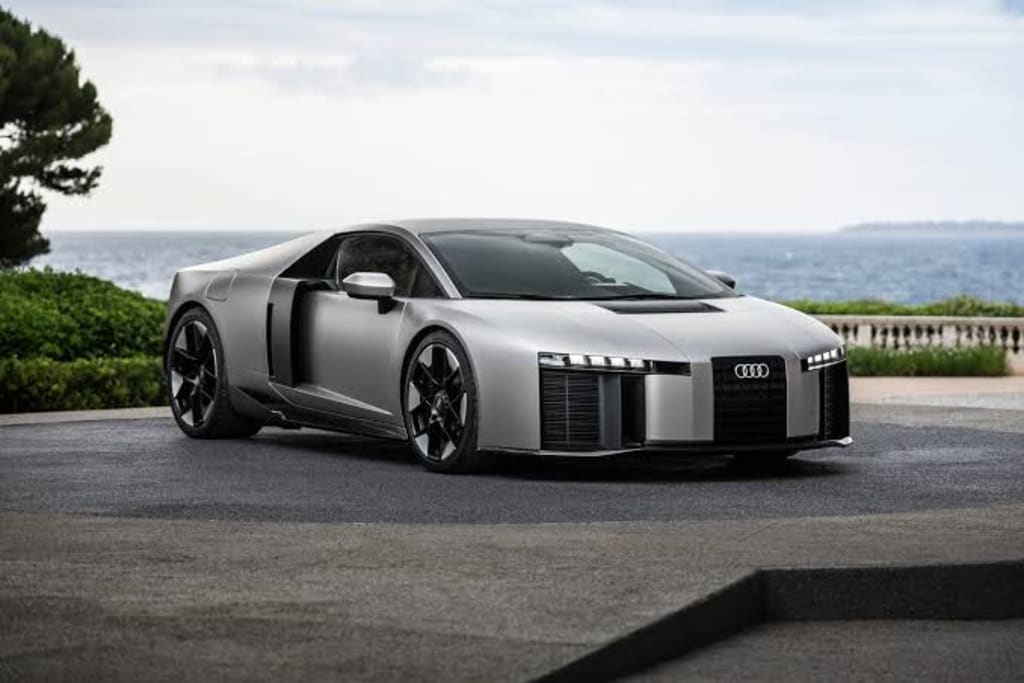
In the first half of 2027, Audi will build 499 left-hand-drive Nuvolari supercars. The car is named for Tazio Nuvolari, the racing driver who won Grands Prix in Auto Union Silver Arrows in the 1930s. It uses a 4.0-liter twin-turbo V8 related to Lamborghini’s engine, three electric motors, and a plug-in hybrid system. Combined output is 1,001 hp. Audi puts it above the R8. The car carries several F1-derived systems. Here is what each part does.
1. Naming and design
The name comes from Tazio Nuvolari. In the 1930s, Auto Union Silver Arrows won repeatedly at European Grands Prix, and Nuvolari was one of the era’s central drivers. Audi says the car follows that track DNA, not the R8’s road-car formula.
The exterior follows the Concept C concept car. Titanium metallic paint is standard. The body uses the ASF Audi Space Frame with carbon-fiber outer panels. The carbon parts are formed with an F1-grade hot-press process. Audi says the body is light and stiff. Lower weight helps power, braking, and aero. Stiffness gives chassis tuners more room.
Center-lock forged wheels are standard. Center locks come from racing pit stops. On a road car, they add ritual and cost.
Aero includes an S-Duct at the front, a three-stage adaptive rear wing, and manual DRS. In high-downforce mode, Audi says the car makes more than 400 kg of downforce. An F1 driver tuned the package on track, according to Audi. At more than 350 km/h, downforce affects stability and cornering.
2. Powertrain
The V8 makes 800 hp and revs to 10,000 rpm. A turbo V8 at that speed needs work on the valvetrain, crankshaft, and piston rings. Audi says this is a reinforced track unit.
Three axial-flux motors bring combined output to 1,001 hp. Two front motors make electric quattro and torque vectoring. The third motor sits between the engine and transmission. A 7.3 kWh battery buffers energy and fills torque. Axial-flux motors are compact and power-dense.
Audi quotes 0-100 km/h in 2.6 seconds, 0-200 km/h in 6.8 seconds, and a top speed above 350 km/h. The system uses F1 energy-recovery logic. In normal driving, the motors provide 0.3g of electric braking. That cuts load on the mechanical brakes. On track, brake heat is spread, and the carbon-ceramic discs last longer.
3. Chassis and brakes
The car uses Audi Ceramic Pro carbon-ceramic brakes with F1-style brake-by-wire. Front calipers have 10 pistons; rear calipers have four. The discs are large and carbon-fiber. Audi says cooling is 21% better than conventional carbon-ceramic systems. Brake-by-wire coordinates with energy recovery and chassis control.
The predictive ride chassis collects vehicle and road data. It adjusts power, braking, and aero before a corner. Five modes cover EV commuting, track dry, track wet, and other conditions. The car can be quiet in the city and track-focused on circuit. Audi has to satisfy collectors, drivers, and regulations at the same time.
4. Cabin and positioning
The two-tone cabin references the 1930s Auto Union layout. Carbon-fiber sport seats are standard. Aluminum trim runs across the console and vents. There is no rear-seat pitch and no GT pretense. Materials and seating position carry the message.
Audi will build 499 units, left-hand drive only. The car sits above the R8 and targets collectors. Scarcity, price, and F1-derived tech make the case. The car also sits at the change from combustion to electric. That timing adds collectible value.
5. Industry significance
The tech list is long: ASF space frame, carbon panels, F1-grade hot-press, center-lock wheels, S-Duct, active rear wing, DRS, 10,000-rpm V8, three axial-flux motors, electric quattro, torque vectoring, F1 energy recovery, brake-by-wire, carbon-ceramic brakes, predictive chassis, and five driving modes. Each item could support a model. Audi put them in one 499-car run.
Audi is pursuing EVs and combustion hybrids in parallel. Cost is high. Brand value is the return. Nuvolari is not a volume car. It is a marker. The 499-unit run means few garages. It will appear in Audi’s technical record.
Deliveries begin in the first half of 2027. Collectors can queue. The industry can see Audi’s choice: a high-revving V8 hybrid as the close of the combustion era.
About the Creator
Jin
Writer of reamstories
https://reamstories.com/jin
Enjoyed the story? Support the Creator.
Subscribe for free to receive all their stories in your feed. You could also become a paid subscriber, letting them know you appreciate their work.
Comments
There are no comments for this story
Be the first to respond and start the conversation.