
Alef Flew Over Tesla. That Does Not Settle the Flying Car Race.
The viral flyover exposed a category error: one company is testing sustained flight, the other is testing a six-second burst.
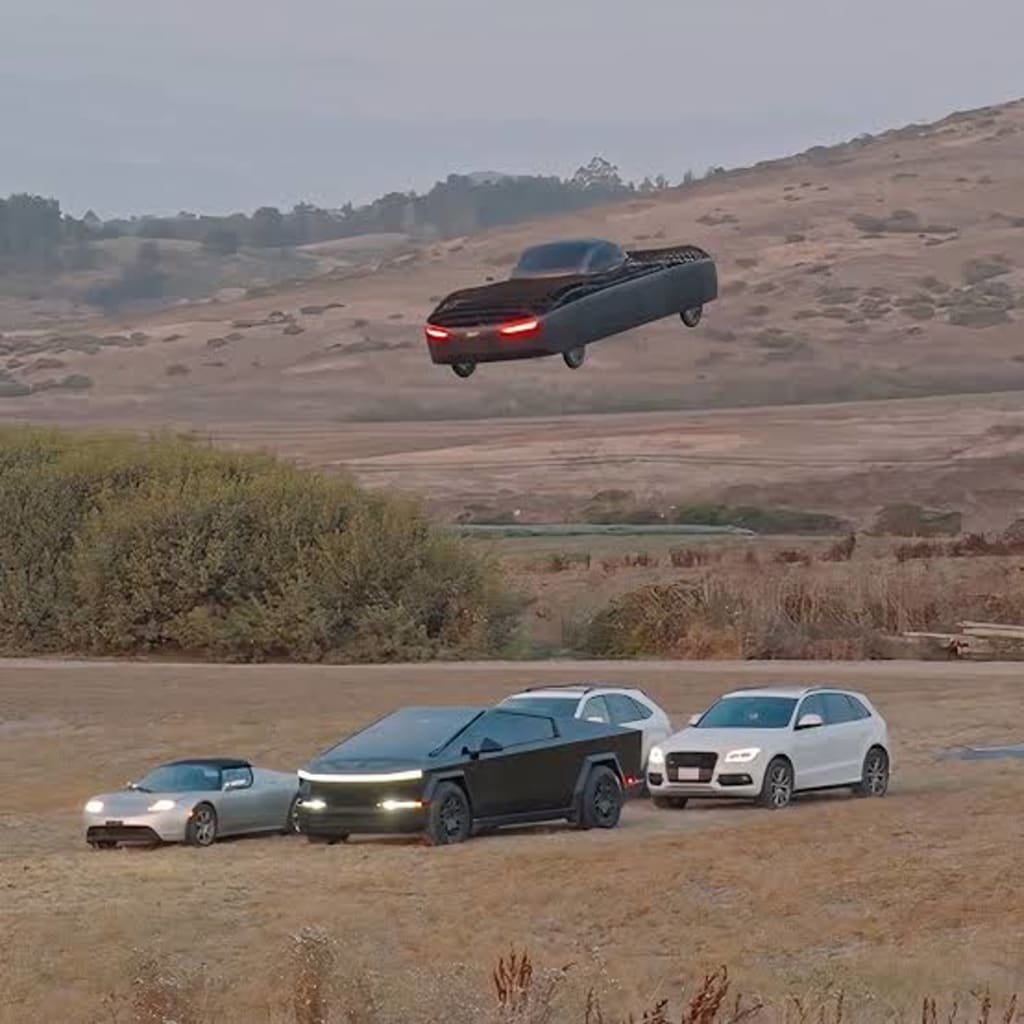
In October 2026, Alef Aeronautics posted a video. Its Model A flew over the Tesla Roadster that had just completed a flight demonstration. CEO Jim Dukhovny added a line: “Welcome Tesla to the flying car race. We have led alone in this position for 11 years.”
The video worked as publicity. It made Tesla’s flying roadster look like an expensive effect. It also invited a bad conclusion. The two vehicles do not belong to the same engineering category. A scoreboard that ranks them together hides the more useful question: what kind of flight is each company trying to prove?
Two kinds of flight
Alef Model A is built for sustained aerial travel. Eight propellers sit inside the body. The airfoil-shaped body acts as a wing in forward flight. The cabin rotates between vertical takeoff and horizontal flight. The vehicle weighs about 386 kg, has a road range of 322 km, a flight range of 177 km, and an 85 kWh battery. Its flight is a full profile: lift off, transition, cruise, land.
Tesla Roadster uses cold gas thrusters from SpaceX. High-pressure nitrogen leaves nozzles and produces thrust without combustion. The Rocket version carries 600 liters of carbon-fiber-wrapped gas cylinders, 10 nozzles, and more than 80 kN of total thrust. That is enough to launch a two-ton car off the ground, flip it in the air, and land it precisely. It is not built for travel. By effective exhaust velocity, 250 kg of compressed air at hover thrust lasts a little over six seconds. The flying version and the road-legal version are separate. The Rocket version removes the passenger seat for extra gas cylinders. Refilling 600 liters takes six to seven hours.
Alef is building an aircraft that can drive on a road and fly with sustained lift. Tesla is demonstrating a ground vehicle with aerospace-grade thrust vector control. One answers how a flying car becomes transport. The other answers what a car can do near the edge of physics. Alef’s constraints come from airworthiness and energy management. Tesla’s come from thrust, gas storage, and structure. A sailboat and a stunt plane do not race on the same course.
What “11 years ahead” means
Dukhovny’s claim has a basis. Alef has moved further on the engineering and airworthiness track.
Alef received FAA special airworthiness certification in 2023. It was the first such certificate for a vehicle that combines road driving and flight. Model A has completed more than 1,000 recorded flights. Preorders exceed 3,600, worth about $1 billion. First hand-built vehicles are scheduled for early customers in late 2026. Mass production is planned for 2027. Special airworthiness certification is not full commercial approval. It allows flight under limits. Type certification and other reviews remain. Still, Alef treats the flying car as a project with a delivery date, a certification path, and a factory plan.
Tesla’s flight capability is at a different stage. The cold gas demonstration is striking: 0 to 96 km/h in 0.81 seconds, an aerial flip, a precise landing, and a fan system that produces about 2G of downforce for upside-down driving. These are performance demonstrations. They do not validate transport capacity. The Roadster Rocket version is planned for 2028 and sold by invitation. Musk has said he is not sure it will be legal in every jurisdiction. The hard problem of cold gas thrust is energy density. Compressed air carries little energy per kilogram. Tesla does not solve that problem. It pushes the boundary of a short burst and turns six seconds of flight into a technical statement.
Alef’s lead holds in one narrow sense. It leads on the path that treats the flying car as an aviation product with certification and iteration. Tesla is not behind on that path. It never entered it.
The sector’s hard constraints
The flyover matters because it separates two questions. Getting a car off the ground is no longer the hardest engineering problem. Making a flying car into sustainable transport still is.
The first constraint is physical. Commercial power batteries are around 250 Wh/kg. The industry generally puts flying cars at 400 Wh/kg or above for useful range and safety margins. Solid-state batteries are the expected route. The distance from lab numbers to aviation-grade production will not close because of a launch event. Alef’s 177 km flight range is pragmatic under current conditions. It is still far from replacing a ground commute.
The second constraint is institutional. Flying cars sit under road traffic law and civil aviation airworthiness rules. The two systems do not fit together by default. A car needs crash safety, lighting, and driver licensing. An aircraft needs airworthiness review, airspace approval, and maintenance systems. Analysts point to dual-track regulation as a core bottleneck. Airworthiness rules lack specific standards for flying cars. Airspace management struggles with frequent low-altitude activity. Vertiport siting and noise control run into urban limits. FAA special airworthiness certification is an early step. Type and production certificates take years.
Commercialization will not be a single breakthrough followed by an overnight market. It will move through scenario tiers. Emergency rescue, inspection, tourism, and short shuttle routes come first. Air taxis on selected routes come next. Daily commuting at scale comes last. The industry sees around 2027 as the start of commercial passenger eVTOL service. Even then, ordinary air taxi travel remains distant. Zhang Yangjun of Tsinghua University gives a slower timeline: five years for demonstration and supporting infrastructure, ten years for the start of scaled use, twenty years before integrated air-ground transport could mature.
China’s track
China’s flying car programs offer a clearer reference point than the Alef and Tesla spectacle.
XPeng AeroHT’s Land Aircraft Carrier uses a split design. The ground module drives on roads. The flight module separates and flies. The Civil Aviation Administration of China accepted the type certificate application for the X3-F flight module in March 2024. It accepted the production certificate application in May 2025. The module completed its first overseas manned public flight in Dubai in October 2025. A mass production plant has started trial production in Guangzhou. Deliveries are planned for late 2026. Geely’s Aerofugia chose the AE200 series, a conventional eVTOL layout for 3 to 6 passengers. Type certification is in its fourth stage. The target is certification and commercial deployment in 2027.
These programs put certification and manufacturing ahead of the story. Their specifications may be less aggressive than Alef’s. Their timelines may not be faster. They answer the same questions Alef answers. How does a flying car pass certification? How does it reach mass production? How does it find a first sustainable use in a low-altitude system that is still being built? Tesla’s Roadster represents a different activity. China’s programs are building runways. Tesla is setting off fireworks. Fireworks are brighter. Runways decide who takes off.
What remains
Alef’s flyover was good publicity and a useful clarification. A car that leaves the ground for a few seconds and a flying car that completes transport missions under airworthiness rules are problems of different scale. Tesla expands the public image of what a car can do. Alef’s “11 years” points to slower mileage on a path closer to transport.
The sector’s outlook depends on battery energy density, dual-track regulation, vertiport networks, and airspace management. Until those constraints move, “who is more advanced” depends on the ruler. The ruler is less important than the blank spaces behind the markings.
About the Creator
Jin
Writer of reamstories
https://reamstories.com/jin
Enjoyed the story? Support the Creator.
Subscribe for free to receive all their stories in your feed. You could also become a paid subscriber, letting them know you appreciate their work.
Comments
There are no comments for this story
Be the first to respond and start the conversation.