
The Red Lantern Lie
You aren't walking through history. You're walking through a franchise—and the price of admission is your disillusionment.
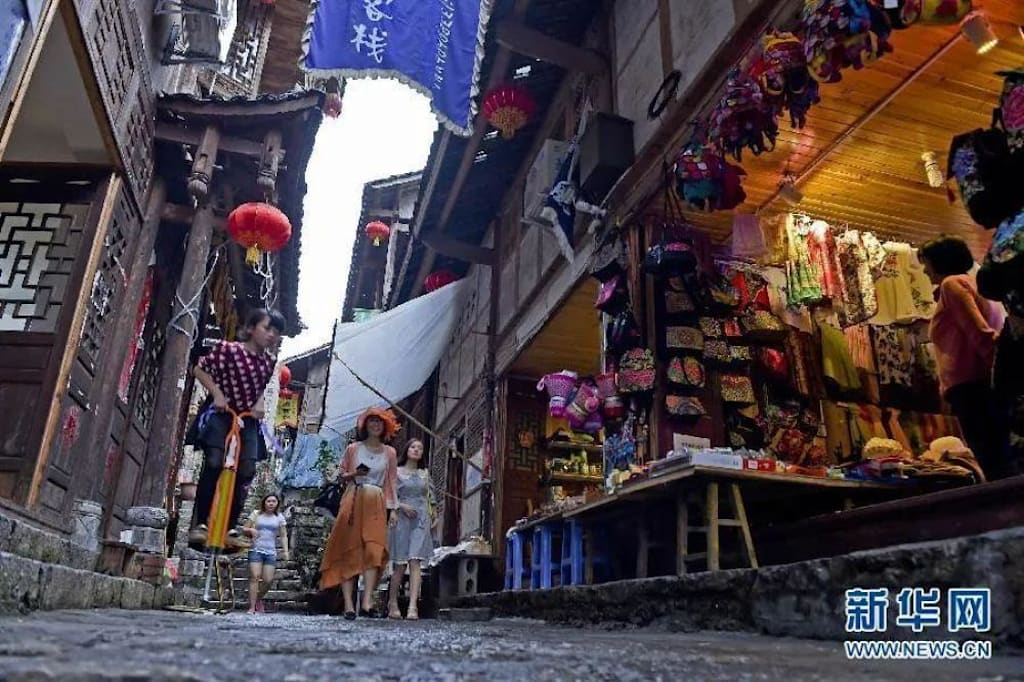
Tracing the "One-Face" Ancient Town: Who's Behind the Same Design?
From Wuzhen to Lijiang, Dali to Pingyao, walk into any "must-visit" ancient town and the same scene greets you.
Wooden windows face the river, vines climb white walls, red lanterns of the same size hang from the eaves. The waterways follow the same pattern: one main street alongside the water, shops on both sides, stone-paved paths about three meters wide that take twenty minutes to walk end to end. You take a photo and post it. Three minutes later, someone comments: "Where is this? It looks just like the one I went to last month."
This isn't a trick of memory.
1. The Three Kits
Every ancient town in the country comes with three sets of standard equipment.
Building kit: faux Ming-Qing wood-and-brick structures, machine-cut bluestone paving, custom-made red lanterns from the same supplier. A restoration builder told me that southern and northern projects order from the same batch of imitation antique bricks, from a handful of big factories in Fujian and Shandong. Designers pull the "Jiangnan Water Street" template from their library, adjust the roofline angle for a northern client, and the plan clears approval; construction goes fast, costs stay low.
Business kit: silver-and-jade shops, Hanfu rental studios with photo shoots, bars and cafés. On a three-hundred-meter street, eleven Hanfu photo studios. Ask the owners where they came from, and seven say, "My last shop was in another ancient town."
Snack kit: Changsha stinky tofu, Taiwanese-style sausages, Xi'an rice cake (zeng gao). In a Jiangnan water town, the zeng gao vendor is from Henan. At the southwestern frontier, the stinky tofu seller was in Zhejiang last month. The local radish fritters, mugwort cakes, and hand-shaved ice that locals have made for decades are either gone or squeezed into the deepest alley, their signs half the size of the one next door.
2. Who Builds Them
Behind these towns, there aren't many different owners.
Weiguang Huitong started in Chuxiong, Yunnan. After the success of the Yi People's Ancient Town, they loaded the same model into different place names: Tianzhou Ancient City in Guangxi, Lingling Ancient City in Hunan, Royal Post Station in Henan. They secure a thousand mu of land, build a faux water street in the middle, and surround it with residential units and shops. The building scale, archway forms, and waterway layout come from the same set of design templates.
Another operator is Chen Xianghong's team. After Wuzhen, they applied the same operations playbook to Beijing's Gubei Water Town, Guizhou's Wujiang Village, and Guangdong's Chikan Overseas Chinese Ancient Town. Closed-loop management, restoration-as-found, lighting design — the quality is higher, but visitors still breathe that familiar "atmosphere."
Then there are the state-owned players. OCT Group once took over dozens of projects at once, including Anren Ancient Town, Huanglongxi, and Shenzhen's Gankeng Hakka Town.
Different companies, same outcome. The reason lies downstream.
3. The Outsourcing Chain
An ancient town is born on an assembly line.
Planning: hire a top-tier cultural-tourism design institute. Fewer than ten in the country do this work. Their proposal structures are identical: "cultural empowerment," "immersive experience" are the buzzwords. The same designer who did a southern project last month takes their asset library north for the next job.
Construction: hire the same heritage-architecture crews. The imitation bricks, machine-made grey tiles, and aged wood come from the same handful of manufacturing bases. If one factory supplies the goods, north and south look the same.
Leasing is the hardest part. Developers rarely lease spaces themselves; they package the job to third-party agencies. A leasing manager opens WeChat, types: "New ancient town opening in X location, stalls available." The national circuit of vendors follows — the giant-squid guys, the leather-craft stalls, the Hanfu photo teams. They don't care where the town is; they care about the schedule.
This chain has run for over a decade. It turns out standardized parts.
4. Why They Can't Slow Down
The problem isn't that vendors lack creativity. It's the money structure.
For the past ten-odd years, the underlying logic of ancient-town development has been "culture and tourism set the stage, real estate sells the tickets." Developers use the cultural-tourism concept to acquire land at below-market rates, then apply for low-interest loans for the tourism project. The real profit comes from selling the surrounding residential units. The town has to open for business within two to three years. Money not returned carries interest.
No developer will spend ten years perfecting a local snack recipe or waiting for an elderly craftsman to pass on their skills. The safest, fastest, most reliably leasable route is to take a proven template and run with it.
The similarity isn't laziness. It's the speed of the assembly line.
5. The Moment the Spell Breaks
Visitors go to ancient towns for immersion.
Disney sells fantasy; ancient towns sell "another time." People want to see locals shelling beans on their doorsteps, the sound of laundry sticks hitting the river at dawn, the flavors that only this patch of soil can produce.
But when you discover the stinky tofu is from Hunan, the zeng gao is from Xi'an, and the silver jewelry comes from Yiwu's wholesale market, that "other time" collapses. You stand under an archway that says "Thousand-Year Ancient Town," surrounded by tourists holding selfie sticks like you, buying the same things as the food court near your apartment.
The spell breaks exactly then: you realize this place wasn't made for you. It was made for your spending power.
6. Two Paths
Homogeneity has exceptions.
Wuzhen stuffed a theater festival and the Mu Xin Art Museum into its ancient-town shell, shifting its operation from "selling scenery" to "selling content." Gubei Water Town copied the Jiangnan skeleton onto northern mountain land, but its operational precision makes the ticket price worthwhile. They're still copies, but at least the quality is there.
Smaller exceptions hide in the corners that never got "developed." In Shaxi, Yunnan, locals still run their own general stores in old houses; tourists and residents share the same street. In Bishan, Anhui, there's no ticket booth, no photo studios, just a bookstore and an old man making oil-paper umbrellas. Their visitor numbers are far below Wuzhen's, but the repeat rate is high — some people go back every year, just because "it's still the same as last year."
The way forward isn't to reject commerce. It's to reprioritize. If "keep locals living their lives" is the first principle, commerce falls to second place. Businesses naturally become local; buildings aren't all retrofitted to "Ming-Qing style."
If "make tourists look good in photos" is the first principle, don't be surprised when every ancient town looks exactly alike.
About the Creator
Jin
Writer of reamstories
https://reamstories.com/jin
Enjoyed the story? Support the Creator.
Subscribe for free to receive all their stories in your feed. You could also become a paid subscriber, letting them know you appreciate their work.
Comments
There are no comments for this story
Be the first to respond and start the conversation.