
Our Kind Of Perfect — Until We Return.
Twenty-four hours through history, wild roads and western light
Our twenty-four hours begin beneath a monument on Abbey Craig, when our rental car pulls into the car park at Stirling’s National Wallace Monument.
The miles that brought us here do not belong to the clock we are about to keep. For us, this day begins here, though the landscape has been gathering around us for some time already: in the famous sweep of Loch Lomond, the deepening green of the forests and the subtle change in the air as the landscape becomes unmistakably itself.
Whatever the season—or the weather within it—we can drive through all four here, sometimes within a single hour. We already feel the pull of the place we love, yet the truest escape still lies ahead. The gateway to the Highlands is waiting for us at Glencoe, never to be experienced the same way twice. You will understand why as we go.
I have loved this country for more years than the hours we have given ourselves in it, yet I have always struggled to explain what it does to me. Not because I do not know.
I know it in my bones.
It is my heart’s home.
My soul belongs here.
My love for this place is as wild, unwavering and wondrous as the country itself: there in its Munros; in waters that fall and lochs broad enough to hold the wind; in its history and culture, people and wildlife—all matching those same heights and depths.
This is our perfect twenty-four hours—not because it promises cloudless skies, easy roads or a plan left undisturbed, but because it promises to be unmistakably itself. Its weather changes its mind while we are still watching. Roads narrow, mountains disappear and return, and the view we came for may arrive beneath entirely different light.
It would not be itself if it behaved.
For a long time, I carried a selfish twinge about sharing it, as though giving someone else the place that felt most mine might lessen it. Then I found in my partner someone who felt the same. His Scottish roots connect him by lineage, but it is the way he recognises the country’s pull that makes him part of it with me. I do not have to explain the escape I find here. He feels it too.
With him, this place is no longer something I surrender by sharing. He has become part of what makes it home.
Perhaps those who recognise the landscape have already guessed where we are. Only here, beneath the monument, does the name settle fully into place.
Scotland.
I stood beneath the Wallace Monument once before, only to find it closed. This time, we have timed our arrival for the first shuttle bus, and our anticipation rises with us towards the towering figure of Wallace himself.
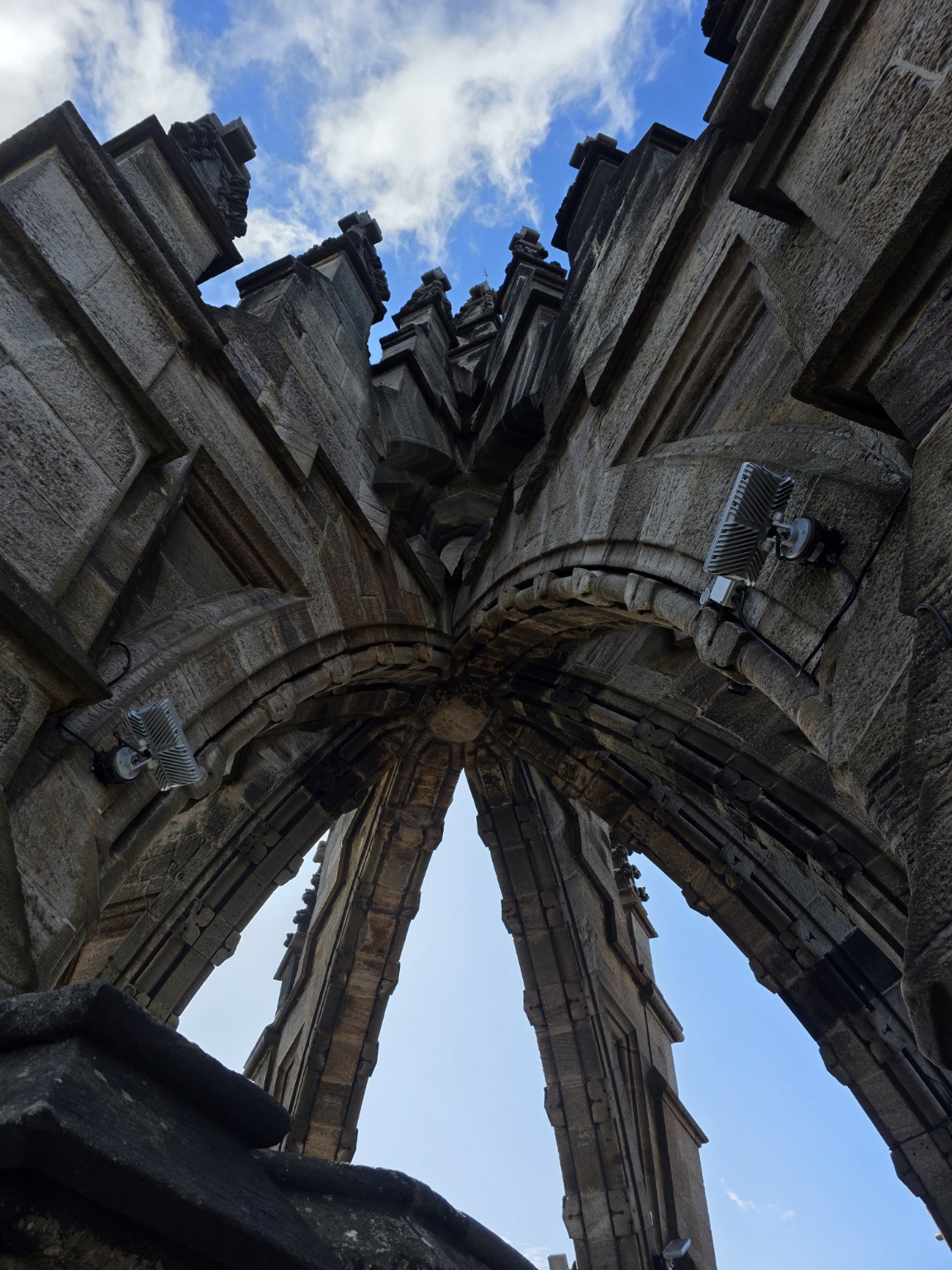
The dark stone carries the brooding elegance I associate with Stirling. Stone twists into something resembling rope; intricate carving sits almost subtly within the vastness of the tower; and Wallace holds his place in its side with all the grace and valour his memory commands.
Three exhibition galleries interrupt the climb, each holding part of the history beneath our feet. I will offer no spoilers. Whether you arrive knowing Scotland’s story or ready to discover it, those rooms deserve to tell it themselves.
Between them come the stairs: 246 stone steps winding upwards in tight, single-file spirals. Narrow windows offer clues to our growing height, but not enough to prepare us for what awaits.
Perhaps it is faith rather than luck, but Scotland’s famously changeable weather has always seemed to meet me exactly as I needed when it mattered most. Clear sky holds as we climb the final stairs. A stone wall shelters us a little longer before the summit opens into four arches and the elements rush in.
The panoramic view is enough to take your breath away. What truly does, though, is the feeling of standing within it.
I have seen Scotland from countless roads and stopping places, but experiencing it from here, knowing what stands beneath me, reaches somewhere words cannot follow. It is one of those moments that could make you cry out with exhilaration and let the happy tears fall. Even the memory still raises them.
A tip for the bold: you are safe, so trust me. Stand in the centre. Close your eyes and open your arms. For a few seconds, feel yourself standing firm against the wind.
Then open your eyes.
You will see for yourself.
Another tip: take sunglasses or clear lenses, whether you ordinarily wear them or not. The wind likes to make itself known, and you will want your eyes open for that view.
Our blue Nissan Qashqai waits below—a rapid petrol-electric hybrid with a panoramic glass roof that turns the sky into another passenger. Rental cars become characters in our Scottish journeys, each earning a personality and, if it serves us well, a place among the memories it carried us towards. This one already belongs there.
The A84 carries us through Doune and Callander. Loch Lubnaig appears beside the road, long and dark between the hills, before the landscape begins stretching taller around us through Strathyre, Lochearnhead and Glen Ogle.
Here, driving is not time spent waiting to arrive.
The road is one of the places.
Beyond Tyndrum, we turn west towards Loch Awe, where Kilchurn Castle keeps its ruined watch near the head of the water. Soon, the unmistakable shape of St Conan’s Kirk brings us to our second stop.
I had seen this Scottish gem in countless photographs, and I am grateful I paid attention. As a Christian lass, I carry an appreciation for places where faith and history meet. Yet St Conan’s needs neither explanation nor shared belief to inspire awe.
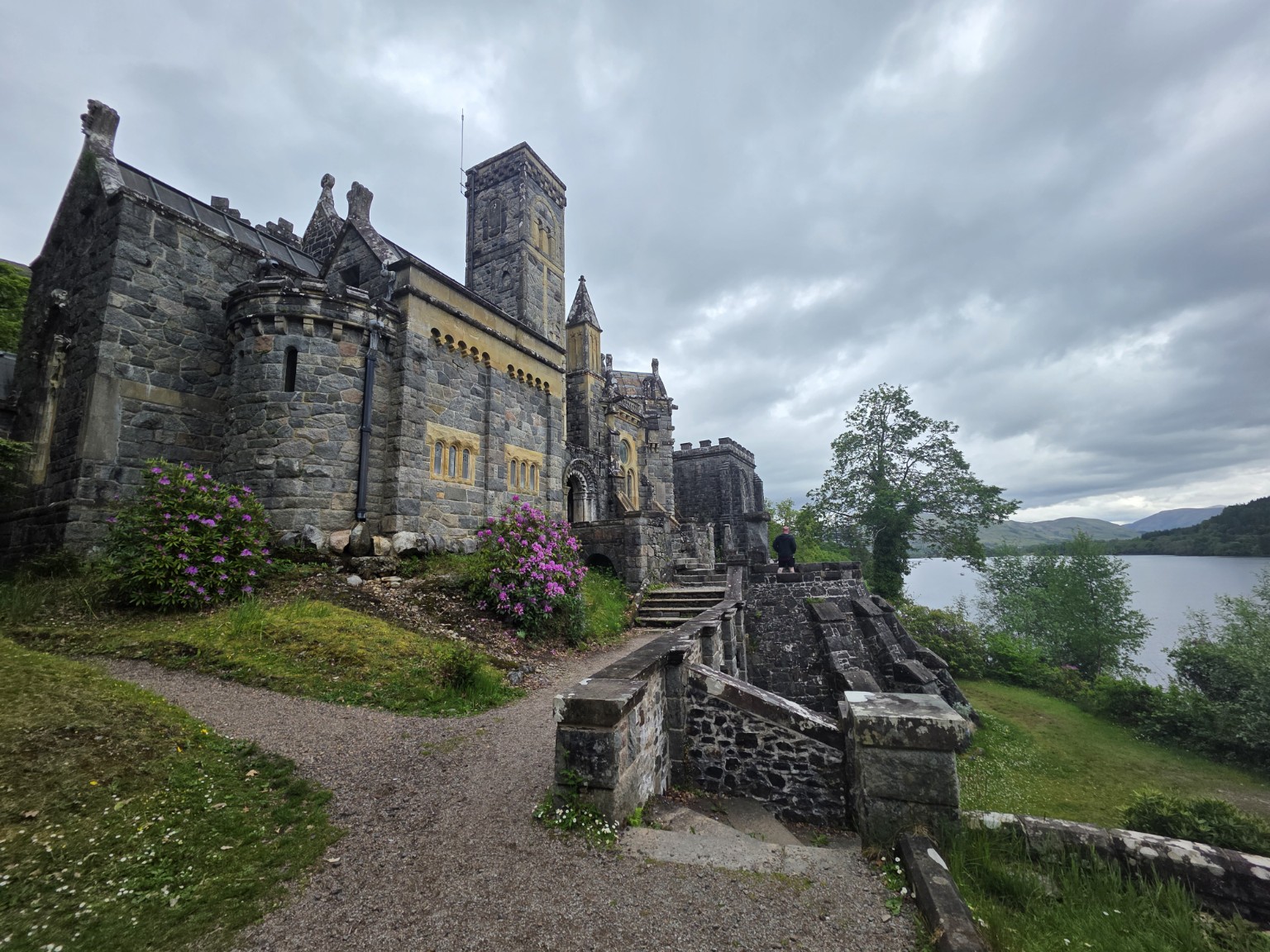
Its stone presence is gentle yet stern, its strength softened by Loch Awe beside it. Architecture and landscape contrast, then somehow complete each other.
We arrive around lunchtime to find much of the Kirk closed for a private ceremony. It will reopen later, but our clock will not allow us to wait. Strangely, I hardly mind.
The gardens hold more than enough: vivid blooms, ancient trees, extraordinary stonework and memorial inscriptions asking us to slow down and look closer.
Sheer, quiet beauty.
Hushed by a different awe from the one above Stirling, we settle into the Kirk’s tearoom. A latte, hot tea and light bites are served by a lovely local lass who gives us something no guidebook could offer.
She was married to her late husband here. Now she works within the place that holds that memory.
Her story leaves a bittersweet tenderness behind—and quietly plants a seed for our own future.
The closed rooms give us one practical reason to return. They are not the real reason. St Conan’s is simply too special to belong to a single visit. Scotland gives us places we leave already planning to meet again beneath another season, sky or open door.
One promise made, we turn westwards towards roads growing wilder with every bend—and every turn of the weather.
We retrace part of our route, but a road travelled in reverse is never quite the same. Mountains turn unfamiliar faces towards us. We pass Bridge of Orchy and Loch Tulla before Rannoch Moor opens around the car and Scotland seems to remove everything unnecessary.
Trees thin. Buildings disappear. The sky grows enormous above land shaped by water, rock and weather. Then Buachaille Etive Mòr rises ahead and the road descends into Glen Coe.
We pass through in afternoon light, quietly praying for a clear night when we return. For now, we resist stopping. Scotland makes that difficult, but the western edge is still hours away.
Beyond Ballachulish Bridge, we turn towards Corran. The little ferry carries us across Loch Linnhe in minutes, the loch wind rushing up to meet us. When its ramp lowers at Ardgour, the roads—and their pace—have changed.
We follow Loch Sunart through ancient oak woodland. Beside me, Andy—the tree surgeon—spots favourite veteran trees and marvels at those known well enough to deserve journeys of their own. They join the list for another time.
At Salen, we take the single-track road west. It develops its own etiquette: move forward, pull aside, wait, wave, continue. Nobody hurries for long. The road will not allow it, and the scenery gives us no reason to argue.
Woodland yields to rougher, open land as we pass beneath Ben Hiant and through Kilchoan. The afternoon lowers around us, warming the land wherever cloud permits. We follow the road as far west as it will take us.
Then Ardnamurchan Lighthouse stands against the sea.
We park Blue beside the Stables Coffee Shop just as the ladies are clearing up. Their welcome is as warm as though we had arrived at opening. Ushered inside and offered anything we wish, we choose light refreshments rather than take advantage of their kindness.
Mentioning our hope of reaching the true westernmost point lights them up. You might expect the question to have grown tiresome. Not here. They remind us of Scotland’s right to roam, arm us with invaluable directions and send us back to Blue for our walking boots.
The literal westernmost point of mainland Great Britain is still a scramble away.
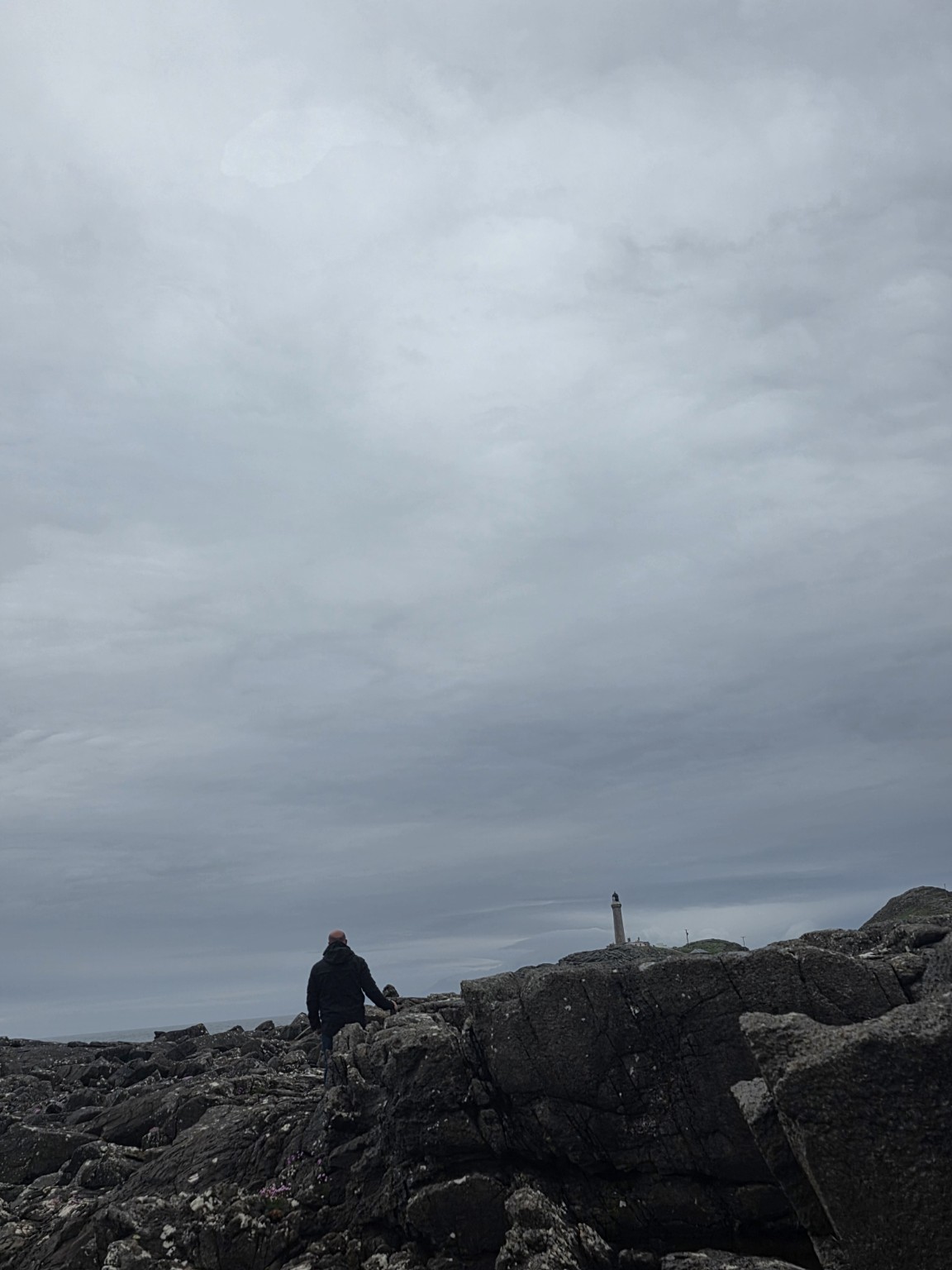
We cross some of the roughest ground I have known, picking our way over rock and leaping narrow streams as the unforgiving elements press in. After so long in the car, it is the most bracing—and freeing—way imaginable to stretch our legs.
Eventually, we get as close to Corrachadh Mòr—the westernmost point of mainland Great Britain—as the terrain and our clock safely allow, looking across wild, choppy water from the edge of the land. It is Scotland at its most exposed, a striking contrast to the gentler shore still waiting farther north.
By the time we return to Blue, afternoon is yielding to evening. We retrace the peninsula, but repetition proves impossible. The water has changed colour; shadows give the hills new personalities; and the glass roof keeps the changing sky inside the car with us.
The Corran Ferry returns us to the eastern shore and Loch Linnhe leads us north. Ben Nevis asserts his presence beyond the gathering buildings as Fort William welcomes us into early evening.
Our favourite pub is waiting.
Along Fort William’s High Street, the Ben Nevis Bar offers everything a great traditional pub should: warmth, lively atmosphere, generous service and a menu capable of restoring more than hunger. I order Balmoral chicken, a Scottish favourite I always look forward to, while we exchange open roads for lamplight, mountain heights for the closeness of a table and miles still to travel for something hot placed before us.
But the sun has not finished with the day, and neither have we.
We take the Road to the Isles west. Loch Eil travels beside us, and at Glenfinnan the railway and its great viaduct draw close to our route while evening light catches the highest ground and lets the lower slopes fall into blue-grey shade.
We had first aimed for the famous Silver Sands of Morar, but beautiful as they are, an inlet will not give us the horizon we are chasing tonight. Near Camusdarach, we turn onto the coastal road, following glimpses of pale sand and sea until we pull into the small car park.
A path leads us through sharpened dune grass. Then the land opens and the whole day—the miles, climbs, crossings and waiting—is answered with nature’s nod.
The road has carried us to the sunset. The final steps must be ours.
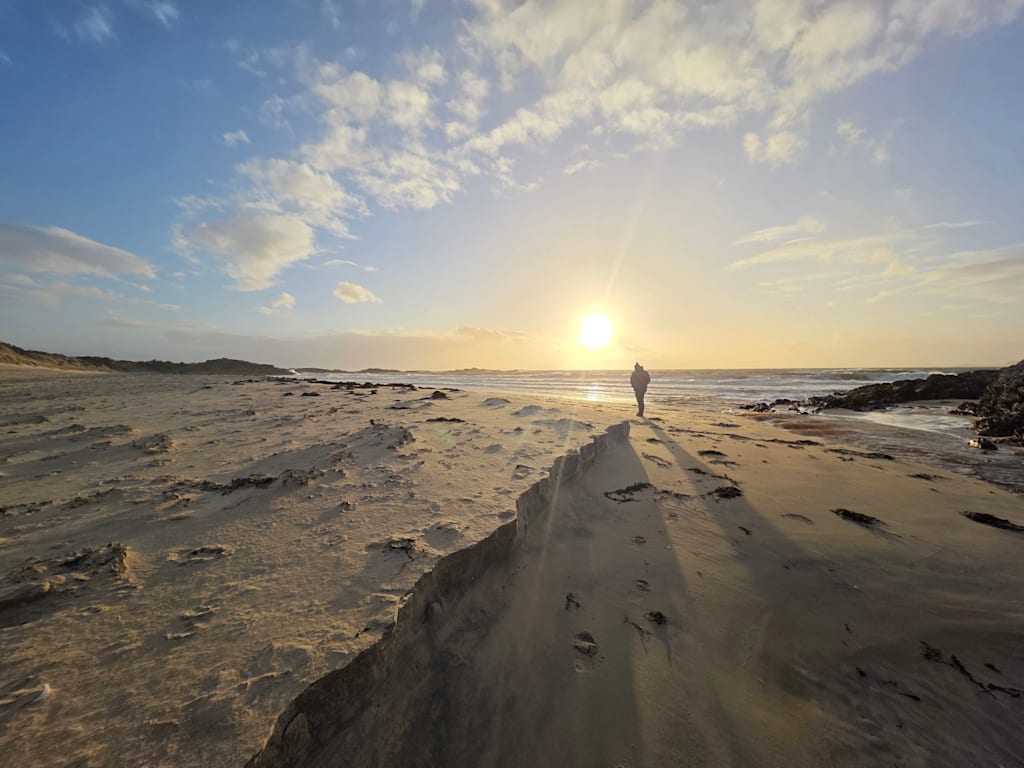
Andy walks ahead until distance turns him into a silhouette against the last gold of the day. I raise my camera and catch him there, between departing light and the evening gathering behind us.
At the time, it is simply a photograph I love.
I do not yet know that this moment—Andy standing small beneath that immense Scottish sky—will inspire my Between Moments logo. Perhaps it could only have begun here: in one of those brief spaces between arriving and leaving, daylight and darkness, holding on and allowing a moment to pass.
The photograph looks calm, but the western wind refuses to let us forget where we are. We brace against it, then fold into an embrace, trying to hold the view and the feeling a little longer.
A couple walking their dog has already assured us that the island sunsets are worth waiting for. Soon, they disappear over the dunes, leaving the whole sweep of golden sand to us. On a beach like this, that solitude feels almost impossible. Just us, in all this country, given this one moment entirely to ourselves—and to those we wish were close enough to share it.
We leave messages in the sand for the setting sun to carry towards them.
By the time we cross the dunes again, colour is draining from the beach. Sunset leaves a long afterglow, but the first true darkness of our twenty-four hours is gathering.
We follow the Road to the Isles east. Water keeps the last of the sky after the mountains surrender it. Fort William meets us again, though this time we pass through, joining the A82 south towards Ballachulish and the mountains we crossed hours ago.
Glencoe receives us differently at night.
The shapes that crowded the road in afternoon light are now vast absences against the sky. Headlights find only a little at a time: rock, grass, the edge of a bend, then darkness again. What daylight revealed in detail, night restores to mystery.
Safe and stopped, we switch off Blue and allow the car its own well-earned rest. Once our eyes adjust and the last artificial light disappears, the sky begins giving back what the road has taken from us all day: distance without destination.
Full-bellied, full-hearted and tired to our bones, we settle down and look up to realise what the night sky can truly be.
Stars appear where towns would ordinarily interrupt them. Without streetlights to bleach the darkness, the longer we look, the more the sky reveals. Familiar constellations are almost lost among the points usually hidden from us, and the night no longer seems to sit above the mountains but to spill between their ridges.
The mountains do not vanish entirely; their dark edges hold the sky in place beneath something seemingly endless. We have spent the day looking outward—from tower, road, kirk, lighthouse and shore—and now the whole country seems to look back.
It draws close like a blanket we could almost touch. Immense enough to feel dangerous, yet somehow gentle too. As the mountains sleep around us, night takes its turn in all its glory.
For what remains of it, we sleep in Scotland’s keeping.
Morning returns the mountains piece by piece: first silhouettes, then slopes, gullies and colour reclaimed from darkness. Tired but replenished in a way sleep alone cannot explain, we pack beneath them and take one final look before rejoining the A82.
We travel through Glencoe for the third and final time on this trip—though never, we promise, for the last. First, it held us in afternoon light. Then it became mystery beneath the stars. Now morning reveals another version—quieter and washed in the new day.
Beyond Buachaille Etive Mòr, Rannoch Moor opens once more. Pools and lochans catch pieces of sky as the road carries us towards Tyndrum and the point where yesterday’s route turned north.
This time, we stop.
The Green Welly is part café, part shop and part refuelling point in every sense. We settle over a welcome fried breakfast, checking the clock between mouthfuls, then wander its shelves for Scottish treats, journey-home supplies and a souvenir for each of our girls.
Breakfast completes what the previous morning began. We have climbed into history, followed lochs and moorland, crossed water, reached the western edge, shared a meal beneath familiar pub lights, watched the sun disappear into the sea carrying our prayers and slept beneath nature’s own glory, with no town to interrupt the stars.
Now, twenty-four hours after arriving beneath Abbey Craig, the clock closes around us at a table in Tyndrum.
The road home will begin when we step outside, but it does not belong to this story.
I never wish to leave this place.
It never truly leaves me.
About the Creator
Enjoyed the story? Support the Creator.
Subscribe for free to receive all their stories in your feed. You could also become a paid subscriber, letting them know you appreciate their work.
Comments
There are no comments for this story
Be the first to respond and start the conversation.