history
The roots of feminism were planted millennia ago; we must understand feminism throughout history to contemplate how much farther we can go.
Body Image in Aging
As I mentioned in my previous article, my focus is on the topic of aging especially regarding women so I'm thinking about old ladies which is what I consider myself since I am "over the hill" (over 50 years of age). Though wise men will say that we ought not compare ourselves to others as it is a source of emotional havoc, I notice that sitting in front of a television or computer screen in a female aging body is a source of loneliness and restlessness. Though I may be wise like those men or other notable wise women in the famous stories, I see daily that comparisons are often made (intentionally or not) almost as if it is impossible to get through the day without doing so. Scroll on Facebook because you're bored and see a joke about sagging breasts. Lots of laughs but would it be funny without comparison? If we didn't have plastic boobs or 15 year old boobs to look at, would the saggy drooping old lady boobs be funny? I'll try not to compare us to animals, but when I get in a serious mood I tend to compare human behavior to the animals and the animals seem to be more civilized. Maybe I shouldn't have said that. Maybe that was as cruel as laughing at your grandmother's breasts. Did you laugh at the porn stars breasts the same way? Oh right, it isn't wise to compare. What? The laughs or the breasts?
By Shanon Angermeyer Normanabout a year ago in Viva
Discipline, Vision, Community: TT Torrez Returns to MCNY to Unlock the Leaders of Tomorrow with #GoGetHer Summit
Full Circle - TT Torrez Returns to MCNY to Unlock Leaders of Tomorrow When Vision Meets Access: The Official Line Up - How TT Torrez Is Redefining Leadership for Young Women of Color
By NWO SPARROWabout a year ago in Viva
Using Viva for My Magazine Ideas
"What it means to be a woman. Viva explores the lives of women, from the workplace to home, family, adventure, ambition, and more." That is the description provided by Vocal for the "Viva" community. I haven't submitted much (if any) to this community although I am a woman who does much "work" at home often thinking about family, adventure, ambitions, and other things. I noticed that in numbers (statistical reports of members and articles) this community is on the low side. So I've decided to FOCUS on this community and narrow my subject matter in my articles to fit this community. I was ambitious enough to want to start an online magazine and call it "Over the Hill" or "Poor People" or "Lonely Old Ladies" but I think this community is sufficient for my writing desires on these subjects.
By Shanon Angermeyer Normanabout a year ago in Viva
The Dark History of White Beauty Standards: Built on Slavery, Racism, and Paedophilic Obsession
Introduction: Why dig into beauty standards at all? If you scroll through TikTok, flick through a glossy magazine, or sit down to watch a blockbuster movie, the women presented as “beautiful” tend to look eerily similar. They are often white or light-skinned, slim, smooth-skinned, and symmetrical. Their eyes appear large, their noses small, their lips carefully shaped. Most importantly, they look young — sometimes so young that they verge on childlike.
By No One’s Daughterabout a year ago in Viva
Ayn Rand: The Woman Who Made Individualism Unstoppable
Two unforgettable heroes came alive from Ayn Rand’s imagination—Howard Roark from The Fountainhead (1943) and John Galt from Atlas Shrugged (1957). To me, they weren’t just fictional men; they embodied the possibility of living by unshakable principles. Their strength wasn’t in superpowers or wealth but in moral clarity—the courage to stand alone when the world demanded conformity. When I first discovered Ayn Rand, I didn’t expect her words to pierce so deeply into my own life. She didn’t just write stories; she gave me a way of thinking—a way of seeing myself and the world. Before her, I was adrift, torn between tradition, expectations, and my own half-formed dreams. After her, I found purpose. --- My First Encounter with Rand’s World I didn’t start with her novels. Instead, I stumbled across her nonfiction—the provocatively titled The Virtue of Selfishness (1964). The very name made me raise an eyebrow. Weren’t we taught that selfishness was wrong? That to live for yourself was immoral? Yet, page by page, Rand dismantled every notion I had absorbed from school, church, and culture. Words like egoism, altruism, and collectivism weren’t just vocabulary—they became sparks in my mind. Suddenly, I saw my own contradictions: saying one thing to please society while silently craving independence. Soon after, I picked up Anthem (1938), a slim book but heavy with meaning. In its pages, I found a world where even the word “I” was forbidden. And yet, the protagonist dared to speak it—dared to claim individuality. That struck me. Because in my own life, I too was afraid to say: I don’t believe what you believe. I don’t want what you want. I am my own person. --- The Clash Between Society and Self For years, I played two roles. Outwardly, I was the dutiful son, the obedient student, the cooperative member of whatever group demanded my time. Inwardly, I was wrestling with Rand’s voice in my head urging me to stop sacrificing, stop pretending, stop hiding. Like many, I felt the pressure of collectivism—the idea that the group, the family, the nation, or the faith comes before the individual. Rand’s words were a rebellion in my mind. They told me that my life belongs to me. --- A Breaking Point That Changed Everything My life shifted dramatically during a difficult period when I served in a strict, hierarchical environment. Rules suffocated individuality. Words like “we” and “us” replaced “I” and “me.” It was eerily similar to Anthem. At my lowest, I found myself at odds with authority. Confrontations escalated until I was sent away, both physically and emotionally cut off. In that moment of collapse, I turned again to Rand. A fellow traveler handed me a worn copy of The Fountainhead. I devoured it. Howard Roark’s uncompromising integrity—his refusal to bend even when the world mocked, punished, or ignored him—became a lifeline. Rand wasn’t promising an easy life. She was promising a meaningful one. --- Finding Strength in Her Fiction Reading We the Living (1936) showed me the suffocating power of collectivism in its rawest form. Though bleak, it made me grateful for the choices I still had. Then came her masterpiece, Atlas Shrugged. That novel was more than a story—it was a mirror. I saw myself in Hank Rearden, not because I was an industrial genius, but because of his battles with family who couldn’t understand his drive. Like Rearden, I felt the sting of being criticized for valuing my work, my ambitions, and my self-respect. Rand’s women—Dominique Francon and Dagny Taggart—also stood out. They weren’t written as victims or side characters but as powerful individuals who matched men in intellect and strength. I admired them, not just as fictional women, but as proof that Rand’s world left no room for mediocrity, male or female. --- Ayn Rand and My Mental Battles Alongside admiration came personal struggle. Living with mental health challenges meant days of mania, depression, and uncertainty. Yet, Objectivism gave me a compass. Rand’s philosophy didn’t promise to heal my mind, but it reminded me that reason could guide me even through storms. When I felt crushed, I remembered her words: “Do not let your fire go out.” That line wasn’t just ink on paper. It became a personal command. Yes, I took medication. Yes, I fought demons in hospitals and quiet rooms. But Rand’s work gave me something medicine couldn’t: meaning. A reason to keep striving. --- Why Rand Still Matters Critics love to dismiss Ayn Rand. They call her cold, arrogant, unrealistic. But I see something else: clarity. She didn’t sugarcoat life. She said, Here is reality. Here is reason. Choose to live fully or waste away in sacrifice. Her ideas are not perfect, and even she had flaws. But the force of her writing, the sharpness of her mind, and the passion with which she defended individualism shaped me forever. Even now, when I speak to friends, colleagues, or strangers online, I find myself quoting her lessons. I tell them: you own your life. You are not here to live as a shadow of someone else’s dream. --- Where I Go From Here Rand once said, “And I mean it.” Those words capture her spirit—unyielding and absolute. That is the kind of certainty I want to carry. Because of Ayn Rand, I no longer fear standing alone. I no longer mistake self-interest for sin. And I no longer apologize for wanting a life filled with purpose, reason, and joy. She may not be a saint or a universally loved figure, but for me, she is the writer who handed me a philosophy strong enough to live by. And that is why Ayn Rand is not just “the unknown ideal” but, in my eyes, the unforgettable ideal woman. ---
By Muhammad Riazabout a year ago in Viva
I Love Rock and Roll
The old jukebox in Eddie’s Vinyl Diner whirred to life with a clank and a hum, just like it had every Friday night since 1982. Its colorful neon lights blinked with stubborn pride, casting a glow on the checkerboard floor. Emma Jameson, 17, dropped a quarter in and punched the buttons: J4.
By iftikhar habibabout a year ago in Viva
5 African Superstitions I Grew Up Believing — And What They Really Mean
Growing up in an African household means you don’t just inherit your family name—you inherit their beliefs, taboos, myths, and stories. Some of them are heartwarming. Others are downright terrifying. But one thing is for sure: they shape the way you see the world.
By Abdushakur Mrishoabout a year ago in Viva
"Bera Sum Na Ijaazat e Numay." (Only the permission to shoot is yours.)
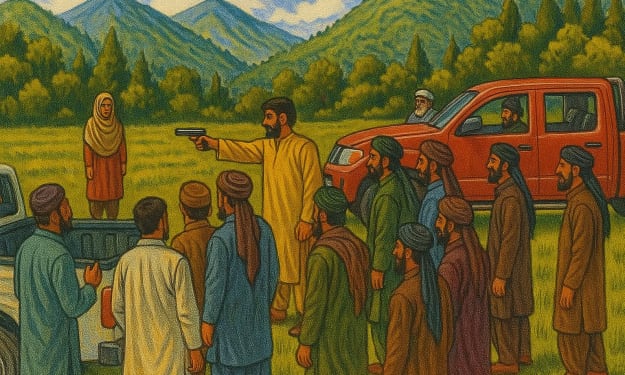
Almost two hundred years ago it is Balochistan. And inside the mountains of Balochistan is a purely tribal area called Kohlu. The interesting thing is that the year is also 1825. That is, exactly two hundred years ago from today. In a house of Kohlu, a child is born. He is named “Lal Han”... Growing up, he becomes a shepherd. It is the monsoon season (just like nowadays)... This shepherd is outside his area with his sheep and goats. A stormy rain begins. In the midst of those mountains, a house is seen. He goes toward that house to seek shelter. The men of the house are not there. According to the customs of that time, the woman of the house becomes the host. She is a newlywed bride. The woman tries to save her tent from the storm. The strong winds take away her dupatta. She is trying to save the belongings. Lightning flashes. In the thousandth part of a second, Lal Han's eyes fall on that woman whose hair is open and the storm has taken away her dupatta, but she, unaware of the world, is trying to save her shelter. In this thousandth part of a second, Lal Han’s life changes and he becomes “Mast Tawakali” and “Sammu Beli”. That woman is none other than “Sammu”. Imagine that it is a purely tribal time from two hundred years ago. Mast Tawakali not only falls in love with a married woman, but also mentions her name in his poetry. He even calls himself “Sammu Beli” meaning friend of Sammu. But no one’s “honor” awakens to go and kill that shepherd. Rather what happens is that they are called “Hazrat Mast Tawakali”. After his death, people come to his grave with great respect and his grave becomes a spiritual center. No one knows the real meaning of the name “Sammu”, but even today thousands of women in Baloch society are named “Sammi”. It is a time fourteen hundred years ago. In Makkah, a woman does business. She is independent. She sends her goods with a young man to Syria. She is impressed by his honesty. She initiates. Sends a proposal through her slave. Yes, fourteen hundred years ago, a woman is sending a marriage proposal. They both get married. That woman is Umm-ul-Momineen Hazrat Khadija (may Allah be pleased with her) and the young man is Hazrat Muhammad (peace be upon him). Here, every year hundreds of women and men are killed in the name of “honor”. These people derive the concept of this “so-called honor” either from tribal customs or from religion. Both of these events negate this idea. Fast forward. It is the developed era of 2025. It is the age of social media. A video is circulating on social media. The time and place of the video are unknown. There is a group of so-called honorable men. A “Sammu” is brought. A Qur’an is in her hands. A wretched one takes the Qur’an from her hands. She is not scared. She is not panicked. She is not pleading or begging. She says one sentence. She makes an explosion. “Bera sum na ijaazat e numay” (Only the permission to shoot is yours.) This is not just a sentence. It is a philosophy, a declaration, a rebellion. She is not asking for permission, she is giving permission. She is issuing an order. She is announcing a verdict. She is declaring that I am not anyone's property. I am not a domesticated animal. I am a living, breathing human. I have the right to live on my own terms, and the right to die on my own terms too. She walks seven steps ahead. And then she becomes free. With the rattling of bullets in the air, the echo of one sentence is heard: “Bera sum na ijaazat e numay” This one sentence is enough to shatter the walls of this so-called honor. There should be poetry written on this, stories should be written, books should be compiled, films and dramas should be made. Bera sum na ijaazat e numay.
By Ikram Ullahabout a year ago in Viva
Why Sigiriya is Called the Eighth Wonder of the World
There is no doubt that the jaw-dropping Sigiriya Rock Fortress is one of Sri Lanka’s noteworthy historical sites as well as a foremost tourist attraction. The ruins of an ancient palace and gardens to be found here have intrigued countless foreign visitors exploring the island nation. Described below are some of the features of this breathtaking site that have gained it the moniker of the 'Eighth Wonder of the World’.
By ameliarosannaabout a year ago in Viva
Una crisis política
I am not in Los Angeles. I do not care, not because I know myself too well. I know that at this moment, I could not resist the urge to protest by any means necessary. And I know that my fire, unchecked, would not help. Not yet. Not like this.
By Jasper Blackwoodabout a year ago in Viva