family
Family life from the feminist perspective; can women have it all? Can anyone?
Old lady grumbling about work
Happy October! May the leaves change colors in glorious autumn fashion and may you enjoy a tasty pumpkin spiced latte or donut this morning. I am here at my desk with a Maxwell House coffee brewed out of the cheapest coffee maker on the Walmart shelf. I like it. One button and will brew the cheapest coffee on the shelf. Good. I'm broke and I'm cheap just like my coffee maker.
By Shanon Angermeyer Normanabout a year ago in Viva
Nicole Kidman: The Shining Star of Hollywood
Nicole Kidman: The Shining Star of Hollywood *Nicole Kidman's Early Life* Nicole Kidman was born on June 20, 1967, in Honolulu, Hawaii, USA. Her mother, Janet Marie, was a nursing instructor, and her father, Anthony David Kidman, was a clinical psychologist and biochemist. Nicole grew up in a middle-class family and moved to Sydney, Australia with her family when she was four years old. *Nicole Kidman's Education* Nicole attended North Sydney Girls' High School and then enrolled in the Australian Theatre for Young People. She began her acting career at a young age, appearing in several commercials and short films. *The Beginning of Nicole Kidman's Acting Career* Nicole Kidman started her acting career in the 1980s, appearing in films such as "Bush Christmas" and "BMX Bandits". However, she didn't land a leading role until 1989 in the film "Dead Calm", which she starred in alongside Sam Neill.
By America today about a year ago in Viva
Eldery people visit profound places
I found this meme today scrolling on Facebook. It was the most profound one I read and decided to write a poem and an article featuring this. Where do you think the elderly or the poor hang out? Some roach infested ghetto apartment or a sparkling clean dazzling condo overlooking the ocean? Both? Some elite gated nursing home featured on Lifestyles of the Rich and Famous or some decaying old building with overworked and underpaid nurses calling it an Assisted Living Facility? A tent in the backyard where Granny fights the dog or the cat to call it "her" tent? A car that's over 20 years old and needs a new transmission and has no air conditioning or heater, but still lets Grandpa take a nap in the Walmart parking lot? Some old dusty hall where they gave the old homeless bum a free pack so he could play Bingo and try his luck? Yeah, I'm sure you can find the elderly at all of the above, but I think the meme is directly referring to places where the elderly have been much more than those younger folks. Typically, young people (child age to say around 30 somethings) are not typically hanging out at the hospital, the prison, or the cemetary unless they are employed there.
By Shanon Angermeyer Normanabout a year ago in Viva
Body Image in Aging
As I mentioned in my previous article, my focus is on the topic of aging especially regarding women so I'm thinking about old ladies which is what I consider myself since I am "over the hill" (over 50 years of age). Though wise men will say that we ought not compare ourselves to others as it is a source of emotional havoc, I notice that sitting in front of a television or computer screen in a female aging body is a source of loneliness and restlessness. Though I may be wise like those men or other notable wise women in the famous stories, I see daily that comparisons are often made (intentionally or not) almost as if it is impossible to get through the day without doing so. Scroll on Facebook because you're bored and see a joke about sagging breasts. Lots of laughs but would it be funny without comparison? If we didn't have plastic boobs or 15 year old boobs to look at, would the saggy drooping old lady boobs be funny? I'll try not to compare us to animals, but when I get in a serious mood I tend to compare human behavior to the animals and the animals seem to be more civilized. Maybe I shouldn't have said that. Maybe that was as cruel as laughing at your grandmother's breasts. Did you laugh at the porn stars breasts the same way? Oh right, it isn't wise to compare. What? The laughs or the breasts?
By Shanon Angermeyer Normanabout a year ago in Viva
Using Viva for My Magazine Ideas
"What it means to be a woman. Viva explores the lives of women, from the workplace to home, family, adventure, ambition, and more." That is the description provided by Vocal for the "Viva" community. I haven't submitted much (if any) to this community although I am a woman who does much "work" at home often thinking about family, adventure, ambitions, and other things. I noticed that in numbers (statistical reports of members and articles) this community is on the low side. So I've decided to FOCUS on this community and narrow my subject matter in my articles to fit this community. I was ambitious enough to want to start an online magazine and call it "Over the Hill" or "Poor People" or "Lonely Old Ladies" but I think this community is sufficient for my writing desires on these subjects.
By Shanon Angermeyer Normanabout a year ago in Viva
5 Life Lessons I Learned Watching Yellowstone
When I first started watching Yellowstone, I thought I was signing up for a series about cowboys, cattle, and sweeping views of Montana. And while I got all of that in abundance, I also walked away with something far more valuable: life lessons wrapped in the chaos, grit, and beauty of the Dutton family’s world.
By No One’s Daughterabout a year ago in Viva
Luna: A Story of Healing and Finding Safety
When I first met Luna at the shelter, she was curled up in the smallest corner of her cage. Her tiny body trembled, and her big brown eyes seemed to carry years of unspoken pain. I remember kneeling beside her and whispering softly, “It’s okay… you’re safe now.” She didn’t move, but her eyes followed me—hesitant, unsure, yet searching for something she could trust. The shelter staff told me her story in fragments. She had lived in neglect, in a place where food was scarce and love was nonexistent. Loud noises would make her run and hide, and human touch was something she had learned to fear rather than welcome. Hearing this broke my heart. I knew that if I brought her home, it wouldn’t just be about giving her shelter—it would be about helping her rebuild her world from scratch. On the first day I brought Luna home, she didn’t rush to explore. Instead, she found the corner of my living room and stayed there, shivering, her eyes darting between me and the unfamiliar surroundings. I placed a soft blanket beside her and set a bowl of water within reach. I didn’t try to pet her right away; instead, I just sat nearby, reading quietly, letting her know that my presence was not a threat. That first night, I heard her soft whimpers while I was in bed. They were not loud cries, but quiet sighs—like the sound of a soul carrying too much weight. I got up and sat on the floor near her, speaking in a low voice. “You’re safe now, Luna. No one will hurt you here.” I don’t know if she understood my words, but after a while, her breathing slowed, and she closed her eyes. The following days were slow and delicate. She often hid under the table or behind the couch, peeking out only when she thought I wasn’t looking. Sometimes she would watch me from a distance, her ears slightly perked up, as if trying to decide if I was worthy of her trust. I never forced her to come closer. Instead, I let her take the lead. Little by little, things began to change. One afternoon, as I sat on the floor eating an apple, she cautiously walked over and sniffed my hand. It was such a small gesture, but to me, it was a milestone—a sign that she was willing to take a step toward me. The next day, she followed me to the kitchen, her tail still low but wagging slightly. Her progress wasn’t a straight line. Some days she seemed confident, and others she would retreat into her safe spot. But I learned that healing isn’t about moving forward without setbacks—it’s about continuing even when the fear returns. After a few weeks, Luna started following me around the house. If I moved to the living room, she would quietly pad behind me. If I went to the bedroom, she would lie down by the door. I began to see glimpses of the dog she was meant to be—playful, curious, and affectionate. She loved sitting by the window, watching the world outside. Sometimes, she would close her eyes and lift her nose toward the breeze, as if the scent of fresh air was reminding her that she was free. The first time she placed her head in my lap, I nearly cried. It was an act of complete trust, a silent message that said, I choose you. From then on, she sought my touch, leaning into my hand when I stroked her fur, and even bringing me her favorite toy—a small, squeaky ball that she carried around like a treasure. Life with Luna has taught me patience, compassion, and the power of gentle love. She is no longer the scared little dog I met in that shelter. She now sleeps peacefully at night, her body relaxed, her dreams undisturbed by the shadows of her past. Luna is not just a pet. She is a survivor, a reminder that even the most broken spirits can heal when given kindness and safety. Her journey is a testament to the fact that love, when given freely and consistently, can rebuild what neglect has destroyed. Every day with her is a new chapter, and I know our story is just beginning. She is home now—truly home—and together we will write the rest of our lives in moments of joy, trust, and unwavering companionship.
By Emily Johnsonabout a year ago in Viva
"Bera Sum Na Ijaazat e Numay." (Only the permission to shoot is yours.)
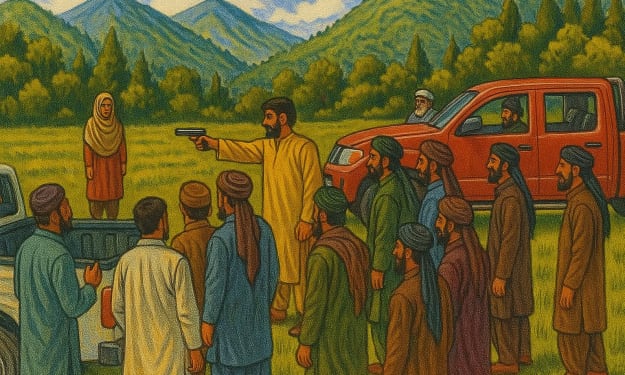
Almost two hundred years ago it is Balochistan. And inside the mountains of Balochistan is a purely tribal area called Kohlu. The interesting thing is that the year is also 1825. That is, exactly two hundred years ago from today. In a house of Kohlu, a child is born. He is named “Lal Han”... Growing up, he becomes a shepherd. It is the monsoon season (just like nowadays)... This shepherd is outside his area with his sheep and goats. A stormy rain begins. In the midst of those mountains, a house is seen. He goes toward that house to seek shelter. The men of the house are not there. According to the customs of that time, the woman of the house becomes the host. She is a newlywed bride. The woman tries to save her tent from the storm. The strong winds take away her dupatta. She is trying to save the belongings. Lightning flashes. In the thousandth part of a second, Lal Han's eyes fall on that woman whose hair is open and the storm has taken away her dupatta, but she, unaware of the world, is trying to save her shelter. In this thousandth part of a second, Lal Han’s life changes and he becomes “Mast Tawakali” and “Sammu Beli”. That woman is none other than “Sammu”. Imagine that it is a purely tribal time from two hundred years ago. Mast Tawakali not only falls in love with a married woman, but also mentions her name in his poetry. He even calls himself “Sammu Beli” meaning friend of Sammu. But no one’s “honor” awakens to go and kill that shepherd. Rather what happens is that they are called “Hazrat Mast Tawakali”. After his death, people come to his grave with great respect and his grave becomes a spiritual center. No one knows the real meaning of the name “Sammu”, but even today thousands of women in Baloch society are named “Sammi”. It is a time fourteen hundred years ago. In Makkah, a woman does business. She is independent. She sends her goods with a young man to Syria. She is impressed by his honesty. She initiates. Sends a proposal through her slave. Yes, fourteen hundred years ago, a woman is sending a marriage proposal. They both get married. That woman is Umm-ul-Momineen Hazrat Khadija (may Allah be pleased with her) and the young man is Hazrat Muhammad (peace be upon him). Here, every year hundreds of women and men are killed in the name of “honor”. These people derive the concept of this “so-called honor” either from tribal customs or from religion. Both of these events negate this idea. Fast forward. It is the developed era of 2025. It is the age of social media. A video is circulating on social media. The time and place of the video are unknown. There is a group of so-called honorable men. A “Sammu” is brought. A Qur’an is in her hands. A wretched one takes the Qur’an from her hands. She is not scared. She is not panicked. She is not pleading or begging. She says one sentence. She makes an explosion. “Bera sum na ijaazat e numay” (Only the permission to shoot is yours.) This is not just a sentence. It is a philosophy, a declaration, a rebellion. She is not asking for permission, she is giving permission. She is issuing an order. She is announcing a verdict. She is declaring that I am not anyone's property. I am not a domesticated animal. I am a living, breathing human. I have the right to live on my own terms, and the right to die on my own terms too. She walks seven steps ahead. And then she becomes free. With the rattling of bullets in the air, the echo of one sentence is heard: “Bera sum na ijaazat e numay” This one sentence is enough to shatter the walls of this so-called honor. There should be poetry written on this, stories should be written, books should be compiled, films and dramas should be made. Bera sum na ijaazat e numay.
By Ikram Ullahabout a year ago in Viva