activism
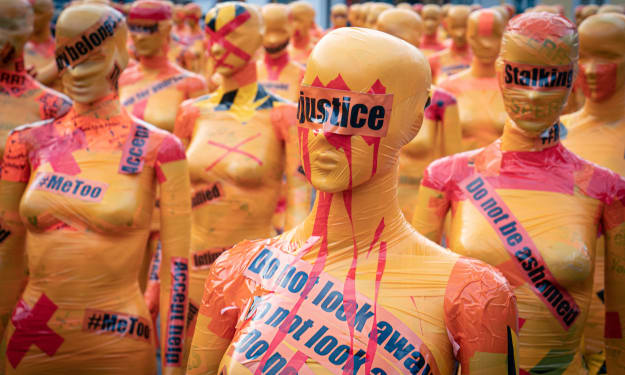
Feminist activists are not deterred by the daunting statistics so much as they're fueled by them.
Black Inside, (Not) Black Outside (Part II)
Recently, I published a text about job interviews in which I describe my experiences and share some tips. Afterwards, I realized that this article lacks nuances because it focuses only on the applicants. Getting hired doesn’t depend only on the applicant, but most often on different other factors, like the interviewer(s) backgrounds and biases, the whole corporative culture, the society values, and the applicant social and ethnical community.
By Marie Cadette Pierre-Louis4 years ago in Viva
The Stages of Emily Doe
Acknowledgments In order to tell this story properly, I must acknowledge those involved– All those who thread my pain together in the blanket that kept me hidden, to those who poked holes in the blanket’s thick wool to let the light hit my face. Some faces I still remember, and others will be burned in my hippocampus until my body meets the ground. It’s important to note that without those people who made me experience what hell feels like, I would not be who I am…but it is because of the people that made me see the possibility of heaven that I am still here.
By Thee Broken Venus 4 years ago in Viva
Black Inside And (Not) Black Outside
I never knew the word black was banished until I left Haiti, a country where most black people wouldn’t dare to forget the story of black people on this island. The word “black” has such an importance there, that even the Haitian Creole word for black (nèg for men, and nègès for women) is also used for referring to people in general. I always knew that there are several words to describe black people, and I have been thinking about them since my childhood. Nevertheless, I supposed that these terms were just used for special contexts, and the word black itself was the most neutral way to illustrate the color of a black person. My confusion over black identity started when people would avoid referring to my color.
By Marie Cadette Pierre-Louis4 years ago in Viva
The Dystopia I Feared Is Upon Us. Top Story - May 2022.
I am a writer. Words and the stories I create with them are my identity and my life's purpose. But every now and then I go through these "no writing" spells, where the stories and words just won't come. I'm starting to recognize that these spells coincide with world events, over which I have no control. I'm trying little tricks to fool myself into storying, like leaving my docs open to the next paragraph or feeding my brain inspiring stuff–books, movies, videos–to get over the hump. But this time, as we face the defeat of women's reproductive freedom in the United States, the words won't come. All I can see is The Handmaid's Tale in my mind, which leaves room for nothing else.
By Hillora Lang4 years ago in Viva
So Much to Lose
I've been thinking about all that could be lost in my life as a single woman who chose never to marry or give control of my life to a man, as the Republican Religious Right works to destroy the gains we've made as a humanistic society, wherein everyone deserves to be treated equitably and respectfully. I'm sure there are many things I haven't thought of yet. Please add your own concerns in the comments.
By Hillora Lang4 years ago in Viva
Him
Sophia woke up abruptly after tossing and turning and successfully rolling herself off the bed, crushing the remnants of last night’s takeout. Listening to the soft pounding of the music next door as she stared at the darkness above her, she briefly wondered if she’d ever have the energy to throw a party like the neighbors were again. She sat up groggily, shoving aside an empty bottle of cherry vodka and rubbing her tired eyes before focusing on the clock. It was only five o’clock in the morning. She hadn’t fallen asleep until after two. On the bright side, she’d slept more than she had the previous few nights. Maybe if she slept for five hours straight next time she would celebrate. Buy a bottle of fancy wine and a couple bags of Doritos.
By Shelby Larsen5 years ago in Viva
The Beauty and Power of Womanhood
What is a Woman? A woman is a female human being. The word woman can be used either generally or locally to refer to adult females. It is also sometimes used to refer to female human beings who are biologically female but who identify as women culturally.
By Nifra Nihar5 years ago in Viva
Be the change you want to see in the world
There's an old story. An young woman used to cut the end of a lamb roast before she puts it in the oven. One day her husband asked her, "Honey, why did you cut the end of the lamb roast?" And she goes, "Well I don't know. I do it because that's what my mom used to do. Then his husband said, "Ok then call your mom. I want to know the reason." The woman called her mom and asked the same. But her mom didn't even know the answer. She replied, "I used to do it because that's what your grandmother did." After that they also called the granny. Granny came with the answer, "Well, in our times the oven was not so big as today. So cutting the end was an option to make it fit in the oven."
By Tanvir Rashik Shafim 5 years ago in Viva
Take Me Serious;
I do not work in so-called corporate America. However, I am over some pretty hefty decisions in my career. I work in customer service for a nationwide 3PL company, and I have my own writing company #KristinaWrites where I handle social media/blogging for an array of customers. Where it feels as if I make upwards of 30,000 decisions a day; why is it so difficult for some to accept my decisions over a man? I am seeing this firsthand far too often; and it is irritating. Is it that my decisions that are respected less than a mans or is it me that is respected less than a man? Either way, I need to talk myself off this cliff right about now.
By #KristinaWrites5 years ago in Viva
7 Ways You Can Stand Against Rape Culture
Rape culture is a term used to describe a society that normalizes and perpetuates the idea that sexual violence is inevitable. It creates an environment in which victims of rape are told they should have done more to prevent it. Rape culture is so ingrained in our society, it can feel impossible to stand up against it. But there are many ways you can start today. Here are some simple, yet powerful, ways you can make an impact in your community and help create a culture where rape isn't tolerated. What is rape culture? Rape culture is the set of attitudes, behaviors, and beliefs that perpetuate rape. It is thought to be a society-wide problem, with one in five women being sexually assaulted during their lifetime. Because of this, it's important for everyone to take a stand against rape culture. Rape culture starts at a young age and continues throughout adulthood. There are many ways to combat it, but the first step is figuring out where you can start. Start by educating yourself and others The first step to standing up against rape culture is educating yourself and others. If you're not sure what constitutes rape, learn more about the different types of rape. If you don't know what consent is, take some time to read up on it. You need to understand the signs of sexual violence before you can help stop it. You can also educate others by bringing awareness to these issues in your everyday life. The more people who are educated about the realities of sexual violence, the less prevalent it will become. Educate your children One of the most powerful ways to create a culture where rape isn't tolerated is to educate your children. Teach them about consent and non-consent, and let them know that no one should ever do anything to someone else without their consent. Additionally, teach your children what to do if they see something happening at school or in the community that could be abuse. Don't victim blame Rape culture often includes victim blaming. It creates an environment in which victims of sexual violence are told they should have done more to prevent it. For example, a woman wearing a short skirt is blamed for her attack because she was "asking for it." Similarly, a man who was drinking alcohol at the time of his assault is told he should have been more aware and sober to protect himself. Refuse to blame the victim. When someone shares their experience with you, support them unconditionally and validate their feelings – don't question how they could have acted differently or what could have prevented it from happening. Practice consent in your relationships The first step to standing up against rape culture is looking at your own behavior and the behaviors of those around you. It's important to establish consent with your sexual partners, especially if you are in a position of power over them. For example, it would be inappropriate for an employer make sexual advances on an employee. Asking for consent before initiating any sexual contact is a simple act that can help create a culture where rape isn't tolerated. It's also important to practice affirmative consent in relationships that aren't explicitly sexual. A partner might want to cuddle on the couch but not kiss or vice versa. Negotiating this kind of touch beforehand is a simple way to create boundaries and prevent misunderstandings about expectations later on. Don't excuse violence against women The first way to stand against rape culture is to not excuse violence against women. The message that "boys will be boys" or "she was asking for it" needs to stop! Violence against women should never be excused, minimized, or tolerated. It's important for everyone in your community, especially those closest to the victim, to stand up and say: "No more." Next, commit to educating others Educating others about rape culture can make an impact. If you know someone who is making excuses for violence against women, talk with them about what they're saying. It may take some time for them to understand why their behavior is damaging and hurtful. But eventually they'll get it. And hopefully once they do, they'll change their views and their behavior as well. Another way you can help create a culture where rape isn't tolerated is by making sure your kids are educated on consent. Start talking with your children early on about what consent means and when it's violated so they will understand the importance of respecting other people's boundaries or telling them no when something doesn't feel right or safe (regardless of gender). You could also talk with them about how wearing revealing clothes doesn't mean that person wants sex just because they're dressed like a "slut." It's important to teach kids these lessons early on before they start developing attitudes or ideas that might lead them into unhealthy situations later in life without even realizing it. Visit RAINN Support survivors of sexual assault Rape culture is a difficult issue to confront head on. It can be hard to talk about, especially if you are close to the person who was assaulted. But in order to stand against rape culture, it's important that we start talking about it and supporting survivors of sexual assault. One way you can support survivors is by going with them to the hospital or police station after they've been assaulted. They might not want to go alone and having someone there with them can make it easier for them. Another way you can help is by learning what resources are available in your community and making sure that people know where and how they can get help if they have been assaulted. You could also use your voice on social media or as a respected member of the community to call out people who are perpetuating rape culture and telling their friends not to do the same thing.
By Abhishek Gupta5 years ago in Viva