
Do not forget the women who rebelled
From the death of Jina Mahsa Amini to the Woman, Life, Freedom movement: a struggle against political oppression, religious authority and the denial of individual freedom.

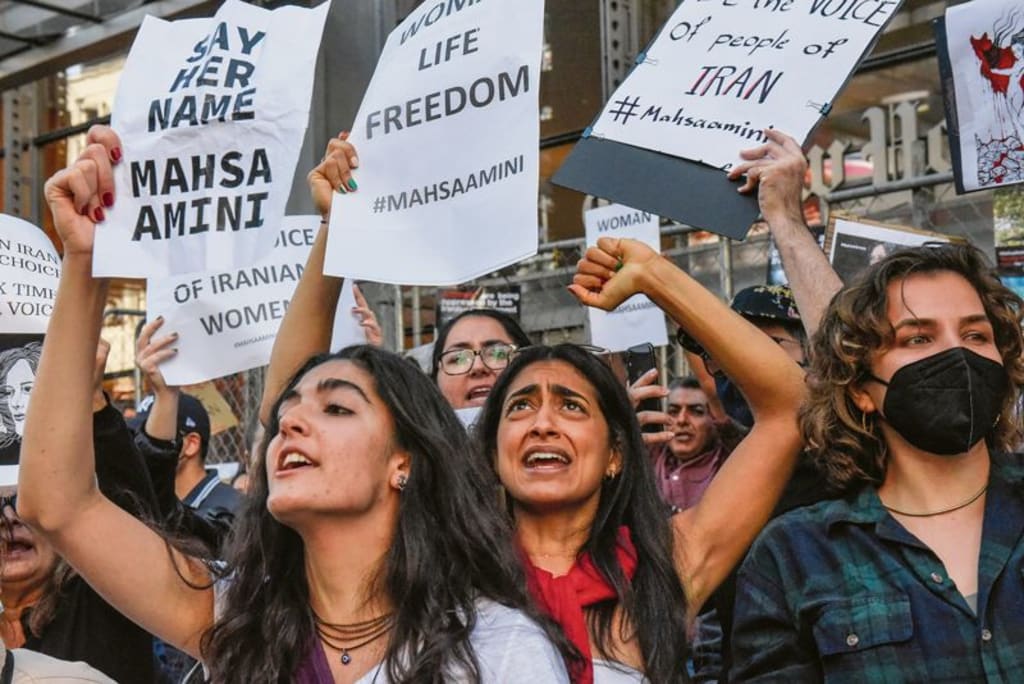
On 16 September 2022, a 22-year-old Kurdish-Iranian woman, Jina Mahsa Amini, died in the custody of Iran's morality police after being arrested for allegedly violating the country's compulsory hijab regulations. Her death sparked demonstrations that would spread throughout Iran, bringing thousands of women and men onto the streets to challenge a political system that has governed their lives for nearly half a century.
Women removed their headscarves, cut their hair and confronted security forces, while students and young men joined the demonstrations. Many were arrested, injured or killed. For the authorities, these acts represented a challenge to the ideological foundations of the Islamic Republic. For those participating, they were an expression of something far more immediate: the desire to determine the conditions of their own existence. Iran has experienced numerous protests over the years, from disputed elections to economic crises and demands for political reform. Yet the movement that emerged in September 2022 brought something particularly unsettling to the country's ruling establishment. Women, whose bodies and behaviour had long been subjected to state regulation, became the most recognisable figures of a rebellion against the very institutions claiming the authority to regulate them.
What could be more dangerous to an authoritarian government than people who begin to question the legitimacy of the authority they have been taught to obey?

This Is Different, but the Struggle Is Not New
To understand the significance of the Woman, Life, Freedom movement, we should return to the Islamic Revolution of 1979. The overthrow of Mohammad Reza Shah Pahlavi brought together political forces with profoundly different visions of Iran's future. Religious conservatives, leftists, liberals and other opponents of the monarchy had participated in the revolutionary struggle, but their expectations of the society that would emerge were not necessarily compatible.
For many women, the contradictions became apparent almost immediately. On 8 March 1979, International Women's Day, thousands of Iranian women demonstrated in Tehran against the new authorities' attempts to impose compulsory veiling and restrict women's rights. Having participated in a revolution promising liberation from an authoritarian monarchy, they now confronted another political authority seeking to determine how they should dress and what place they should occupy in society. There is a disturbing irony here. A revolution undertaken in the name of political liberation had created conditions in which women once again needed to defend their most elementary freedoms.
The struggle continued through subsequent decades. Iranian women's organisations campaigned against discriminatory laws, while the One Million Signatures Campaign, launched in 2006, sought legal reforms concerning marriage, divorce, inheritance and other inequalities. Later movements used social media to challenge compulsory veiling and bring women's everyday experiences into public view. This historical continuity matters because the women who rebelled in 2022 did not suddenly discover the meaning of resistance. They inherited a struggle that previous generations had already undertaken, often at tremendous personal cost. What distinguished the movement was its scale, its younger participants and the way women's freedom became inseparable from wider demands for political change.
Baraye: When a Song Becomes a Collective Voice
One of the uprising's most memorable expressions came through music. In September 2022, Iranian musician Shervin Hajipour released Baraye, meaning For or Because of. The song was constructed from messages shared by Iranians on social media, expressing their frustrations with economic hardship, political repression, restrictions on personal freedom and the difficulties of ordinary life. It quickly became an unofficial anthem of the demonstrations, reaching millions of people before Hajipour was arrested. He was released on bail in October 2022, subsequently sentenced to imprisonment in 2024 and later announced that he had received a pardon.
What interests me about Baraye is the simplicity of its political expression. It does not depend upon an elaborate revolutionary programme. Its emotional force emerges from the accumulation of everyday experiences, from things that might appear insignificant to someone who has never been deprived of them. The ability to dance, to express affection, to dress according to one's wishes or to imagine a future free from constant fear: why should these ordinary possibilities become demands that people must risk their lives to defend?
Perhaps this is what makes the song so revealing. Political oppression is not experienced only through imprisonment, executions or the visible violence of security forces. It enters personal relationships, ambitions, gestures and decisions. It reaches into the ordinary circumstances through which individuals construct their identities. A government may claim authority over public behaviour in the name of religion, morality or national unity. But what happens when that authority begins to determine the intimate conditions through which a person understands their own existence?

The Women Who Refuse to Be Victims
There is another aspect of the Iranian women's movement that deserves particular attention. International reporting frequently presents Iranian women through the violence committed against them. Although that violence must be documented, concentrating exclusively on their suffering risks overlooking their capacity to resist and transform the society in which they live.
Research published in Women's Studies International Forum in 2020 offers an interesting perspective. A qualitative study involving interviews with 17 young Iranian women and written responses from 87 participants in a larger survey of 391 women in Shiraz examined how they negotiated social restrictions and developed strategies for change. The researchers identified two interconnected themes: the formation of multiple identities and the understanding of women as agents of social change. The first is especially revealing. Women described negotiating different expectations across public life, private relationships and their online activities. These were ways of managing restrictions without necessarily abandoning their individual desires and beliefs.
I find this psychologically interesting because it raises a question about identity. What happens when an individual is required to maintain one existence in public while experiencing another in private? When the social identity demanded by political authority comes into conflict with the person someone understands themselves to be? Yet the women interviewed did not regard themselves as powerless. They described ways of challenging restrictions through education, social relationships, digital communication and changes in everyday behaviour. Their experiences remind us that political resistance does not always begin with a demonstration. Sometimes it develops through the refusal to accept that the conditions inherited from society must determine the possibilities of one's future. This also helps explain why the compulsory hijab became such an important symbol of the 2022 uprising. The central question is not whether women should wear a headscarf. Many Iranian women choose to do so as an expression of religious or personal identity. The problem arises when that choice is removed, and compliance becomes an obligation enforced.
The Regime's Response and the Construction of an Enemy
The Islamic Republic has repeatedly attempted to explain protests through accusations of foreign interference, particularly by the United States and other Western governments. This narrative is politically convenient. By presenting dissent as an extension of external hostility, the authorities can seek to transform legitimate domestic grievances into questions of national security and loyalty.
However, the historical relationship between Iran and Western powers cannot simply be ignored. American and European sanctions have placed considerable pressure on the Iranian economy, while research has documented their effects on access to essential medicines and healthcare. The political problem becomes more complicated when measures supposedly directed against a government also impose costs upon the population living under it.
But acknowledging these consequences does not require accepting the authorities' explanation of the protests. Iranian women did not need foreign governments to teach them that they were being denied fundamental rights. Their resistance had already existed for decades. The United Nations' investigation into the 2022 demonstrations subsequently established that Iranian security forces had committed serious violations, including unlawful killings, arbitrary detention, torture and sexual violence. The investigation concluded that some of the violations amounted to crimes against humanity.
What kind of political legitimacy can be maintained through the imprisonment, intimidation and killing of people demanding the right to participate in determining their own future?

A Revolution Worth Remembering
Four years after the death of Jina Mahsa Amini, Iran's political circumstances remain deeply troubled. Compulsory hijab regulations have not been abolished, even as many women continue to defy them in public. Further nationwide protests beginning in December 2025 were met with another severe crackdown, while international human rights investigators continued to document repression and the absence of accountability.
It would therefore be premature to describe the Woman, Life, Freedom movement as a completed revolution, or to pretend that its aspirations have already been realised. But should a movement be judged only by whether it succeeds in overthrowing a government? The women who entered the streets in 2022 challenged something that had been presented as an unquestionable feature of Iranian political and social life. Their actions exposed the distance between the authority claimed by the state and the consent of those expected to obey it. There is a profound difference between living within a society and accepting that every aspect of one's existence belongs to the institutions governing it. The young women of Iran have demonstrated this distinction through their own lives, often facing consequences that those of us observing from elsewhere can scarcely imagine.
We should remember them because political freedom has never been maintained by declarations alone. It depends upon individuals who are prepared to question the authority exercised over them, sometimes when doing so means risking everything they possess. The women who rebelled in Iran should not become another forgotten image of international protest, remembered only when a new tragedy briefly returns their country to the headlines. Their struggle deserves something more enduring than our temporary attention.
Do not forget the women who rebelled.
Written and published by Sergios Saropoulos
Sources and Selected Bibliography
United Nations Independent International Fact-Finding Mission on Iran. Report of the Independent International Fact-Finding Mission on the Islamic Republic of Iran (2024). Findings on Jina Mahsa Amini's death, the 2022 protests, unlawful killings and state responsibility.
https://www.iranrights.org/library/document/4143United Nations Office at Geneva. Human Rights in Iran — Human Rights Council, 21 September 2026. Statements on continuing repression, lack of accountability and the protests of December 2025.
https://www.unognewsroom.org/teleprompter/en/3270/hrc-63-human-rights-in-iran-21-september-2026/9704Human Rights Watch. Unveiling Resistance: The Struggle for Women's Rights in Iran (26 June 2023). Historical background on women's activism and the One Million Signatures Campaign.
https://www.hrw.org/news/2023/06/26/unveiling-resistance-struggle-womens-rights-iranSalehi, Asiyeh, et al. “Young Iranian Women as Agents of Social Change: A Qualitative Study.” Women's Studies International Forum, vol. 79, 2020, article 102341. Research on multiple identities, social restrictions and women's agency.
https://researchportal.scu.edu.au/esploro/outputs/journalArticle/Young-Iranian-women-as-agents-of/991012927071702368Hadi Kahalzadeh. The Islamic Republic of Iran's Chastity and Hijab Law and the Weaponization of Women's Economic Vulnerabilities. Brandeis University, Crown Center for Middle East Studies, December 2024. Research on compulsory veiling, public opinion and economic coercion.
https://www.brandeis.edu/crown/publications/middle-east-briefs/meb162.htmlPEN America. Shervin Hajipour — Writer at Risk. Documentation of the musician's arrest, sentencing, pardon and continuing restrictions following the release of Baraye.
https://pen.org/writer-at-risk/shervin-hajipour/Mohamadi, Efat, et al. “Impacts of Economic Sanctions on Population Health and Health System: A Study at National and Sub-national Levels from 2000 to 2020 in Iran.” Globalization and Health, 20, article 81, 2024. Research on sanctions and healthcare access.
https://link.springer.com/article/10.1186/s12992-024-01084-2Amnesty International. Why Is Amnesty International Calling for International Justice for Crimes Against Humanity in Iran? 16 September 2026. Documentation of protest-related human rights violations and the need for accountability.
https://www.amnesty.org/en/latest/campaigns/2026/09/why-is-amnesty-international-calling-for-international-justice-for-crimes-against-humanity-in-iran/Human Rights Watch. World Report 2026: Iran. Assessment of women's rights, compulsory hijab enforcement and restrictions on fundamental freedoms during 2025.
https://www.hrw.org/world-report/2026/country-chapters/iranCouncil of the European Union. EU Sanctions Against Iran. Official explanation of EU human rights sanctions, including targeted restrictions and measures relating to internal repression.
https://www.consilium.europa.eu/en/policies/sanctions-against-iran/
About the Creator
Sergios Saropoulos
As a Philosopher, Writer, Journalist and Educator. I bring a unique perspective to my writing, exploring how philosophical ideas intersect with cultural and social narratives, deepening our understanding of today's world.
Enjoyed the story? Support the Creator.
Subscribe for free to receive all their stories in your feed.
Comments
There are no comments for this story
Be the first to respond and start the conversation.