
You Can Copy Buffett’s Checklist. You Can’t Copy His Nerve.
AI can read every shareholder letter and build a perfect model. The hard part starts when the market changes and the checklist runs out.
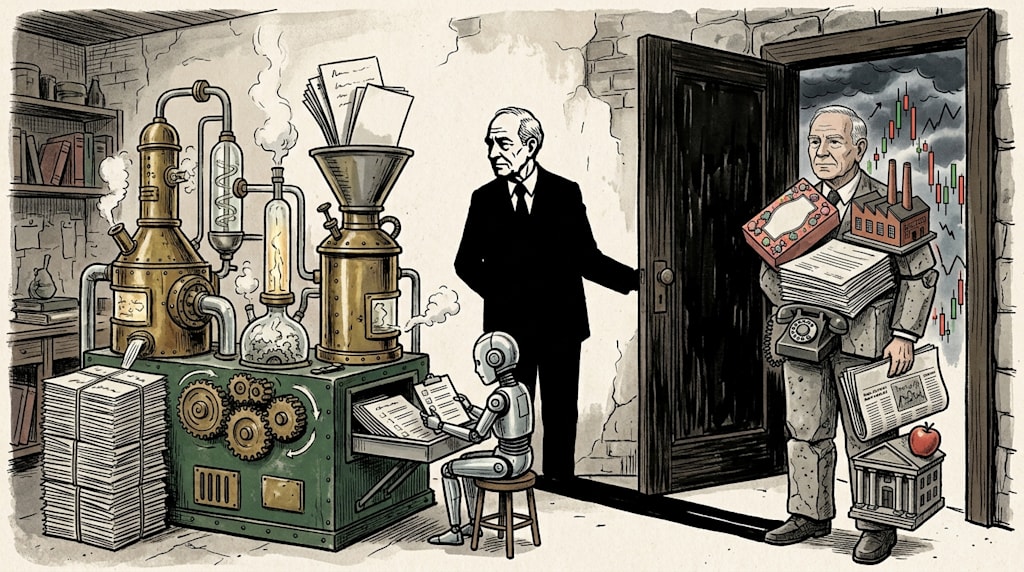
Why We Can’t Distill a Buffett
1
Over the past few years, as AI moved into finance and investing, one of the liveliest pursuits has been “distilling Buffett.”
In open-source communities, some people have split Buffett, Munger, Duan Yongping, and Li Lu into separate AI agents. Buffett looks at financials and valuation. Munger handles contrarian thinking and risk checks. Duan Yongping looks at business models and corporate culture. Li Lu looks at long-term certainty. It sounds like a well-defined all-star investment research team.
So far, hardly any product reliably reproduces Buffett’s judgment.
The reason is simple. What people distill is what Buffett said and did. They do not distill how he keeps judging, betting, correcting, and evolving when the answer is not in the data. The first is history. The second is investing.
2
Distillation began as a chemical process. A mixture is heated. Components vaporize at different boiling points. They condense and separate. Large-model research borrowed the term: knowledge distillation.
The idea is to let a small model imitate a large model’s behavior and knowledge. Parameters and computation drop. Performance is supposed to stay close to the teacher’s.
That works in image recognition, text generation, and Go. The teacher is stable. The task is well defined. Feedback is dense. The student can keep closing the gap.
An investment master is not a stable function.
Buffett is not a model that takes in financial statements and outputs buys and sells. He is a person who changed, corrected himself, and evolved over decades. What you distill is a snapshot.
3
Buffett’s shareholder letters, interviews, speeches, and cases are a rich mine. AI can break them into rules: moats, circle of competence, margin of safety, contrarian thinking, long-term holding, concentrated investing.
A checklist is not judgment.
See’s Candies raised prices every year. Customers stayed. Buffett judged that a moat.
Berkshire’s textile mill accounted for 25% of U.S. cotton capacity. It did not make money. Buffett judged that scale in a commodity industry is not a moat.
The rules can be summarized as brand, switching costs, network effects, cost advantages. The hard part is knowing which rule applies now, how much weight it deserves, what price still works, whether management can be trusted, what the opportunity cost is, and when the rule will stop working.
AI can learn rules. It can learn exceptions. It has trouble learning when to make an exception.
The most valuable part of investing is the exception, the adjusted weight, the timing. Those things are not in the text. They are in practice.
4
Buffett’s moat judgments are often intuitive. That intuition was not innate. It came from decades of watching businesses, reading, talking, failing, and reflecting.
He moved from cigar butts to See’s Candies-style quality investing. Later he bought Apple. He was evolving.
Distill a static Buffett, and the market changes. He stops working.
Buffett’s success did not come from following a rule. He created rules in practice and kept changing them. Rules go stale, market structure shifts, and competition changes. Technology and interest rates change too.
AI can distill his framework in finer and finer detail. What it extracts are judgments he already made. It does not extract the judgments he will make next.
In a new market, that second thing is the hard part.
5
Many people think Buffett’s skill is stock picking. It is more than that.
His advantage is a mix of cognition, temperament, capital structure, organizational design, reputation, network, and the era he worked in.
Cognition: business judgment, capital allocation, management evaluation, long-term certainty.
Temperament: patience, concentration, decisiveness, admitting mistakes, long-term reputation.
Structure: insurance float, permanent capital, tax deferral, cash flow from controlled businesses.
Network: Munger, bankers, entrepreneurs, management, deal flow.
Era: postwar U.S. growth, consumer brands, falling interest rates, globalization.
You can have AI play Buffett. It does not have Berkshire’s capital structure. It does not have insurance float. It does not have money that will never be pulled because of redemptions. It does not have Buffett’s reputational promise when he buys a company: keep the culture, do not dismantle it, give it autonomy.
Same judgment, no ability to execute it, different result.
Insurance float is low-cost, long-term, sometimes negative-cost leverage. It lets Buffett buy when others panic and hold when others are forced to sell. AI can learn “buy high-quality low-beta.” Without float, it cannot reproduce the funding.
Buffett’s reputation gets him deals others cannot get. Goldman Sachs, GE, bank preferred stock. Those opportunities are not available for the asking in the public market. AI has no such deal flow.
6
In 2013, Andrea Frazzini and others published “Buffett’s Alpha.” They used a quantitative model to attribute Berkshire’s performance over thirty years. They found that a “Buffett factor” explained a large part of the returns: a bias toward low-beta, high-quality stocks, plus low-cost leverage from insurance float.
The paper summarizes Buffett’s method well.
But it replicates the statistical features of his portfolio. It does not replicate the process by which he used other, less visible clues to choose. The paper admits that the factor model is built on public data and cannot replicate Buffett’s achievement.
Factors explain past returns. They do not tell you what to buy in a new environment.
Factors are statistical features, not a generative mechanism. They tell you what he once bought. They do not tell you why he bought, when he bought, how much he bought, or when he sold.
7
Large-model distillation assumes stable teacher inputs and outputs. The student can approximate them. Investing is open, non-stationary, noisy, and reflexive.
Non-stationary: rules go stale, market structure changes, factors become crowded.
Reflexivity: if everyone distills Buffett and buys high-quality low-beta, prices rise, expected returns fall, and alpha gets arbitraged away. Market participants’ beliefs change the market.
Sparse feedback: a major decision may not be validated for years. Samples are few. It is not Go, where millions of self-play games are available.
Missing counterfactuals: you do not know what he rejected, what he passed on, why he passed, or why the position was 5% instead of 20%.
Tacit knowledge: many judgments are implicit, contextual, and relational. They cannot be fully formalized. Polanyi said, “We know more than we can tell.”
Buffett can look at management, an industry, a person, and decide in minutes. That kind of judgment cannot be fully encoded.
8
AI is useful. It can be a strong investment research assistant.
It can read financial statements quickly, summarize shareholder letters, generate moat checklists, run risk checks, simulate styles, monitor portfolios, flag biases, and stress-test positions.
It can distill Buffett’s framework in fine detail. Ordinary investors can then use a master’s checklist.
It cannot replace Buffett. Buffett is not a set of compressible parameters. He is a living system.
You can have AI help you ask, “If Buffett saw this company, how would he think about it?” You cannot have AI answer, “Should I bet now?”
9
AI can write shareholder letters that sound like Buffett. Shareholder letters are after-the-fact communication. They are not the reason for the decision.
Investment judgment requires bearing risk, reputation, legal responsibility, and psychological pressure.
AI has no skin in the game. It does not bet or sit through a drawdown. It never faces the fear of being wrong.
Investing is practical wisdom, not technical knowledge. It demands commitment with incomplete information and the discipline to correct mistakes in noise.
AI can help process information. It is not the decision-maker.
10
The technology is strong enough. The goal is wrong.
You can distill Buffett’s shadow. You cannot distill his next judgment.
The first is history. The second is investing.
We can distill Buffett’s shareholder letters, Munger’s latticework, Duan Yongping’s benfen, and Li Lu’s long-term certainty. We can turn them into agents, workflows, and research assistants.
We cannot distill a living person who keeps judging, betting, correcting, and evolving in the unknown.
What matters most about Buffett is not what he bought. It is how he will face a world that has not appeared before.
A shadow will not place a bet in the next cycle.
About the Creator
Jin
Writer of reamstories
https://reamstories.com/jin
Enjoyed the story? Support the Creator.
Subscribe for free to receive all their stories in your feed. You could also become a paid subscriber, letting them know you appreciate their work.
Comments
There are no comments for this story
Be the first to respond and start the conversation.