
Why Hong Kong Loved Tycoon Family Dramas — and Why Mainland China Often Struggles to Make Them Work
From The Greed of Man and At the Threshold of an Era to Heart of Greed, Hong Kong’s richest families were never just rich. They were recognizable.
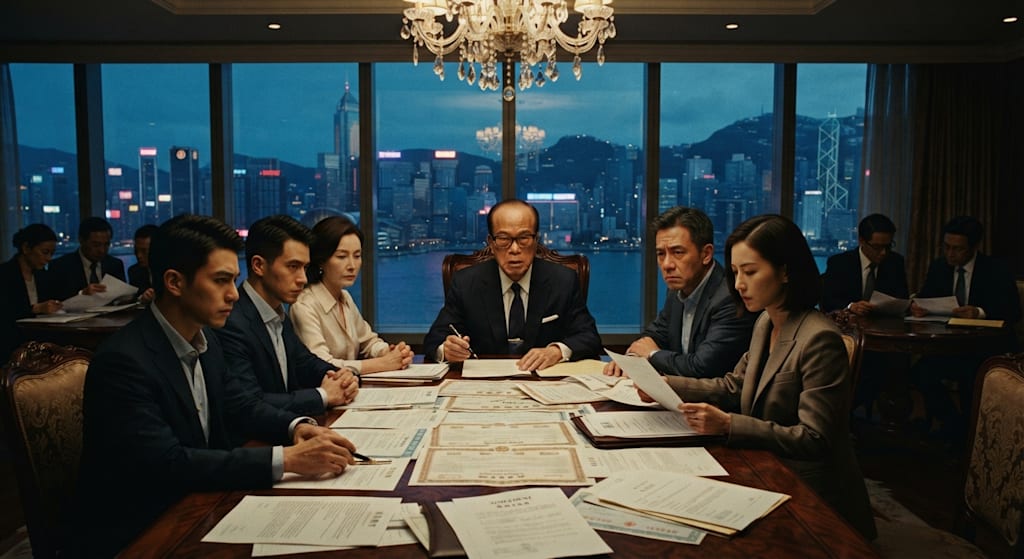
There is a particular kind of television drama that Hong Kong once made better than almost anyone else.
Put a giant family business on the screen.
Add three generations of relatives.
Give the father control of the company, the sons different ideas about money, the daughters complicated marriages, the second wife her own ambitions, and the lawyers, brokers, property developers and accountants their own interests.
Then put a succession battle in the middle of the dining room.
The result is not merely a family drama.
It becomes a miniature version of Hong Kong itself.
That is one reason the old TVB business-family dramas still have such a long afterlife.
The Greed of Man (大時代), starring Lau Ching-wan and Adam Cheng, was built around two families whose fortunes became entangled with money, revenge and the Hong Kong stock market. TVB itself describes the drama as a story spanning almost three decades, using two families and two generations to explore what happens when wealth, status and human relationships become inseparable.
Seven years later, At the Threshold of an Era (創世紀) pushed the formula further. The drama followed entrepreneurs, property development, business competition, friendship, betrayal and the rise and fall of entire fortunes. TVB's own description centers on the transformation of the characters from small-time builders into major property figures, with family and business interests gradually becoming impossible to separate.
Then came Heart of Greed (溏心風暴).
Here, the battlefield was smaller.
A family business.
A house.
A kitchen.
A dining table.
A marriage.
An inheritance.
And somehow, the emotional pressure became even higher.
The show became a television laboratory for one of the most reliable engines in popular drama: take money, put it inside a family, and wait.
The money itself is rarely the most interesting thing.
The interesting thing is what people do when they believe the money belongs to them.
The secret was never luxury. It was recognition.
This is where Hong Kong's old tycoon dramas had an advantage.
They did not need to convince the audience that rich people existed.
Everyone already knew.
Hong Kong was a compact financial city whose public life had long been saturated with property developers, business families, stock-market personalities, entertainment entrepreneurs and newspaper stories about succession, marriages, lawsuits and corporate battles.
The distance between television and newspaper culture was therefore unusually small.
A fictional billionaire did not feel like an alien species.
He felt like somebody the audience had already seen somewhere.
Perhaps not personally.
Perhaps not even accurately.
But in a newspaper photograph.
In a magazine profile.
In a court report.
In a business headline.
In a gossip column.
In a rumor discussed over lunch.
That distinction matters.
A fictional wealthy family works when the audience possesses a mental model of what a wealthy family could plausibly look like.
Hong Kong had one.
The old TVB writer did not have to invent the entire ecosystem from scratch.
The audience already understood the vocabulary:
property,
shares,
family companies,
board meetings,
succession,
mistresses,
inheritance,
private schools,
overseas assets,
second marriages,
business partners,
old money,
new money,
and the quiet question underneath everything:
Who gets what when the patriarch dies?
That is why the best Hong Kong tycoon dramas never depended entirely on expensive houses and expensive cars.
The real spectacle was ownership.
The audience knew that the family table was also a balance sheet.
This is probably the most important difference.
A weak wealth drama treats money as decoration.
A strong wealth drama treats money as a relationship.
Who controls the company?
Who owns the shares?
Who has voting rights?
Who has the father's trust?
Who controls the information?
Who has children?
Who married whom?
Who has influence over the lawyers?
Who knows about the offshore company?
Who has already moved the assets?
Who is pretending not to care?
Those questions create drama without requiring the characters to behave like cartoon villains.
The family dinner becomes a corporate meeting.
The wedding becomes a transaction.
A divorce becomes an ownership dispute.
A death becomes a succession crisis.
A romantic relationship becomes a potential change in the balance of power.
A family argument becomes a governance problem.
That is why money works so well as a dramatic device.
Money is measurable.
Love is not.
Jealousy is not.
Respect is not.
But money can be divided into percentages.
Ten percent.
Twenty percent.
A controlling stake.
A property.
A trust.
A company.
A voting right.
Suddenly an emotional conflict has an external shape.
The audience can see what is at stake.
And once the audience understands the stakes, even a conversation in a living room can feel like a boardroom coup.
Hong Kong television also understood the pleasure of recognition.
Some of the old dramas clearly operated in the cultural shadow of real Hong Kong business stories.
That does not mean every fictional character can be cleanly matched to one real person, and it would be misleading to treat every resemblance as documented biography.
But the larger phenomenon is undeniable at the level of popular culture: viewers recognized echoes of the city's property empires, family businesses, celebrity entrepreneurs, inheritance disputes, legal battles and tabloid scandals.
That recognition added another layer to the drama.
A fictional tycoon was not simply fictional.
He occupied the same imaginative space as the tycoons appearing in newspapers.
The audience could watch a scene and think:
"I've seen this kind of family before."
Or:
"This sounds like something that could happen in one of those famous business families."
Or even:
"Who are they borrowing this from?"
That final question is extremely powerful in popular entertainment.
It turns viewers into amateur detectives.
They stop watching only for the plot.
They begin watching for references.
Who does this character resemble?
Which business family is being echoed?
Which scandal does this subplot remind me of?
Which newspaper story has been transformed into a television scene?
Once that game begins, the boundary between reality and fiction becomes part of the entertainment.
The Gem of Life pushed the formula into full social spectacle.
The Gem of Life (珠光寶氣) took the wealthy-family formula and expanded it into a much broader portrait of status, luxury, relationships and social hierarchy. The series ran for 82 episodes and moved its characters through a world of jewelry, business, travel, family relationships and elite social circles.
At that scale, wealth becomes almost architectural.
It is not merely a character trait.
It becomes the environment.
The houses are expensive because the houses are supposed to tell you something.
The jewelry matters because jewelry represents status.
The vacations matter because access itself is a form of power.
The family business matters because it determines who gets to sit at the table.
The audience is not simply watching a rich person spend money.
They are watching an entire social system operate.
And this is where Hong Kong drama had a peculiar advantage.
The audience could simultaneously desire the lifestyle and understand the people inside it.
They could look at the mansion and still recognize the argument happening inside the mansion.
The aspiration and the criticism could exist at the same time.
That combination is difficult to manufacture.
Why did this become addictive?
Because these dramas offered two fantasies at once.
The first fantasy was obvious.
What would it be like to live like that?
The second was more important.
What would happen if all that wealth were suddenly placed inside my family?
That is the fantasy that turns luxury into drama.
Most people will never control a listed company.
Most people will never inherit a property empire.
Most people will never sit inside a boardroom deciding whether to sell a controlling stake.
But everyone understands family conflict.
Everyone understands favoritism.
Everyone understands the resentment of seeing one sibling treated differently.
Everyone understands the fear of being excluded.
Everyone understands the moment when a parent says:
"This is mine."
And somebody else thinks:
"One day it will be mine."
The tycoon drama simply places these familiar human conflicts inside a much larger economic structure.
The amounts become enormous.
The emotional mechanisms do not.
That is why the genre is surprisingly universal.
And this is also why many mainland Chinese “rich family” dramas feel awkward.
The problem is not that mainland China lacks wealthy families.
It obviously does not.
Nor is it that audiences dislike stories about wealth.
They clearly do not.
The problem is that wealth on screen often becomes too abstract.
The audience sees the villa before it sees the balance sheet.
The sports car appears before the company does.
The designer clothes appear before the ownership structure.
The characters announce that the company is worth billions, but the viewer cannot understand what the company actually does.
The family supposedly controls an enormous business empire, yet the business itself feels like a cardboard backdrop.
Someone says:
"We control the entire group."
Fine.
But what does the group produce?
Where does the cash come from?
Who are the customers?
What happens when a subsidiary loses money?
What does the father actually do all day?
What does the son actually want to control?
Without answers to these questions, wealth becomes decoration.
And decoration quickly becomes embarrassing.
The viewer is being shown a fantasy of wealth rather than a functioning social world.
That is a crucial distinction.
A believable rich family still has to behave like a family.
This sounds obvious.
It is not.
Money does not eliminate ordinary human behavior.
Rich parents still favor one child over another.
Siblings still compare themselves.
People still marry for complicated reasons.
Parents still misunderstand their children.
Adults still lie to avoid humiliation.
Relatives still keep score.
People remember insults from fifteen years ago.
A family office does not erase jealousy.
A private jet does not erase insecurity.
A penthouse does not make a bad marriage interesting.
Those things only become interesting when money changes the consequences.
That is what Hong Kong television often understood.
The conflict was not:
"We are rich."
The conflict was:
"You are my brother, but you control the company I spent twenty years building."
Or:
"You are my wife, but your children will inherit what my children believe belongs to them."
Or:
"I love my father, but I know what happens to the company if I obey him."
Those are recognizable conflicts.
The money simply increases the scale.
The real difference is not Hong Kong versus the mainland. It is texture versus abstraction.
This is the part that is easy to miss.
It would be too simple to say:
Hong Kong dramas are realistic.
Mainland dramas are unrealistic.
Reality is more complicated.
There are sophisticated mainland television productions with convincing business worlds, and there are plenty of Hong Kong dramas that rely heavily on melodrama.
The deeper difference is one of texture.
The old Hong Kong business drama was often built out of small institutional details.
The company had offices.
The characters knew bankers.
They negotiated property.
They discussed shares.
They worried about contracts.
They had employees.
They had creditors.
They had competitors.
They had newspapers watching them.
They had relatives who wanted money.
The business existed outside the protagonist.
That external world gave the characters friction.
By contrast, when a rich-family drama exists only inside an ornamental mansion, every conflict has to be generated by the characters themselves.
The writer has fewer tools.
So people shout.
People misunderstand each other.
People reveal secrets at dramatic moments.
People suddenly fall in love with the wrong person.
People discover hidden children.
People inherit mysterious companies.
The plot starts producing plot.
The audience can feel the machinery.
Hong Kong had another advantage: the city itself was part of the story.
This may be the most underrated reason these dramas worked.
Hong Kong was never merely a backdrop.
Its geography, business culture and social density were embedded in the stories.
The city had a visible hierarchy.
Public housing beside luxury towers.
Old neighborhoods beside financial districts.
Small shops beside multinational corporations.
Families living close together.
Businesses operating across the harbor.
Fortunes rising and collapsing within a generation.
The economic miracle was visible from the street.
That gave business drama a physical environment.
You could film a wealthy businessman leaving a boardroom and immediately place him against the same city occupied by taxi drivers, shopkeepers, office workers and university students.
The contrast did not need to be explained.
It was already there.
The audience could see it.
That matters enormously.
Wealth becomes dramatically powerful when the audience can imagine losing it.
This is another thing the old dramas understood.
A rich character is only interesting if the wealth is unstable.
If the billionaire can solve every problem by writing a cheque, there is no drama.
But if the billionaire can lose control of the company, suddenly every relationship becomes unstable.
The father needs the son.
The brother needs the sister.
The wife needs the lawyer.
The shareholder needs the chairman.
The chairman needs the banks.
The banks need the numbers.
Everyone becomes dependent on someone else.
The economic system creates the emotional system.
That is why the best business dramas feel different from ordinary melodrama.
The characters are not simply fighting because the script requires conflict.
They are fighting because their interests are structurally opposed.
The family itself becomes an institution.
And institutions create consequences.
The audience was also watching a fantasy of social mobility.
There is another layer beneath all the family warfare.
Hong Kong's classic business dramas are often stories about people moving upward.
Poor becomes rich.
Builder becomes developer.
Employee becomes owner.
Friend becomes rival.
Family member becomes competitor.
The emotional engine is partly ambition.
The audience is not only asking:
"Who will inherit the fortune?"
It is also asking:
"How did this fortune get created in the first place?"
That question gives business dramas a historical dimension.
At the Threshold of an Era, for example, begins with characters building themselves upward through construction and property before the business relationships eventually fracture under pressure.
The audience therefore watches both the creation of wealth and the destruction caused by wealth.
That is much richer than simply showing people living in expensive houses.
And then comes the most uncomfortable part.
The fascination with wealthy families does not disappear when wealthy families behave badly.
Sometimes the opposite happens.
A scandal can make the mythology stronger.
The mansion remains the mansion.
The family remains powerful.
But now the audience knows that something terrible happened behind the gates.
This creates a strange psychological effect.
People may condemn the behavior while continuing to be fascinated by the world surrounding it.
The contradiction is not necessarily a weakness in the audience.
It is part of the appeal of wealth stories.
Luxury produces distance.
Scandal destroys some of that distance.
For a moment, the audience sees the rich person as ordinary:
jealous,
afraid,
greedy,
lonely,
controlling,
desperate to preserve status.
The mansion becomes a stage set.
The billionaire becomes a family member.
The family member becomes a human being.
And then the money comes back.
That oscillation is addictive.
This is why a modern remake would probably be irresistible.
Imagine a contemporary TVB production called:
Heart of Greed: The Heirs.
The company is no longer simply a traditional business.
It owns property.
Healthcare assets.
Retail.
Logistics.
Private investments.
Maybe a media company.
Maybe a technology platform.
The patriarch has three children.
One built the overseas business.
One stayed in Hong Kong.
One spent ten years pretending not to care.
There is a second marriage.
There is an inheritance structure.
There are trusts.
There is an old shareholder agreement.
There are lawyers.
There is a family office.
There are journalists.
There are anonymous leaks.
There are WhatsApp messages.
There is a board meeting nobody wants to attend.
And somewhere in the middle of all this, someone has to answer a simple question:
Who actually owns the empire?
That is enough material for fifty episodes.
Because once ownership becomes uncertain, every relationship becomes unstable.
The son who appears irresponsible may secretly control the votes.
The daughter who appears loyal may have her own exit plan.
The second wife may not want the money at all. She may want security.
The eldest child may not want control. They may want recognition.
And the father may discover that he created a company so complicated that nobody can inherit it without destroying the family.
That is drama.
Not because the characters are rich.
Because the wealth has consequences.
The old TVB formula was never really about billionaires.
It was about proximity.
The audience was watching people who lived one social layer above them, not people from another planet.
They could imagine the newspaper story behind the fictional character.
They could recognize the business model.
They could recognize the family argument.
They could recognize the city.
They could recognize the ambition.
And then television exaggerated all of it.
That is the trick.
Good melodrama does not feel realistic because every event is realistic.
It feels realistic because the underlying machinery is recognizable.
That is why The Greed of Man still has cultural weight. It turned finance, family history, revenge and social change into one narrative system.
That is why At the Threshold of an Era still feels unmistakably like its period: it is a business epic attached to the rise of a city and the ambitions of people trying to build something larger than themselves.
And that is why Heart of Greed could make a family business and an inheritance dispute feel like a national sporting event.
The audience was never merely watching rich people argue.
They were watching a society argue with itself.
Who deserves wealth?
Who deserves loyalty?
Does family come before money?
Does money corrupt family?
Can success survive inheritance?
What happens when the children inherit the company but not the values that built it?
And perhaps the most persistent question of all:
What would happen if this were my family?
That question is why the genre survives.
The mansion is incidental.
The money is the weapon.
The family is the battlefield.
And the audience is there because, underneath all those billions, the argument still looks painfully familiar.
About the Creator
Jin
Writer of reamstories
https://reamstories.com/jin
Enjoyed the story? Support the Creator.
Subscribe for free to receive all their stories in your feed. You could also become a paid subscriber, letting them know you appreciate their work.
Comments
There are no comments for this story
Be the first to respond and start the conversation.