
The Trader Who Stopped Looking: How Zeroing In Made Him Profitable
Elliott Cross was getting crushed by false breakouts. Then an old man on Amsterdam Avenue rewired his entire approach to the market.
He Deleted All His Watchlists
Elliott Cross slammed his coffee mug onto the keyboard. It wasn't yet dawn in Manhattan.
On the screen, the candlestick chart flatlined like an EKG, then jumped straight down. His natural gas long position had wiped out a month's profit in three minutes. It was the fourth time this week he'd been rinsed out by a false breakout.
"Damn it," he said, finding that only the consonants could contain the anger.
He shut off the screen, threw on an unironed shirt, and took the subway to the Upper West Side. He had an appointment.
The old man was Vincent Hayes, formerly head of commodities proprietary trading at Salomon Brothers. Now retired, he spent his days in an old apartment on Amsterdam Avenue, growing potted rosemary. The door was open. Hayes was pouring boiling water into a French press. Elliott sat down and began describing how he simultaneously traded crude oil intraday, S&P breakouts, corn trend-following, and forex news plays—his account equity curve like a roller coaster, doubling in two months, then zeroing out in three days.
Hayes listened, then set down the French press.
"Those screens on your desk," Hayes said, gesturing toward the living room table piled with monitors. "How many?"
"Six."
"All on?"
"Of course, all on."
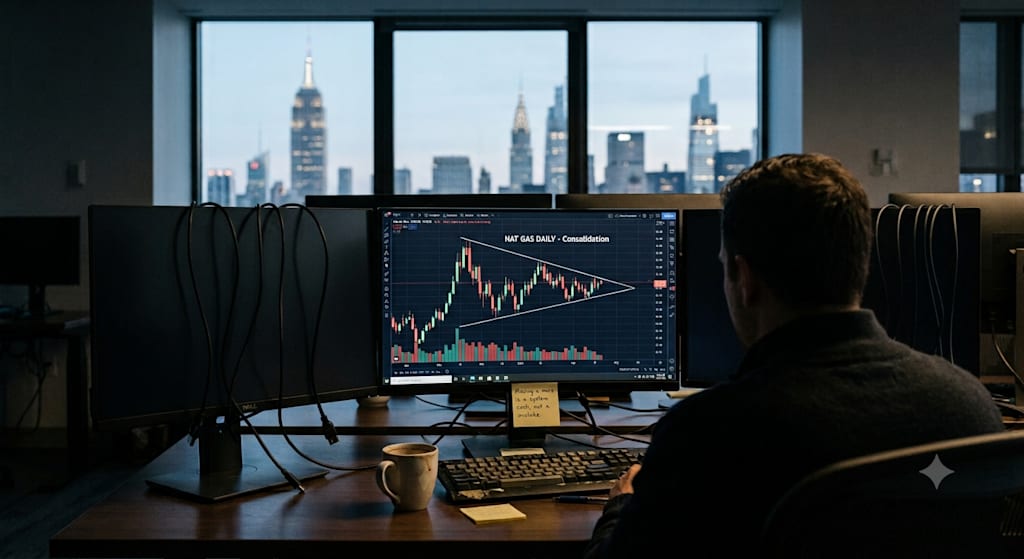
Hayes stood, walked to the desk, and pulled the power cords from five of the monitors. Only the middle one remained lit, displaying a daily chart.
"Now what are you looking at?"
Elliott stared at the solitary daily chart. "…Natural gas."
"Keep looking."
He watched for fifteen seconds. Nothing happened.
"What do you see?"
"Sideways."
"Wait a bit longer."
Two more minutes passed. Elliott said, "Coiling."
Hayes held the five power cords in his fist like a handful of evidence. "The money you lost: the five monitors I unplugged didn't earn it back for you. They lost it for you. The more opportunities you see, the poorer you become."
When Elliott returned to the office that day, he cut his watchlist from forty-seven names down to six. He kept only the most liquid instruments on the daily timeframe: the 10-year Treasury note, the S&P 500, gold, natural gas, the euro, and crude oil. He stared at that list, his fingers itching to add back a few small-cap stocks and hot tech names. He grabbed his own wrist, the way a man trying to lose weight holds himself back from opening the refrigerator.
For the next three months, he traded only one type of setup: a breakout from a daily-level consolidation, entered only when the potential reward was at least three times the risk, with a stop placed just below the lower boundary of the range. All shorter-timeframe fluctuations were shut out completely.
The first week, he missed a violent rally in gold. A colleague in the break room remarked, "Cross, you didn't trade that? It was a gold mine—eight percent in a day." Elliott said, "Yeah." He went back to his desk and looked at the words he'd written on a sticky note: Missing a move is a system cost, not a mistake. He stuck it to the bezel of his monitor.
The second month, he took four consecutive stop-outs. Each time, natural gas faked him out with a false breakout, and he drew down seven percent over two weeks. That evening, he walked to the parking garage, sat in his old Ford, and didn't start the engine. He remembered what Hayes had told him: A drawdown doesn't mean you did something wrong. It's the admission fee you pay to buy profit. He repeated the words aloud, like an incantation. The engine turned over.
By the sixth month, his equity curve had become a line sloping gently upward to the right. Not steep, but without any serrations.
At year's end, Elliott printed a sheet of paper and wrote nine rules on it with a marker, pinning it to his cubicle partition. People from the break room glanced at it as they passed:
Abandon all short timeframes. No entries below the daily.
No chasing vertical spikes that lack a prior base or consolidation.
No new positions in the late stage of a trend.
Don't touch counter-trend pick-the-bottom or pick-the-top trades.
If the structure is unclear, don't trade it.
Don't get chopped up trading the middle of a range.
When moving averages are tangled in chaos, stay in cash.
Don't chase gap openings or news-driven spikes.
Any signal conceived from emotion or the urge to make back losses is void.
The trader in the next cubicle, Kaufman, asked him, "So what's left for you?"
Elliott said, "About a dozen good trades a year."
"And the rest of the time?"
He nodded toward the screen. "Waiting."
Kaufman laughed. "You call this trading? It's a monastery."
Elliott didn't answer. He was watching the daily chart of natural gas. A coiling structure had been forming for fourteen days, the moving averages gradually unfurling from their tangle. He set a price alert, turned off the screen, and went to the break room for a cup of coffee. The coffee was from yesterday, slightly bitter. He added no sugar and no cream.
Three hours later, the alert sounded. He returned to his desk, entered the order, set his stop, placed a conditional take-profit order, then picked up his phone and booked a weekend train ticket to the beach at Montauk.
The Atlantic in February was slate-gray, but that didn't matter.
He deleted the last financial news app from his phone.
About the Creator
Jin
Writer of reamstories
https://reamstories.com/jin
Enjoyed the story? Support the Creator.
Subscribe for free to receive all their stories in your feed. You could also become a paid subscriber, letting them know you appreciate their work.
Comments
There are no comments for this story
Be the first to respond and start the conversation.