
The Illusion of TTM Technologies' Profitability: Unraveling Receivables Anomalies Behind Glitzy Valuations
TTM Technologies: Assessing "Paper Profits" Risk and Valuation Traps Amidst Ballooning Receivables

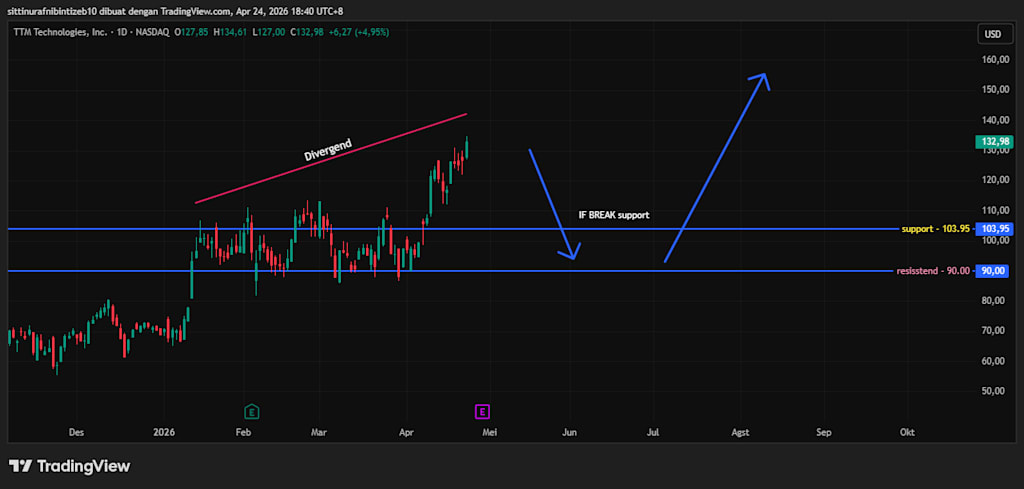
Challenging Thesis
On the surface, TTM Technologies appears to be a rising giant in the electronic components sector, boasting steady net income growth. However, the central thesis of this article posits that the quality of the company's earnings is dangerously fragile. There is an alarming divergence between "on-paper" profits and actual cash flow. Unless the company can immediately rectify its working capital management, the profits reported today are merely "imaginary gains" waiting to be written off. We are witnessing an entity that looks operationally busy but is financially failing to convert that activity into tangible liquidity.
Paradigm Shift
For years, the market has lauded TTM Technologies for its expansion into the high-barrier aerospace and defense sectors. However, investors must shift their focus from mere top-line growth to cash-conversion efficiency. The new paradigm for investors should be: "Profit is an opinion, but cash is a fact." When a stock price skyrockets without a corresponding conversion of cash, the rally is nothing more than speculation on accounting figures that lack real purchasing power.
Deconstructing Management: The Massive Receivables Anomaly
Data: TTM’s financial statements show a "Change in Receivables" figure reaching -201,754 on a TTM (Trailing Twelve Months) basis, while Net Income stands at only 177,448. Furthermore, operational cash flow for the quarter ending 3/31/2025 was recorded as negative -10,655.
Interpretation: There is a drastic imbalance where the value of uncollected invoices far exceeds the company's entire profit. Management appears highly aggressive in booking sales but significantly weak in actual cash collection.
Implication: Negative operational cash flow forces the company to remain perpetually dependent on external financing or debt to fund routine operations, despite looking "profitable" on the income statement.
Sharp Argument: Management appears to be practicing "phantom growth." Reporting profits without cash is a classic red flag; if these receivables go uncollected or if a major client defaults, TTM faces a massive asset write-down that could incinerate shareholder equity overnight.
Strategic Moat: A Fortress Eroded by Interest
While TTM possesses a strategic moat in the form of high-density PCB technology, the economic effectiveness of this fortress is being cannibalized by a top-heavy capital structure.
Data: The company’s long-term debt has surged to 1,028,413, with annual interest expenses consistently holding at 45,334 (TTM).
Interpretation: The operational gains generated by their advanced technology are not being fully enjoyed by shareholders; instead, they are being funneled en masse to creditors as fixed interest payments.
Implication: The company’s margin for flexibility—to invest in R&D or pursue strategic acquisitions—is becoming razor-thin. TTM is trapped in a cycle where they must work harder just to service their own debt burden.
Sharp Argument: A moat is supposed to provide a cost advantage, but for TTM, their technological edge has become a hostage to a parasitic debt structure. Investors aren't just buying future technology; they are subsidizing a perpetual bank installment plan.
Taming Risk: Disproportionate Valuation Traps
The third risk stems from market euphoria, which has assigned an irrational price to shaky fundamentals.
Data: TTM’s Trailing P/E Ratio has spiked to 75.41x, up from 37.50x at the end of 2024. The Price-to-Book (P/B) ratio has also climbed sharply from 1.63 to 7.47.
Interpretation: The market is valuing the company at 75 times its earnings, despite those earnings—as discussed earlier—not yet manifesting as cash. A nearly five-fold increase in the P/B ratio suggests the stock price has completely detached from net asset value.
Implication: At these valuation levels, there is no "margin of safety." Even a minor miss in upcoming financial reports could trigger a mass sell-off, as current prices are predicated on an expectation of perfection.
Sharp Argument: TTM's current valuation mirrors that of a high-margin SaaS company, not a debt-laden manufacturing firm. Buying TTM at these levels is a speculative gamble that ignores economic gravity; investors are buying the peak of a house of cards whose cash foundation is crumbling.
Valuation Anchor Point
The "North Star" for TTM Technologies' valuation should no longer be the easily manipulated P/E ratio, but rather the Price-to-Free Cash Flow (P/FCF). Given the negative operational cash flow in the most recent quarter, TTM's intrinsic value should be significantly lower than its current market price. Until management proves they can convert that 201k in receivables into cold hard cash, a conservative fair price should, at minimum, revert to historical P/B ratios in the 1.5x - 2.0x range. Without an improvement in cash quality, the current price target is a bubble waiting for the needle of reality to pop it.
About the Creator
Lena
Financial Analyst & Content Creator 7 Yrs Exp. Merging Fundamental Research PEG/Value with Advanced Technical Analysis. Specialist in Equities & Crypto narratives that turn complex data into high stakes Alpha.
Enjoyed the story? Support the Creator.
Subscribe for free to receive all their stories in your feed.
Comments
There are no comments for this story
Be the first to respond and start the conversation.