
The Great American Copper Heist
How a $40 million arbitrage bet and a looming tariff just locked 1 million tonnes of the world's most critical metal inside U.S. borders—and broke the global supply chain.
I. The Phenomenon
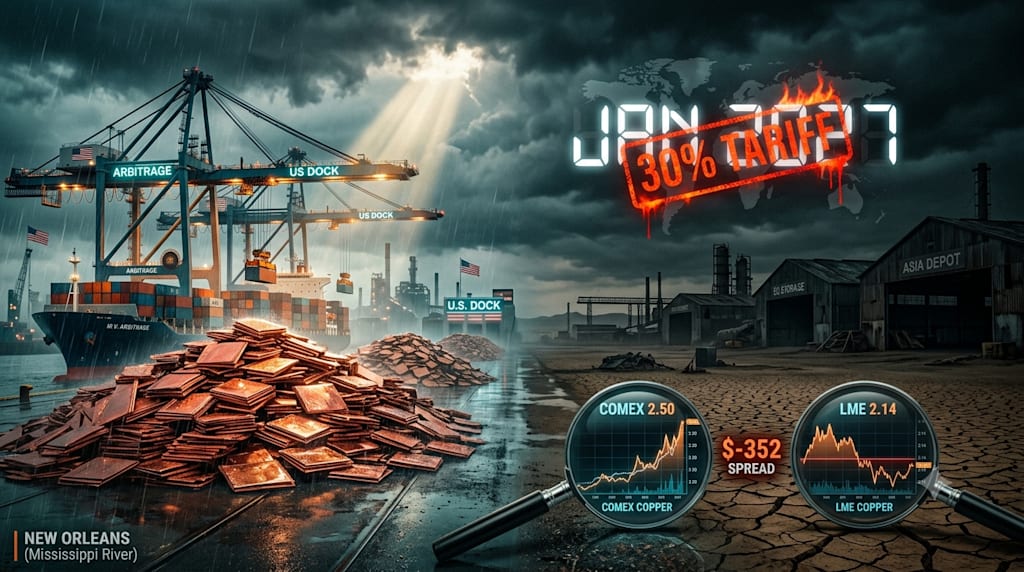
In July 2026, U.S. ports received roughly 200,000 metric tonnes of refined copper. That is the highest monthly inflow since shipping records began in 2014. Over the previous five years, average monthly imports had never exceeded 80,000 tonnes.
This was no isolated spike. COMEX copper inventories rose 41% from the start of the year. Adding LME stocks held in U.S. warehouses and off‑warrant inventories at ports, the total physical copper locked within U.S. borders surpassed 1 million tonnes by August 5. At the same time, the combined visible inventories across the three major exchanges (COMEX, LME, SHFE) totalled 1.11 million tonnes. In other words, 64% of the world’s trackable copper stocks were piled up in the United States.
“Copper rush” is no longer a metaphor. It is a collection of real shipping contracts, warehouse receipts, and arbitrage positions.
II. The Drivers
1. The arbitrage calculator
In July 2025, former President Donald Trump signed an executive order imposing tariffs of up to 50% on copper semis and derivatives. Refined copper (purity ≥99.99%) was temporarily exempted. In January 2026, the Department of Commerce, in its Section 232 investigation report, recommended a 15% tariff on refined copper starting in January 2027, rising to 30% in 2028. The recommendation has not yet received the President’s final signature, but the market has already priced in “inevitable future tariffs.”
In July 2026, the average daily spread between the COMEX front‑month contract and the LME three‑month copper contract was $352 per tonne**, with intraday peaks touching $420. The marginal cost of transatlantic transport (shipping, insurance, and warehousing) is roughly $120–150 per tonne. That left a net arbitrage margin of about **$200 per tonne. For the 200,000 tonnes that arrived in July, the gross arbitrage profit for the month was approximately $40 million.
That margin was enough to make a cargo vessel originally sailing from Chile to Shanghai turn around in the middle of the Pacific and dock instead in New Orleans. Shipping data show that in July, about 15% of copper shipments from South America and Africa originally destined for Asia were temporarily diverted to the United States.
2. Strategic expectations
In November 2025, the U.S. Geological Survey added copper to the critical minerals list for the first time, alongside rare earths and lithium. The reason is straightforward: U.S. domestic refined copper production is about 1.1–1.2 million tonnes per year, while annual consumption is roughly 2 million tonnes. That is a deficit of nearly half.
Both ends of the gap are expanding:
AI data centers: A single hyperscale computing facility requires about 15,000–30,000 tonnes of copper for cables, busbars, and cooling systems. In 2026, there are over 1,000 data centers under construction globally, with the U.S. accounting for 30%.
Grid upgrades: 70% of U.S. transmission and distribution lines have exceeded their 25‑year design life. The federal grid investment budget for 2026 exceeds $100 billion. Every mile of high‑voltage cable requires about 10 tonnes of copper.
New energy vehicles and defense: An EV uses 80 kg of copper (four times that of an ICE vehicle). An Arleigh Burke‑class destroyer uses over 200 tonnes of copper cabling.
U.S. companies are not scrambling for copper today. They are locking in supply for 2027 and beyond. As long as tariff expectations persist, the financial cost of front‑loading inventories (interest plus warehousing) is far lower than the potential future tax increase.
3. Supply fears
Even without tariffs, the global copper market was already in short supply. The International Copper Study Group (ICSG) projects a refined copper deficit of about 420,000 tonnes in 2026, mainly due to long‑term grade declines at mines in Chile and Peru, and average project delays of 18 months for new capacity. In June 2026, northern Chile experienced a once‑in‑a‑century drought. Escondida, the world’s largest copper mine, announced a 10% production cut – roughly 60,000 tonnes per year.
Rigid supply meets rigid demand. Inventories become the only buffer. The large‑scale buying by U.S. traders effectively moved that buffer from a global public good into their own private cellars.
III. Transmission: The Triple Squeeze on Non‑U.S. Markets
1. Premiums soar
LME copper inventories in European warehouses fell to their lowest since 2019. The spot premium over the three‑month contract surged from about $12/tonne at the start of the year to $65/tonne. Asian markets tightened in parallel. Shanghai bonded zone stocks dropped to an 11‑month low, and the Yangshan copper premium (import premium) rose from $25–30/tonne in Q1 to $55–70/tonne.
Cable manufacturers and electronic component makers in China, Japan, and Germany are being forced to accept higher spot premiums. These costs eventually pass down the supply chain as changes in price quotes to downstream customers.
2. Shipping misallocation
In July, three cargo ships originally scheduled for Chinese ports changed course mid‑voyage to the U.S. West Coast. This was not an isolated incident. Reuters, citing vessel‑tracking data, reported that at least 82,000 tonnes of refined copper originally allocated for Asian delivery were reallocated to U.S. buyers in July. Some Asian smelters, facing delayed raw material arrivals, lowered their refined copper output guidance for August by 3%–5%.
3. Policy spillover
On August 3, the European Commission announced a supply chain security assessment for copper. It focused on “the impact of irregular procurement practices by third countries on EU industry.” Though it did not name the U.S., the document’s footnotes cited the publication date of the U.S. Section 232 investigation report. The EU Internal Market Commissioner mentioned in informal meetings that export licenses or quotas were not off the table.
IV. The Biggest Variable: Will the Tariff Land in January 2027?
The current 1‑million‑tonne stockpile is entirely a bet on an administrative recommendation that has not yet taken effect. The final decision rests with the White House. Two outcomes produce two radically different price trajectories.
Scenario A – Tariffs take effect as scheduled (15% in 2027, rising to 30% in 2028)
Stockpilers immediately gain the tax differential. COMEX prices may jump again. Overseas prices could come under pressure from sustained supply diversion, widening the spread to over $500/tonne and triggering a second wave of front‑running until the window closes at the end of December 2026. The non‑U.S. market deficit would widen to roughly 600,000 tonnes, forcing China and Europe to tap their national strategic reserves.
Scenario B – Tariffs are shelved or cancelled (due to industry opposition or WTO litigation)
The fundamental logic of arbitrage stockpiling collapses. The COMEX‑LME spread could narrow from $300 to under $50 within a week. The 1 million tonnes sitting in the U.S. would face re‑export or discounted selling pressure, potentially triggering a 15%–20% price correction. Traders who bought at high prices would suffer heavy losses. Over‑leveraged smaller dealers might default.
Uncertainty itself is already a cost. So far in August, implied volatility in COMEX copper options has risen to 45%, the highest since March 2020. Any information – a tariff hearing, a presidential social media post, or a congressional letter – could trigger price swings of more than 2% within an hour. This noise is eroding copper futures’ price‑discovery function.
V. The Zero‑Sum Nature of Resource Grabbing
From a commercial standpoint, trader arbitrage is unobjectionable. But when the U.S. – one of the world’s largest consumers – uses tariff expectations as a “demand‑signal amplifier” to suck in global physical supplies, this transcends market behavior. It becomes policy‑driven resource reallocation.
Historically, resource games have mostly been initiated by suppliers (e.g., OPEC production cuts). This time, the demand side is acting by creating expectations of future high prices to lock in current supply in advance. The negative externality is that it does not add a single tonne of mined copper, nor build a single new smelter. It simply moves already‑tight physical stocks from European and Asian warehouses into American ones. The total globally available inventory is unchanged, but the geographical distribution is severely skewed. This causes local shortages alongside local surpluses and an overall loss in efficiency.
The deeper damage is to the global commodity market’s expectation of “fair availability.” If any major power can pre‑emptively grab supplies through tariff threats, then long‑term supply contracts, annual pricing agreements, and even global benchmark prices at exchanges will gradually lose reliability. Mining investment will weigh “political security” more heavily than “economic cost,” ultimately raising resource acquisition costs for all countries.
VI. Looking Ahead
As of August 2026, U.S. ports still have about 42,000 tonnes of copper awaiting unloading. South American mines are accelerating shipments to squeeze in as much as possible before tariffs take effect. The near‑term direction of global copper prices will depend less on fundamental balance sheets and more on the signature on a document in Washington.
For industrial users, the safest strategy today is not to bet on direction. It is to shorten procurement cycles, increase scrap copper substitution, and negotiate flexible delivery terms with multiple suppliers. For investors, copper long positions are at record highs. Any policy pivot could trigger a stampede of liquidations.
When January 2027 arrives – tariffs or not – the global copper market will undergo a sharp repricing. Until then, every vessel heading for New Orleans, every spot premium quote outside the U.S., and every intraday swing triggered by a policy hint is casting a vote for that moment. The result will not be “good” or “bad.” It will be a new equilibrium price, distorted by policy.
About the Creator
Jin
Writer of reamstories
https://reamstories.com/jin
Enjoyed the story? Support the Creator.
Subscribe for free to receive all their stories in your feed. You could also become a paid subscriber, letting them know you appreciate their work.
Comments
There are no comments for this story
Be the first to respond and start the conversation.