
The Four People Who Won (and Lost) on Unitree’s Historic IPO
From a $47,000 lottery win to a 23% same‑day loss—what the humanoid robot debut tells us about incremental markets and the price of being early.
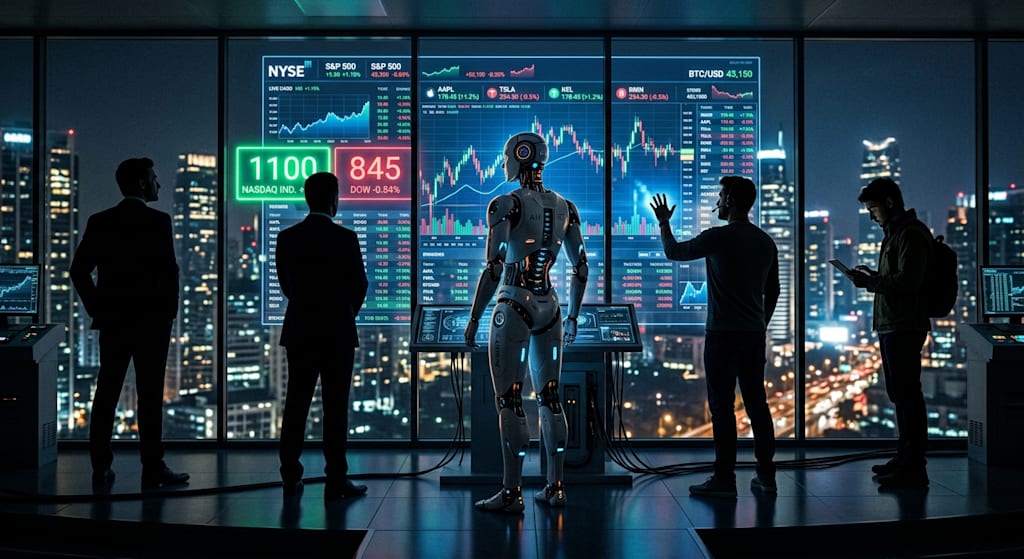
The Four Kinds of People on the Day of Unitree's IPO
On the morning of the listing, Wang Xingxing did not ring the bell at his Hangzhou headquarters. He folded the announcement bearing the number 150.80 twice and placed it in the bottom drawer of his desk. Through the glass wall, he could see the lights across the corridor still on—the legal team was confirming the expiry date of the last vesting clause.
At 9:30 a.m., the screen at the Shanghai Stock Exchange flashed 1,100 yuan. Three hours later, that number had become 845.
The 255-yuan gap between those two numbers was the price paid by those who entered the market that day, and the reward cashed out by those who left.
I
Let's start with the numbers.
Unitree's IPO price was 150.80 yuan per share, giving it a market capitalisation of approximately 61 billion yuan. It opened at 1,100 yuan. Anyone who won one lot (500 shares) and sold at the opening price would have made a floating profit of 474,600 yuan. If they sold at the closing price, the profit was 347,000 yuan. If they bought at the opening price and held to close, they were down 23%.
The online lottery success rate was 0.01809759%—one allocation for every 5,500 accounts that participated. A record for the STAR Market.
Why did so many scramble for it?
Over the past decade, this company's valuation had gone from 13.33 million yuan to an intraday peak of over 440 billion yuan—a 33,000‑fold increase. The early entrants were not smarter than those who came later; they just sat down at the table earlier.
II
Check the prospectus. It listed Unitree's price‑to‑sales ratio against its peers: 35.89x at IPO, versus an industry average of 6.38x. Nearly six times higher.
Expensive? Yes.
What justified that price? Revenue of 1.699 billion yuan in 2025, and 1.152 billion yuan in the first half of 2026—up 48.54% year‑on‑year—with net profit attributable to shareholders of 274 million yuan, turning a loss into profit. Global shipments of humanoid robots ranked first.
But the small print told a different story.
Non‑recurring net profit fell 19.34% year‑on‑year. The company cited a sharp increase in R&D spending and heavy sales expenses in the first quarter. In plain terms: revenue is still growing, but to maintain that growth, spending is growing even faster. Gross margin dropped from 42.3% in 2025 to 38.7% in the first half of 2026. Operating cash flow was negative 320 million yuan.
Put these numbers together, and the picture is this: a company still burning cash at high speed, but one that has already proven it can sell things. The market gave it a P/E of 219x not because of what it will earn next year, but because it bets on whether it can stand in everyone's homes, factories, and warehouses a decade from now.
One line from a Guosen Securities research report put it bluntly: "What you're buying is not the 2026 performance, but the early discounting of a trillion‑yuan market for humanoid robots in the long term."
"Discounting"—that one word is the root of all pricing controversy.
III
Wang Xingxing once said in an interview, a line that has been reposted tens of thousands of times: "Young people should go into emerging industries."
On the day of Unitree's listing, that line found three levels of reflection.
The first level is the entrepreneur. Wang Xingxing himself held 33.36% of Unitree. At the opening price, his net worth approached 150 billion yuan. When he founded the company in 2016, its valuation was only 13.33 million yuan. In those ten years, he did two things: he turned quadruped robots into shippable products, and he made Unitree the world's number one shipper of humanoid robots. He never explained why he persisted, but in one interview he mentioned this: "In 2018, when we had only two months of payroll left in the bank, we were still revising the cooling structure of the joint motors."
The second level is early‑stage investors. Names like Sequoia China, Tencent, and DeepSeek lined up in the shareholder register. They entered at valuations ranging from a few hundred million to a few billion yuan. By listing day, their paper returns varied from tens to hundreds of times. This was not a matter of ability—it was a matter of timing. They pushed their chips onto a track that had not yet been validated, using due diligence and industry conviction.
The third level is the retail lottery winners. Among the 0.018% who got shares, some sold in the morning and made 470,000 yuan; others bought at the opening price and were down 23% by the close. Both were "participating in an emerging industry"—one on the asset side, the other on the trading side. The former captured beta; the latter gambled on sentiment.
Wang's sentence needs a second half: go into incremental markets, but go before they are fully priced in.
IV
What does Unitree's listing mean for the entire industry?
First, it set an anchor.
Before this, there was no consensus on how to value humanoid robotics companies. Hong Kong‑listed UBTECH traded at around 19x P/E; there was no scalable comparable in the U.S.; and pre‑IPO rounds in the primary market were priced through negotiations with no clear benchmark. Unitree posted a 219x P/E and a 61‑billion‑yuan market cap—and from then on, everyone else had a reference point.
The immediate consequence: in the first half of 2026, the embodied intelligence sector raised 93.5 billion yuan in funding, more than five times the same period last year. Money poured in faster than any single company could ramp up production.
Second, it changed the game.
Before Unitree, the industry competed on "who can build a robot that can stand up first." After Unitree, the competition shifted to "who has lower supply‑chain costs, higher shipment volumes, and more stable gross margins." The rules switched from a technology race to an industrial race.
Unitree's joint motors, reducers, and controllers are all self‑developed, and its supply chain is over 90% domestic. That means it can push costs down to a level that competitors dare not follow. In 2025, it shipped 5,500 humanoid robots. The second‑place number has not been disclosed, but industry sources suggest it is not in the same order of magnitude.
Third, it began the culling.
For start‑ups further down the pack, the arithmetic changed overnight. Unitree is now public, with access to secondary‑market capital, brand power to win orders, and a mature supply chain that can cut prices at any time. If your solution still relies on buying motors and reducers from outside and assembling a demo, investors will no longer look at you.
The industry has been forcibly pushed from the "storytelling" phase into the "show‑me‑the‑numbers" phase.
V
On everyone's personal ledger, the calculation is simpler.
You don't have to start a company. You don't have to become a cog in a robotics firm. You don't even have to own Unitree stock.
Acknowledge one fact: the gap in wealth distribution between incremental industries and stagnant ones is exponential.
The people who entered the internet industry around 2010 were not necessarily more capable than today's graduates, but the industry was expanding—jobs were multiplying, salaries rising, options appreciating, promotion pipelines lengthening. A rising tide lifts all boats—not because anyone swims better, but because the water level itself is going up.
Enter the internet now, and the tide is at its peak. No matter how hard you try, you are just picking food from someone else's bowl.
Humanoid robotics, AI, commercial space—these sectors are now where the internet was in 2010: the cake has not yet taken shape, but the oven is preheating.
Not every company will survive. But the overall salary levels, equity premiums, and career ceilings across the entire sector will be an order of magnitude higher than in traditional industries. That is the power of beta, not the victory of alpha.
VI
"Participating" and "how you participate" are two different things.
Unitree's first‑day price action is a reminder: opened at 1,100, closed at 845. If you bought at the open, by the time you read this, your account was down 23%.
Incremental markets offer returns, but they also have cycles. Buy when it is cheap—not after the drums and gongs. Those who went all‑in on the Nasdaq in 2020, or bought into tech in 2024, captured beta. Those who chased ARKK in 2021, or bought Unitree at the open on its first day, learned a lesson.
Same track, different entry costs—completely different outcomes.
VII
One last detail.
In the prospectus, there is a line: the number of shares issued is 40,446,434. The decimal point goes down to the single share. Behind that number are countless rounds of financing, ratchet clauses, buyback terms, and employee option pool calculations.
Within those 40.44 million shares, a portion belonged to the first engineer who joined in 2017. At that time, the company was still operating out of a residential apartment in Hangzhou, with windows that wouldn't close properly, and he had to wear a down jacket while coding in winter. His option strike price, converted to per‑share cost, was less than one‑tenth of a yuan.
On listing day, he did not sell. Someone asked him why. He said: "I'll wait and see."
That "wait and see" says more than any research report. The people who truly captured the upside are not the ones who gambled on the lottery odds, nor the ones who rushed in at the open for a quick flip. They are the ones who finished writing the code in that drafty winter apartment.
And they are the ones who sat down at the table before the industry was ever noticed.
Closing
Unitree's IPO is a cross‑section of China's hard‑tech sector moving from the laboratory to the balance sheet. It carries wealth effects, sets a benchmark for the industry, and transmits value from the primary market to the secondary.
It is also a testing ground for human nature.
Greed, fear, herd mentality, hesitation—all of it is laid bare in the candlesticks.
The engineer coding in that cold apartment and the retail trader chasing at 1,100 yuan on opening day are looking at the same company. Between them lie ten years of time, and an industry's beta.
What ordinary people need to do is not become Wang Xingxing. It is to find the next table that has not yet been flipped over, and sit down before it is noticed.
No need to ring the bell. Just sit down.
About the Creator
Jin
Writer of reamstories
https://reamstories.com/jin
Enjoyed the story? Support the Creator.
Subscribe for free to receive all their stories in your feed. You could also become a paid subscriber, letting them know you appreciate their work.
Comments
There are no comments for this story
Be the first to respond and start the conversation.