
The Fed Raised Rates. The Nasdaq Jumped 440 Points. Here’s Why That Matters.
Semiconductors, oil, and the long-end Treasury trade that flipped the script on September 17.
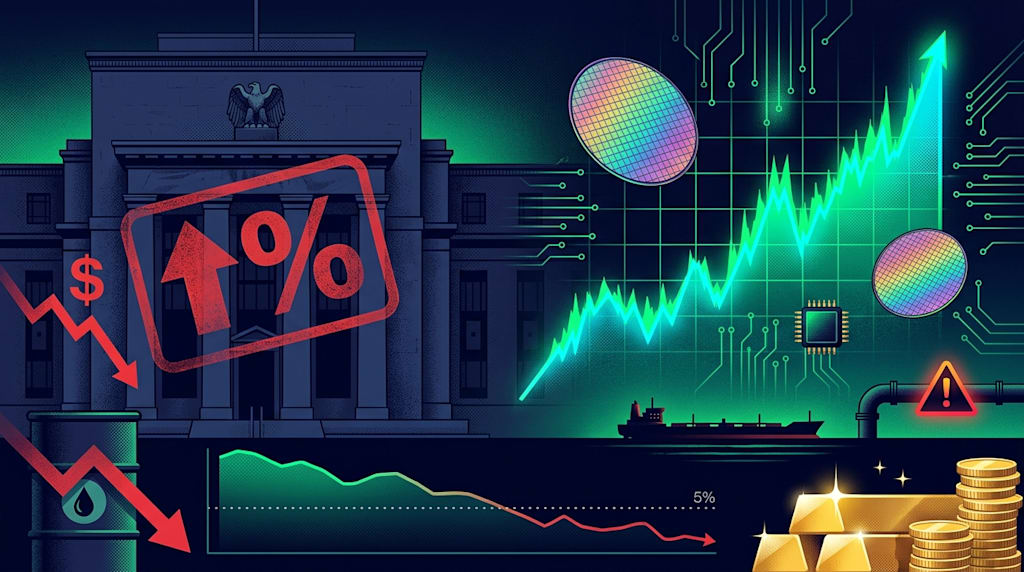
The post-hike counteroffensive: a breakdown of the U.S. stock market on September 17
The Dow rose 0.61%, the Nasdaq rose 1.69%, and the S&P 500 rose 1.14%. The Nasdaq added 440 points in one day. Semiconductors led: ARM +8.57%, Intel +7.67%, AMD +6.36%. WTI crude fell to $101.91, Brent fell to $104.82, the dollar index closed at 100.248, and the 10-year Treasury yield fell back below 5%. Gold miners rose across the board. The Wind U.S. Tech Seven Giants Index rose 1.76%.
These numbers do not fit the textbook rule that rate hikes hurt tech stocks.
I. 25bp was already priced in
On September 16, the Fed raised the federal funds rate by 25bp to 3.75% to 4%, ending a nearly three-year pause. The Dow fell 1.21% that day, and the 10-year Treasury yield returned above 5%. By the 17th, the 10-year yield had fallen from 5.02% on Wednesday to as low as 4.93%, and the 30-year fell from 5.36% to 5.27%.
The market had priced the hike. The CME FedWatch Tool showed the odds of another hike in October above 53%. Goldman Sachs expects another 25bp in October. Bank of America expects hikes in October and December.
Trading moved from “will they hike?” to “after the hike, where do inflation and financial conditions go?”
II. Liquidity: price tightened, water level not drained in sync
The Fed raised rates while maintaining ample reserves in the banking system. It said it could buy short-term Treasuries if needed to keep liquidity. This tightens the price of money. It does not drain reserves and run down the balance sheet at the same time.
Base dollar liquidity did not fall in sync. It did not increase either. Higher funding costs pressure valuations, especially for high-valuation growth stocks. Because base liquidity did not collapse, the market still had room for structural trading.
Tech stocks and semiconductors pushed higher through a reallocation of existing liquidity into high-beta sectors. Nasdaq minute-level candles flatlined at highs, a pattern of intraday churn. Quant funds compile sentiment all day. Repeated gap-ups and gap-downs created arbitrage space.
III. Oil: risk premium giveback
Oil’s drop was the day’s most direct catalyst for risk appetite.
The market had worried that an attack on Saudi Arabia’s East-West Pipeline, a suspension of loading at Yanbu port, and disruption to Hormuz shipping could create a global supply-chain shock. On September 16 and 17, Saudi Arabia increased crude loadings via Omani waters and prepared to restore partial capacity on the East-West Pipeline. Brent fell from near $109 to $104.82. WTI fell to $101.91.
EIA inventory data was anomalous. On September 11, U.S. crude inventories fell by 640,000 barrels to 423.4 million barrels; analysts had expected a decline of 1.6 million barrels. Distillate inventories, including diesel and heating oil, rose by 1.6 million barrels to 107.9 million barrels; expectations were for a rise of 71,000 barrels.
Oil fell, inflation expectations cooled, and Treasury yields moved lower. Shipping through Hormuz remains constrained, diesel futures are high, and the physical market is tight. The risk premium compressed. That is not proof of collapsing demand.
IV. Treasuries: the long-end logic has changed
The market’s long-standing logic: higher oil lifts inflation expectations, rate-hike expectations rise, 10-year and 30-year Treasury yields break above 5%, and tech-stock valuations come under pressure.
The recent drop in crude means energy prices are having a weaker impact on CPI, PCE, corporate costs, and real household income. The inflation risk premium that the bond market watches most closely has declined. When oil and policy expectations cool, the long end has room to fall.
The 10-year yield fell from 5.02% to 4.93%. The 30-year fell from 5.36% to 5.27%. Lower long-end yields eased discount-rate pressure on tech stocks.
The Middle East has not improved. Iran is still attacking tankers. The Houthis in Yemen are still fighting. The fundamentals have not changed much. The risk premium compressed. Saudi Arabia cannot fix the pipeline this week; the market guesses it will be fixed next week.
V. Gold and tech: the same rates logic
Short-term gold pricing depends on real rates, the dollar, and safe-haven demand. The word “hike” matters less.
On September 17, gold rose more than 2% intraday. COMEX gold futures closed down 0.16% at $4,380.6/oz. COMEX silver rose 1.23% to $65.72/oz. Gold miners rose: IAMGOLD +3.03%, Franco-Nevada +2.81%, Barrick Gold +2.67%, AngloGold Ashanti +2.65%, Royal Gold +2.42%, Kinross Gold +2.35%, Newmont +2.14%.
The dollar index fell sharply, closing at 100.248. With the 10-year yield falling and the dollar weakening, the opportunity cost of holding gold declined. U.S. fiscal deficits, debt, and geopolitical conflict provided structural buying.
Tech-stock logic is more direct. AI and large-cap tech are long-duration assets. They are sensitive to long-term real rates. The earlier break above 5% in the 10-year yield raised the discount rate on future cash flows. Now that long-end yields have fallen, valuation pressure has eased. AI stocks are modestly negatively correlated with real rates. The speed of rate increases matters.
Gold and tech stocks rose together. That looks contradictory. Both trade the same variable: lower long-end yields, a weaker dollar, and marginal easing in financial conditions. Gold trades real rates and safe-haven demand. Tech trades discount rates and risk appetite.
VI. Semiconductors: supply-side catalyst
The semiconductor surge needs more than rates logic. Supply-side catalysts were more direct.
Intel CEO Lip-Bu Tan said rapid CPU demand growth has caused tight supply and demand. Current supply can meet only 50% of customer demand. “Several big-company CEOs have called me, and I can only apologize to them,” he said. He also said the 18A node has entered mass production, and the 14A node will begin production in Q1 next year. Intel rose 7.67% that day, and its market cap surged by about $40.7 billion overnight.
Nvidia’s Jensen Huang expects chip sales to double next year. GPU cloud provider Nebius announced an average price increase of about 20% starting in October. ARM rose 8.57%, AMD rose 6.36%, Micron rose 5.50%, and the Philadelphia Semiconductor Index rose 3.14% overall.
Supply shortage, demand growth, and pricing power stacked. The semiconductor rally has industrial fundamental support. Rates alone do not explain it.
VII. Cracks
The hike is done. At most there will be one more in October. Oil risk, inflation risk, and long-end rates are easing marginally at the same time. Financial conditions have improved for now.
This may be only a short-term repair.
If Hormuz or Saudi energy facilities suffer another large-scale disruption, oil could race back to $110 to $120 and spread into core inflation. The 10-year Treasury has already climbed back above 5% multiple times. If the market continues to finance on a large scale, the term premium continues to rise, and the return on AI capex deteriorates again, the current situation will be hard to sustain.
Watch two indicators: whether oil and long-end Treasury yields can continue to fall.
About the Creator
Jin
Writer of reamstories
https://reamstories.com/jin
Enjoyed the story? Support the Creator.
Subscribe for free to receive all their stories in your feed. You could also become a paid subscriber, letting them know you appreciate their work.
Comments
There are no comments for this story
Be the first to respond and start the conversation.