
The Fed Just Raised Rates for the First Time in Three Years. Here’s What It Means for Your Wallet, the World, and China
Inflation is still hot, oil is above $100, and the Fed voted 12 to 0 to hike. From your credit card to China’s central bank, here’s how six links in the rate chain connect.
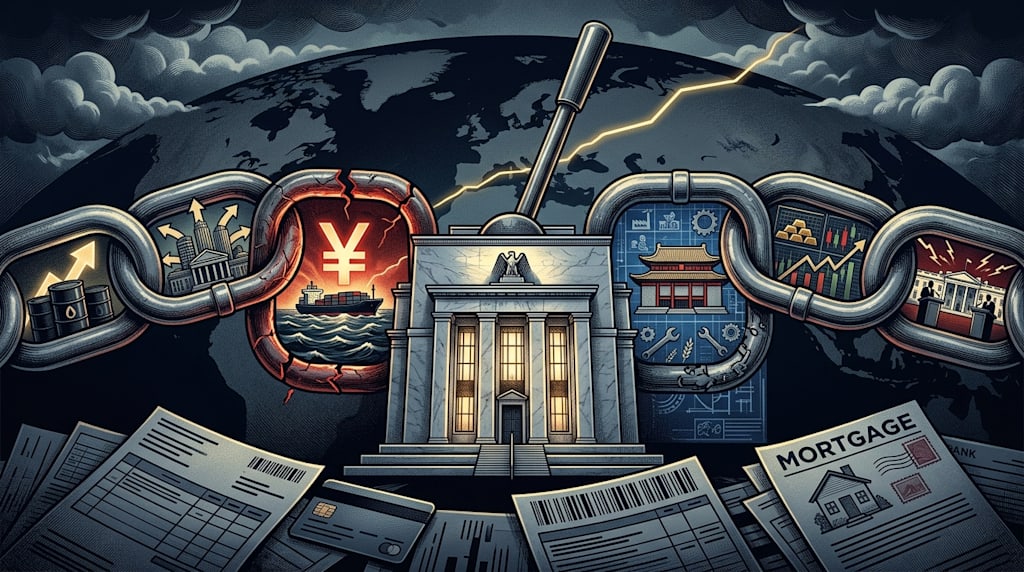
After the Fed hike: six links in the rate chain
On September 16, 2026, the Federal Open Market Committee voted 12 to 0 to raise the target range for the federal funds rate by 25 basis points, to 3.75% to 4.00%. It was the first hike since July 2023. Chair Kevin Warsh said at a press conference that inflation was "too high, and has been too high for too long." He offered no forward guidance.
1. Inflation data
In August, the U.S. producer price index rose from 4.8% to 5.4% year on year. Core consumer prices rose 0.3% month on month, against an expected 0.2%. A University of Michigan survey showed one-year inflation expectations rising from 4.0% to 4.6%, and longer-term expectations rising to 3.4%.
Energy is the driver. Brent crude briefly topped $109 a barrel, and WTI touched $104. Moody's Analytics estimates that since the U.S. military strikes on Iran in late February, the average U.S. household's bills have risen by about $1,760. BlackRock estimates the conflict will raise global headline inflation by about 0.8 percentage points.
In the dot plot, 12 of 18 officials expect one more hike by year-end, four expect two, none expect a cut this year, and the median year-end rate rises to 4.1%. The Fed revised up its 2026 PCE inflation forecast to 3.7%, with core at 3.4%.
2. Global central banks are no longer in sync
The European Central Bank last week raised its deposit facility rate to 2.50%. The Bank of Japan is expected this week to raise its policy rate to 1.25%, the highest since 1995. The Reserve Bank of Australia has hiked three times this year, and the Reserve Bank of New Zealand once. The UK, with a weakening labor market, has a buffer against rising energy costs and had previously leaned toward holding steady.
The IMF in July raised its 2026 inflation forecast to 4.7%. Economies differ in their dependence on energy imports and their sensitivity to wages and employment. A synchronized tightening cycle has not appeared.
3. The renminbi's pricing power switch
The 10-year U.S. Treasury yield returned above 5%, touching 5.021% intraday. China's 10-year government bond yield held steady near 1.69%. The spread inversion is about 300 basis points, an extreme range in 22 years.
The renminbi did not weaken with the spread. Since August, the renminbi has been firm against the dollar, up nearly 4% year to date, with the offshore rate touching 6.70. August's trade surplus was $119.09 billion. The single-factor explanatory power of the China-U.S. rate spread for the renminbi exchange rate fell from 88% in 2022-2024 to 1% since 2025; the rolling trade surplus term rose to 0.50. Pricing power has shifted from the financial account to the trade account.
4. Constraints and tools of China's central bank
In its Q2 Monetary Policy Report, the People's Bank of China judged that rate hikes by major overseas economies bring changes in rates and liquidity, not a reversal in policy orientation, and that the impact may be smaller than before. Wang Yifeng, deputy director of the Everbright Securities Research Institute, said this is a preventive hike and the market had expected it.
Domestic August CPI rose 0.8% year on year. In August, the weighted average rate on new corporate loans was slightly below 3%, and the weighted average rate on personal housing loans was 3.1%. Rate cuts face a marginal constraint from the China-U.S. spread inversion. Policy tools favor consumption subsidies and targeted property support, not simply cutting benchmark rates. The U.S. uses rates to adjust the aggregate; China, under multiple constraints, uses structural tools.
5. Asset repricing
The logic of long-end U.S. Treasury pricing is changing. Fiscal deficits, debt supply, term premiums, and corporate bond issuance driven by AI data centers, chips, and power infrastructure are pushing up long-end yields. The dollar index broke above 99.8.
Gold hit $4,256 an ounce intraday after the hike, then turned higher, hovering around $4,300. On September 17, the three major A-share indices opened lower; the Shanghai Composite closed down 0.41%. Biologics, agriculture, forestry, animal husbandry and fisheries led gains, while precious metals and nonferrous metals came under pressure.
Southern Asset Management said the relative appeal of dividend and high-cash-flow assets has strengthened. J.P. Morgan Asset Management recommended balanced equity portfolios, including Asia and Europe, where earnings growth is strong and valuations are low. Li Zhan of China Merchants Fund said exchange rates and capital flows react before the real economy, and renminbi-priced assets transmit through three channels: rates, earnings, and logic mapping.
6. The White House and the Fed
Trump told reporters on the day of the hike that Warsh is "a good man," but that the Fed Board is "hostile." On social media, he demanded "rapid" rate cuts, saying U.S. rates should be 1% or lower.
When asked about discussions with the president, Warsh smiled and said: "I have nothing to tell you about discussions with the president."
Eswar Prasad, a professor at Cornell University, said Warsh has drawn a clear line around his goals and intentions, and that regardless of data and outcomes, this will put him in conflict with Trump's demand for cuts. Obstfeld, a senior fellow at the Peterson Institute for International Economics, said the Fed either incurs the president's wrath or undermines its market credibility, and the latter could lead to more severe inflation consequences later.
The 12 to 0 vote was the Board's answer to political pressure.
The next meeting is in October. Oil prices, core PCE, and nonfarm payrolls will decide whether the 12 votes in the dot plot materialize.
About the Creator
Jin
Writer of reamstories
https://reamstories.com/jin
Enjoyed the story? Support the Creator.
Subscribe for free to receive all their stories in your feed. You could also become a paid subscriber, letting them know you appreciate their work.
Comments
There are no comments for this story
Be the first to respond and start the conversation.