
The Fed Hiked Once. The Market Priced Three. Here's Why Neither Number Is Right.
Warsh says rate hikes won't hurt jobs. The Treasury is quietly undoing them. And AI doesn't care either way. Welcome to the mildest, most fragile tightening cycle in decades.
The Start of a Mild Tightening Cycle: Length, Logic, and Structural Constraints of the Fed's Rate-Hike Cycle
On September 16, 2026, the Federal Reserve voted 12–0 to raise the target range for the federal funds rate from 3.50%–3.75% to 3.75%–4.00%. The last hike had come in July 2023. This was Kevin Warsh's first as chair, and he had been in the job less than four months.
The market's focus was not the hike. Before the decision, the probability had already exceeded 90%. The question was how far the cycle would run.
I. Dot plot: 16 officials expect at least one more hike in 2026
Of the 18 officials who submitted rate projections, 16 expect at least one more hike before the end of 2026. Twelve see the year-end rate at 4.00%–4.25%. Four expect higher. In June, only six officials expected two or more hikes this year; now 16 expect at least one more.
The median rate projection went from 3.8% in June to 4.1%. The end-2027 median is 4.1%, unchanged from 2026. End-2028 falls to 3.9%, and end-2029 to 3.6%. The longer-run estimate rose from 3.1% to 3.2%.
The 2027 split is wide. Eight officials expect one more hike, six expect no change, three expect two cuts, and one expects four.
The Fed also marked inflation up. Its 2026 PCE projection rose from 3.6% to 3.7%, and core PCE from 3.3% to 3.4%. Inflation returning to the 2% target was pushed to 2029.
II. Market pricing: three more hikes by mid-2027
Interest rate swaps show traders have priced three more hikes by the middle of next year, one more than before the decision. Futures price about 33 basis points of additional tightening this year and 75 basis points cumulatively by June next year. The implied policy rate rose from about 3.8% to about 4.4%. The number of priced hikes went from roughly 0.8 to 3.4.
Institutional forecasts diverge, but the mainstream view has moved from a one-off adjustment to the start of a cycle. BNP Paribas chief economist Speranza expects at least three consecutive hikes, in September, December, and January. Deutsche Bank chief U.S. economist Luzetti says the Fed's patience with inflation has run out. KPMG chief economist Swonk argues a tightening cycle has officially begun. Industrial Securities chief economist Liu Yu judges that if AI capital expenditure keeps growing at a high rate, a 2027 hike is likely, with the terminal rate between 4% and 5%.
Morningstar disagrees. It argues the AI boost will fade, aggregate demand will weaken in 2027, and unemployment will average 4.6% by 2028, above the Fed's 4.1%. It expects two cuts in 2027 and four more in 2028. Citi has delayed its cut expectations to 2027 and expects three that year.
Everyone agrees inflation is sticky. What divides them is whether AI-driven growth can be sustained. If AI capital expenditure is structural, the cycle runs longer. If it is cyclical, the Fed turns earlier.
III. Warsh's reaction function: hikes won't hurt employment, so there is no reason not to hike
UBS noted in its post-meeting report that Warsh's policy reaction function has shifted from his predecessor's. He is more sensitive to inflation and supply shocks, less concerned about the labor market, and has set a higher bar for calling policy restrictive. The risk skews toward rates staying higher for longer.
At the press conference, Warsh said, "I don't think we need to damage the labor market to achieve our goals." UBS read this against the usual logic. The conventional case is "the labor market is fine and inflation is too high." Warsh's case is that higher rates will not dent employment at all. So: hikes won't hurt employment, therefore hike.
On inflation, Warsh said "there are still too many categories of goods and services with prices rising at annualized rates above 3%." He named three variables that have shaped decisions since July: a strong labor market, a troubling inflation trend, and geopolitics and its effect on energy prices.
Warsh used the phrase "second-round effects," which belongs to the European Central Bank's vocabulary more than the Fed's. It signals that he will act against supply shocks rather than wait for them to pass. He also said current financial conditions "are not restrictive," and that this hike only removed "some accommodation." In his framework, 4.00%–4.25% is not tight.
IV. The Treasury's hidden easing: bill issuance offsets the hikes
The Fed's hawkish stance runs into an offset. The Treasury is adding liquidity to the financial system through debt management.
The strategy is duration compression. The Treasury buys back long-term debt to hold down long-end yields, and issues short-term bills to raise cash. When bill yields sit slightly above the overnight reverse repo rate, money market funds move out of the Fed's system and into bills. Short rates stay inside the target corridor without the Fed doing anything.
Bills get pledged four to five times in the repo market, which produces a money multiplier above four. Hudson Bay Capital estimates that over the past year this operation created a "medium- and long-term coupon debt gap" equal to a 100-basis-point cut in the federal funds rate, nearly offsetting all of the Fed's earlier hikes.
Bloomberg macro strategist Simon White argues the trend will push inflation up structurally, weaken Fed independence, and raise the risk of market instability. One transmission chain runs like this: the Treasury compresses duration, short-end supply grows, reserve pressure builds, and the Fed may resume buying bills, expanding its balance sheet. Markets trade expectations, which is one reason gold and Bitcoin have risen during a hiking cycle.
The U.S. deficit is about 5.7% of GDP. Expansionary fiscal policy and a neutral-to-tight monetary policy pull in opposite directions. As more public debt is tied to short-term rates, every Fed hike raises the government's interest bill right away, which limits how much further the Fed can go.
V. K-shaped divergence: hikes do nothing to AI investment and plenty to everyone else
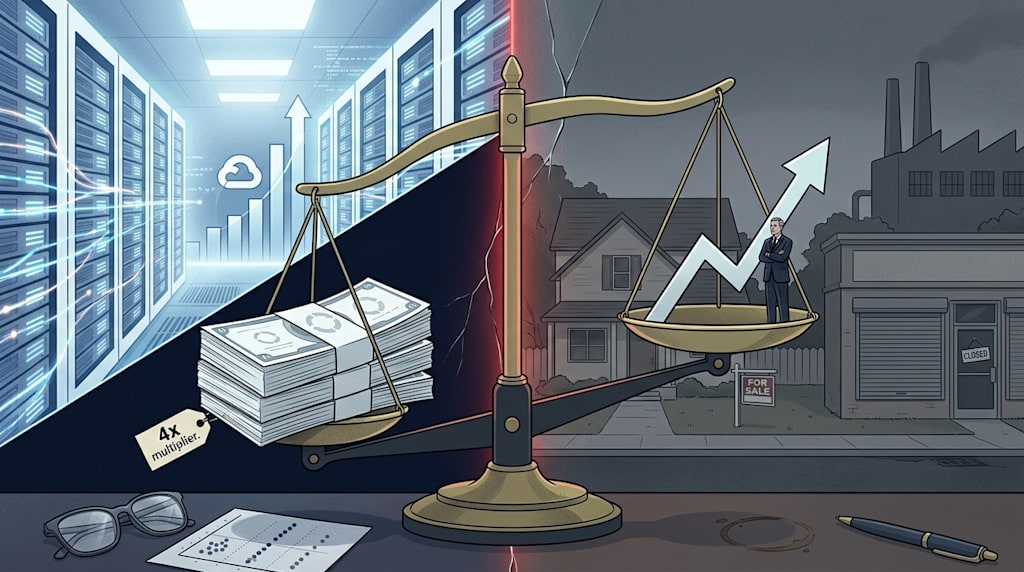
The K-shaped split in the U.S. economy is the second brake on the cycle.
In the upper K, AI investment drives growth. Morgan Stanley finds that from 2025 through the first half of 2026, broad AI-related investment added about 0.61 percentage points on average to real GDP growth. Strip out capital expenditure that would have happened anyway, and AI-driven investment still added about 0.42 points. Goldman Sachs expects AI investment alone to lift U.S. capital expenditure by about 3.3 percentage points in 2026. Annualized AI-related spending reached roughly $650 billion in the first quarter of 2026. The four largest cloud providers will spend close to $725 billion between them in 2026, up 77% from a year earlier.
Those firms have operating margins above 15%. A 25-basis-point increase in credit rates does not change what they build. Hikes barely touch the AI boom, and the AI boom is now the largest single contributor to U.S. growth.
In the lower K, the 30-year fixed mortgage rate is above 6.5%, and August existing home sales fell 2% to the slowest pace in more than a year. If the 10-year Treasury yield holds above 5%, housing and commercial real estate will look worse. Fitch chief economist Coulton says rising long-term yields are pressing on residential and real estate sectors that were already weak.
So the hikes do little about inflation, because the drivers that matter, AI investment and energy prices, ignore rates. They keep squeezing the parts of the economy that were already struggling. AI capital expenditure itself pushes long-end yields up, and high long-end yields hit exactly the sectors most sensitive to them. That asymmetry is why lower-K employment and investment will eventually force the Fed to stop, and probably to cut, in 2027.
VI. Overall judgment: two to three hikes, through the first quarter of 2027
The cycle will likely run two to three hikes, 50 to 75 basis points in total, through the first quarter of 2027. BNP Paribas's forecast of three hikes between September 2026 and January 2027 is the most useful baseline.
Call it mild because the terminal rate should land between 4.25% and 4.75%, well below the previous cycle's 5.25%–5.50% peak. Call it fragile because three things hold it back. The Treasury's hidden easing dilutes each hike. Lower-K pressure keeps building. And the drivers of inflation that matter, AI investment and geopolitical energy prices, do not respond to the policy rate.
Three variables will decide the length: whether core PCE falls below 3%, whether lower-K employment and traditional investment deteriorate faster, and whether Treasury bill issuance keeps expanding enough to change how monetary policy transmits.
If core PCE drops below 3% before the first quarter of 2027 and unemployment stays under 4.5%, the Fed can pause in March 2027. If bill issuance keeps growing, the hikes lose more force, and fiscal reality keeps eroding Warsh's hawkishness. Warsh will stay hawkish exactly as long as those three variables let him.
About the Creator
Jin
Writer of reamstories
https://reamstories.com/jin
Enjoyed the story? Support the Creator.
Subscribe for free to receive all their stories in your feed. You could also become a paid subscriber, letting them know you appreciate their work.
Comments
There are no comments for this story
Be the first to respond and start the conversation.