
The AI Trade Is Being Repriced Around a Harder Question
Investors still like the AI story. They are no longer sure they like the bill.
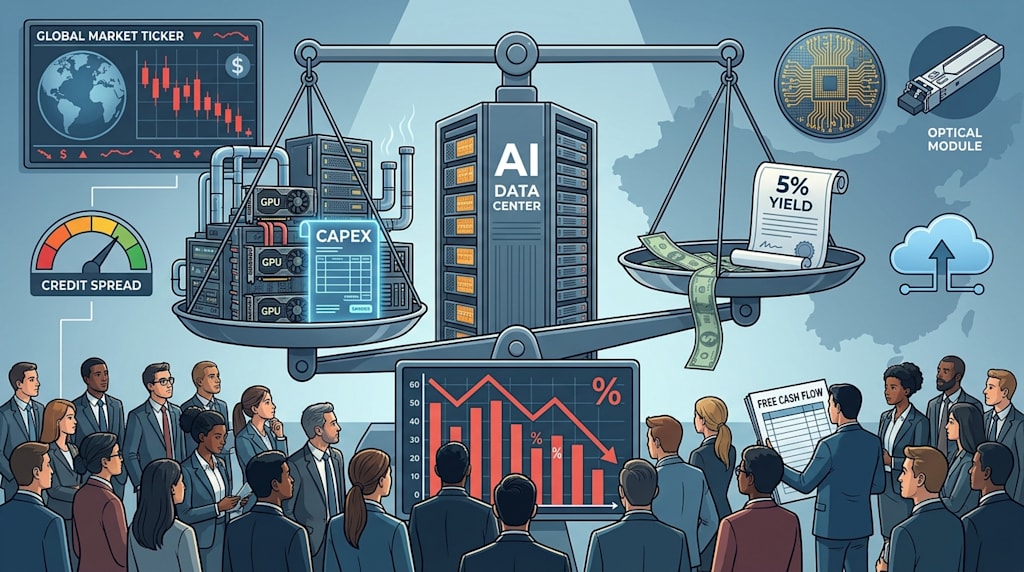
Global markets have fallen fast, and everyone is looking for a cause. Some blame Treasury yields briefly touching 5.3%. Some blame quant selling. Others point to geopolitics and domestic liquidity. Each factor matters. None explains the whole move.
Before mid-October, the story was simple. Treasury yields rose, tech stocks fell, and growth valuations compressed. In late October, that link broke. Tech stocks kept falling while Treasury yields pulled back, and money moved into bonds. Stocks and bonds no longer fell together. Tech stocks fell while Treasuries rose.
If rates were the only driver, tech stocks should have steadied when yields fell. They did not. Investors preferred Treasuries yielding around 5% to catching tech stocks. The market is worried about more than the discount rate. It is reassessing how the AI supply chain makes money.
My view: the main force in this global adjustment is a change in the pricing logic of tech stocks, especially AI. The market is moving from a revenue-growth story to a free-cash-flow and return-on-capital story. The old question was how much revenue AI could generate. The new question is how much must be spent before that revenue arrives.
Recent U.S. earnings show the shift. Alphabet fell 12.6% in one day after its third-quarter report, one of its largest one-day drops as a public company. Third-quarter capex reached $51.4 billion, mostly for technical infrastructure. Investors now ask how far free cash flow will fall as AI spending rises.
Amazon’s AWS grew more than 39% year over year. Under the old framework, that number would have been enough. The company even expects AWS to grow more than 40% in 2027 and 2028. The stock still came under pressure.
Revenue growth has not collapsed. The market has stopped valuing these companies on revenue growth alone. That is the change.
The AI rally of the past two years rested on an assumption. Cloud providers would spend heavily on chips, servers, networking, and data centers. That infrastructure would become AI applications, cloud revenue, and cash flow. The profits would cover the investment and financing costs. As long as the assumption held, higher capex looked like confidence. It also promised more orders for chip and computing suppliers.
Now investors ask a harder question. If capex grows faster than revenue, and revenue cannot outrun depreciation, energy, financing, and maintenance, does the model still work? The market is pricing the future and the bill that comes before it.
A distinction matters here. The tech industry and tech stocks are not the same thing. The industry can keep growing while stocks go through a hard reset. The internet did not disappear, but internet stocks in 2000 still crashed. EV adoption can keep rising, but that does not protect every supplier’s margin.
Every dollar a growth company invests should eventually produce more profit and cash. A company with revenue but no cash flow, and capex but no return on capital, may look like a growth stock. In practice, it may be a capital-heavy cyclical business wearing an AI label.
This selloff differs from an ordinary rotation. The market is recalculating returns across the AI chain. Chip companies depend on cloud capex. Cloud providers depend on AI applications that generate revenue. If application revenue arrives slowly, pressure travels from downstream to upstream.
Cloud capex used to be treated as an insurance policy for upstream earnings. Investors now see that the policy needs cash flow to stay active.
The fall spread quickly because too much capital stood on one side. Tech giants, chips, and compute leasing became one AI trade. Their index weight rose. Their holdings in active funds, quant products, and passive funds became concentrated. In the rally, tech gains lifted fund returns, inflows bought more tech, and upstream orders and capex reinforced the story.
Once return on capital came into doubt, the loop reversed. Leaders fell. Fund returns dropped. Investors cut risk. Crowded assets were sold. In many past stampedes, everyone owned the same stocks, believed the same story, and used similar stop rules. The size of a selloff often depends on how many people were on the same side before the news broke.
Quant selling, passive redemptions, and trend stops can amplify a move. They still need a signal. The signal here is doubt about the return on AI capex.
A-shares reacted earlier and faster. Domestic tech had already started to weaken in late September. From September 25 to October 9, the domestic AI chip index fell 10.3%, and some core names dropped more than 9%. By mid-October, semiconductors, memory, optical modules, and computing-power stocks fell again. A-shares were already trading three issues: large prior gains, higher Treasury yields, and whether overseas cloud capex can hold up. The overseas tech selloff confirmed a logic that was already in place.
Long supply chains tend to react early. Many A-share tech companies sit upstream in global AI capex. Their stocks trade orders, capacity, and prices several quarters ahead. If the market doubts 2027 capex, stocks can fall even when 2026 orders look strong. Shares may trade the next downturn while earnings are still at their peak. By the time reports show stress, the market may already be trading recovery.
That is why A-share tech often rises early, falls early, and trades expectations early. It is not all bad. It does mean investors must watch the time horizon the market is pricing, not just the latest quarter.
The market has now accepted that AI investment is priced differently. In the past, any capex increase excited the upstream chain. Next, investors will separate companies that turn revenue into free cash flow from companies that need debt and equity financing to keep expanding. Tech opportunities will narrow into winners and laggards. Leaders with cash flow and technical barriers may gain share after the shakeout. Companies that depend on outside money and high valuations will struggle.
With the risk-free rate near 5%, the market will demand a return on AI capital. AI can no longer be only a big future. It must answer where the money comes from, when it returns, and whether the return is high enough.
Three indicators matter now.
First, watch capex against operating cash flow and free cash flow. If capex rises while revenue and cash flow grow as fast or faster, the adjustment is mostly valuation. If capex keeps consuming cash and forces outside financing, the worry will last.
Second, watch credit conditions in the AI chain. If rates fall and tech stocks keep dropping, the problem is bigger than the discount rate. Bond yields, credit spreads, and funding access for compute leasing, data centers, and leveraged infrastructure may matter more than the 10-year Treasury.
Third, watch crowding and market breadth in domestic tech. If only a few high-flying tech names fall while other sectors and cheap assets absorb money, the shakeout is local. If fund returns, margin positions, and quant strategies feed on each other and selling spreads, liquidity becomes the risk.
Rates, geopolitics, and domestic liquidity started this move. The core of the global tech repricing is the gap between AI capex and cash returns.
The market used to trade whether AI existed. It now trades whether AI makes money.
The AI industry can keep growing. AI stocks can still go through a valuation reset. Valuation language is changing from revenue growth, order expectations, and capex upgrades to free cash flow, return on capital, financing capacity, and credit spreads. AI can change the world. That does not mean every AI-labeled company survives the cycle.
The next question is not whether the AI story can continue. It is who can turn AI revenue into cash flow, and who has merely used capex to buy an expensive ticket into the game.
About the Creator
Jin
Writer of reamstories
https://reamstories.com/jin
Enjoyed the story? Support the Creator.
Subscribe for free to receive all their stories in your feed. You could also become a paid subscriber, letting them know you appreciate their work.
Comments
There are no comments for this story
Be the first to respond and start the conversation.