
The AI Rally Looks Strong. The Fed and Big Tech Earnings Will Decide If It Lasts.
Tech stocks jumped before the Fed decision as AI financing news returned. The market still has one hard question: can earnings prove the spending?
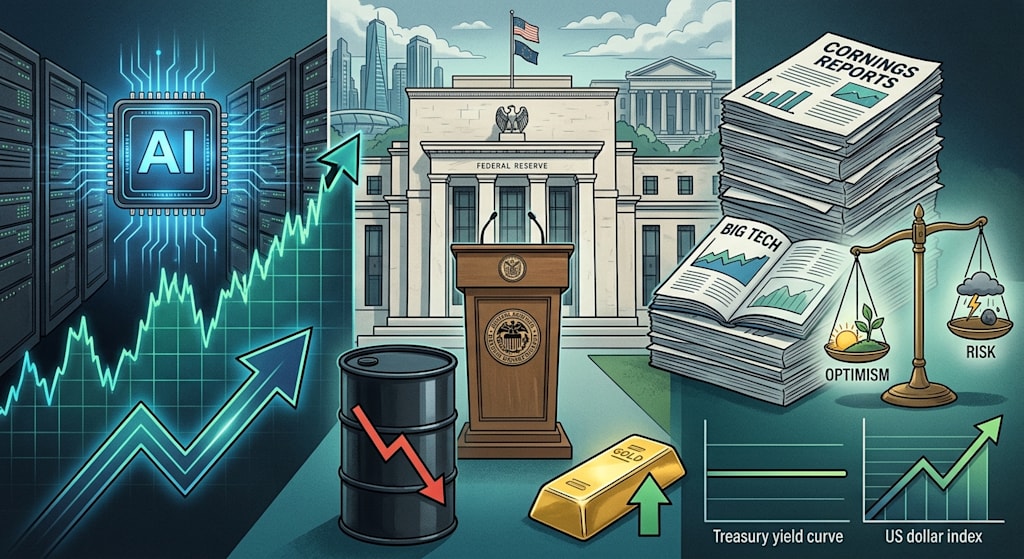
1. AI Financing News Restarts the Narrative, and Tech Stocks Stage a Concentrated Rebound
U.S. stocks extended gains on Tuesday, with the tech sector leading. The Nasdaq 100 rose 1.3%, the S&P 500 gained 0.6%, the Dow was roughly flat, and the Russell 2000 rose 1.16%. The Philadelphia Semiconductor Index rebounded 3.6% in a single day. The Nasdaq 100 also reclaimed its 100-day moving average, a signal of technical improvement.
The main catalyst was a dense run of AI financing and industrial cooperation news. Broadcom announced a $63 billion AI chip financing arrangement. The funds will be used to purchase Broadcom AI accelerators and networking equipment and lease them to AI large-model developer Anthropic. Chip deliveries are expected to begin in 2027. Broadcom shares rose 4.00% that day and helped chip stocks escape their July lows. AMD rose 5.45%, Intel gained 3.61%, Marvell rose 4.19%, Micron gained 2.77%, and Nvidia rose 0.90%.
Oracle also expanded its cloud-service cooperation with OpenAI, and Meta’s $25 billion equity offering was five times oversubscribed. Goldman Sachs’ technology trading desk summarized these events as the core drivers of the strong rebound in the AI sector. It also noted that some stocks rebounding from oversold territory and the easing of heavy selling pressure helped. Bloomberg macro strategist Tatiana Darie said U.S. stocks are digesting concerns about high borrowing costs, and earnings results prove that the resilience of the profit cycle has been underestimated.
This rebound was not a broad-based rally. It was highly concentrated in the AI chain. The Goldman Sachs U.S. Broad AI Index rose 5.08% that day, while the portion of the S&P 500 excluding AI-enabled stocks fell 0.32%. The market was repricing the sustainability of AI capital expenditure, not simply returning to a broad risk-on environment.
2. Rebound Structure: Cloud Service Providers, Storage, and Optical Communications Show the Most Elasticity
Within the sector, emerging cloud service providers and AI infrastructure-related companies showed the greatest elasticity. CoreWeave rose 7.94%, Nebius jumped 11.22%, and IREN gained 7.90%. Crusoe CEO Chase Lochmiller said the market had overreacted in selling off such companies. The remark reflects that, against the backdrop of still-strong AI computing demand, some previously suppressed cloud-service and computing-power leasing companies are experiencing a sentiment recovery.
Storage and optical communications strengthened in tandem. Western Digital rose 6.95%, Seagate gained 3.67%, and SanDisk rose 3.92%. Coherent gained 6.45%, Lumentum rose 5.88%, and Applied Optoelectronics jumped 6.96%. Seagate fell 6% after reporting earnings after the close, showing that stock-specific risks during earnings season have not disappeared and that the market remains demanding about earnings delivery.
The Magnificent Seven diverged internally. Amazon rose 1.61%, Apple gained 0.93%, and Microsoft fell 0.24%. Tesla rose 4.04% and touched a three-month high during the session. Barclays upgraded Tesla to Overweight from Hold, a bullish view that it will outperform peers, and raised its 12-month price target to $450 from $370. It cited improved growth prospects for the core automotive business, a turning point in the robotaxi business, and strong energy-storage demand.
Energy stocks were a drag. As oil prices fell for a second straight session, Exxon Mobil dropped 2.53% and Chevron fell 1.63%. Power stocks rose, with Constellation gaining 2.57% and Vistra rising 3.48%. Beyond the AI narrative, traditional energy prices and power demand are becoming important variables affecting sector rotation.
3. Oil Prices Continue to Fall: Futures Are Cooling, but the Spot Market Remains Tight
The oil market was another key variable that day. As officials from Saudi Arabia, Turkey, and Pakistan traveled to Tehran for diplomatic consultations, expectations grew that tensions in the Persian Gulf would cool. WTI crude fell about 1.8% to below $100 per barrel, while Brent closed below $114 per barrel.
In refined products, U.S. diesel was quoted at 479.11 and European diesel at 1,453.25, both falling to one-week lows. Crude and refined-product inventories were about 76 million barrels below seasonal averages, and the national average U.S. gasoline price fell to $4.266 per gallon.
Tightness on the spot side has not eased. The Brent December-January spread was $5.07, still in backwardation and wider than a week earlier. Futures prices fell on expectations of easing tensions, but the spot market is still pricing short-term supply tightness. For stocks, falling oil prices are a signal of easing inflation pressure, but the widening backwardation suggests that supply risks have not been fully removed.
4. Macro Data Beat Expectations; Treasuries Move Sideways and the Dollar Rebounds
Macro data released that day beat expectations across the board. September durable goods orders rose 1.8% month over month, the largest increase in five months. The Conference Board’s October consumer confidence index rose to 91.7, far above the market expectation of 81.0. September new home sales came in at an annualized 676,000, versus expectations of 651,000.
The stronger macro economy offset the impact of weaker oil prices, leaving Treasury yields basically flat. The 10-year Treasury yield was 4.9843%, down 0.41 basis points, after rising to 4.997% intraday, with a full-day range of 4.9595% to 5.0050%. The 2-year yield was 4.7286%, up 1.27 basis points. The 30-year yield was 5.2975%, down 0.53 basis points. The 2s10s spread narrowed by 1.25 basis points to 25.36 basis points.
The dollar found support. The dollar index closed at 102.319 in late foreign-exchange trading, up 0.35%. EUR/USD fell to 1.1135, and USD/JPY rose to 157.95. Despite the stronger dollar, gold still rebounded sharply from the $4,000 support level. Spot gold was quoted at $4,061.92 during New York hours, up 1.11%, after falling below $4,000 before the New York open and touching a low of $3,989.16. Spot silver was at $54.26, up 0.87%. Bitcoin rose above $80,000 to $80,672.94, up 0.80%.
Gold’s V-shaped move deserves attention. A stronger dollar and stronger-than-expected macro data theoretically weigh on gold. Support near $4,000 and safe-haven demand are still at work. The market has not formed a one-sided risk appetite. It is swinging back and forth between AI optimism and macro uncertainty.
5. The Test Ahead: The Fed Decision and Hyperscaler Earnings
The market’s attention then turned to this week’s Federal Reserve rate decision and earnings from three major hyperscale tech companies. The Fed will announce its rate decision on Wednesday afternoon U.S. time. The market prices in rates staying unchanged at 3.75% to 4%, while a December hike remains the mainstream expectation, with a probability above 70%. Chair Warsh has previously pledged not to provide forward guidance, and the Q&A session at the press conference may become a source of volatility.
After the close that day, Microsoft and Google were the first to report, followed by Amazon and Intel. The market needs to test whether the capital expenditure just propped up by the financing arrangements can be delivered in earnings. Whether the AI trade can shift from being driven by financing news to being verified by earnings and cash flow will determine the sustainability of this rebound.
Tony Pasquariello, head of hedge fund client business at Goldman Sachs, said the bull market will continue but with weakening momentum. Mike Wilson, chief U.S. equity strategist at Morgan Stanley, believes the correction has entered its final stage but another leg down is still possible, and that sharp declines instead create buying opportunities. Bloomberg macro strategist Frank Monkam breaks the correction into three stages: rotation, contagion, and liquidation. He says the turning point is when credit stress transmits to breadth.
Conclusion: The Rebound Is a Repair, Not the Endgame
Tuesday’s strength in U.S. stocks looked more like a repair rally jointly driven by AI financing news, oversold rebounds, and earnings expectations. It was not a return of broad risk appetite. Tech stocks led, energy dragged, gold rebounded, Treasuries moved sideways, and the dollar strengthened. The market picture was differentiated but not disorderly.
Next, the market must answer two questions at the same time. First, under the framework of no forward guidance, how will the Fed respond to high borrowing costs and inflation pressure? Second, can hyperscaler earnings prove the return path of AI capital expenditure? If earnings deliver on capital expenditure guidance, the AI trade may continue to broaden. If the Fed is hawkish or earnings verification is insufficient, the current highly concentrated rebound could easily give back its gains.
The core contradiction is simple. The AI narrative is re-igniting the market. Financing can drive valuations. Only earnings can sustain trends. At the intersection of the Fed decision and earnings season, the market’s optimism is visible, and so is its fragility.
About the Creator
Jin
Writer of reamstories
https://reamstories.com/jin
Enjoyed the story? Support the Creator.
Subscribe for free to receive all their stories in your feed. You could also become a paid subscriber, letting them know you appreciate their work.
Comments
There are no comments for this story
Be the first to respond and start the conversation.