
The 5‑Year Yuan Shock
Goldman Sachs predicts a 22% surge. Is this economic warfare—or a fragile house of cards?
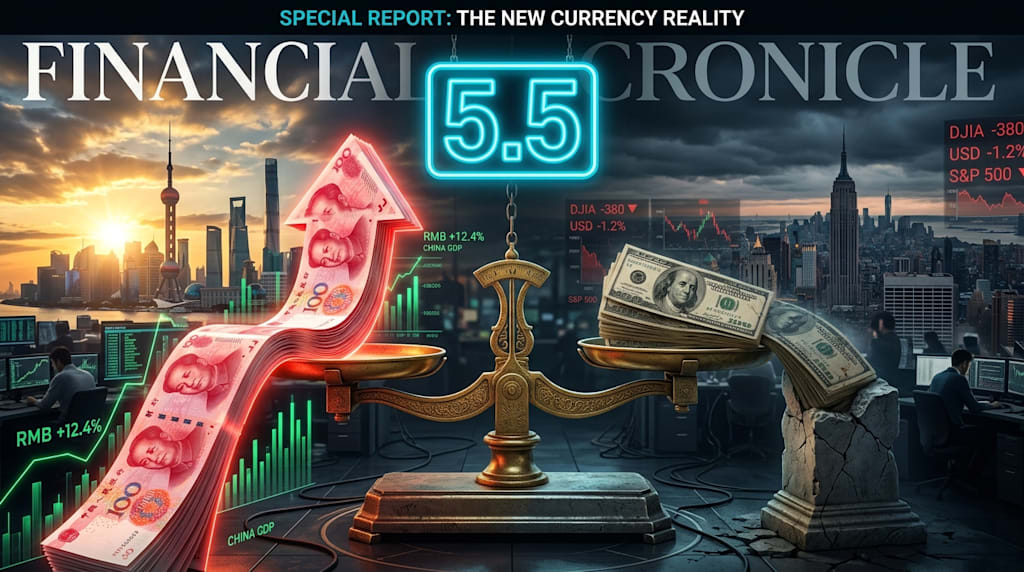
In early September 2026, a Goldman Sachs research report on the renminbi (RMB) attracted widespread market attention. The report forecasts that the RMB will appreciate in an orderly manner, at an annual pace of about 3–5%, reaching 6.0 per USD by end‑2028 and 5.5 per USD by end‑2031. That implies a total appreciation of roughly 22% over five years.
At the time of the report, the RMB was trading around 6.72, already up about 4% year‑to‑date, making it one of the best‑performing Asian currencies.
Is this forecast a precise macro judgment, or an overly optimistic bet?
1. An Active Strategy, Not a Passive Outcome
Goldman frames RMB appreciation as an active policy choice, not a passive response to market forces. The report lists three core objectives:
First, ease trade partners' anxieties. China's goods trade surplus has reached 6% of GDP and over 1% of global GDP. With the US already imposing tariffs and the EU also eyeing measures, a moderate appreciation can signal goodwill and reduce the risk of retaliation.
Second, narrow the China‑US interest rate gap and attract capital. The gap currently exceeds 300 basis points – China's 10‑year yield is around 1.7%, while the US 10‑year offers more than 300 bps higher. RMB assets lag in interest income. But if markets anticipate sustained appreciation, the exchange‑rate gain can offset the interest shortfall. Appreciation expectations become a cheap tool to hedge the yield gap.
Third, accelerate the nominal GDP catch‑up with the US. Since the property market correction in 2021, China's nominal GDP growth has slowed, and the dollar‑denominated catch‑up has stalled. With limited room to boost internal growth, RMB appreciation can directly lift dollar‑denominated GDP – a paper catch‑up that requires no real economic effort.
Goldman also included a “catch‑up timeline” table, using China's nominal GDP growth rate and RMB appreciation rate as variables to estimate when China's GDP will surpass that of the US.
2. The 3–5% Sweet Spot – A Calculated Range
Why did Goldman specifically choose an annual range of 3–5%?
The report lays out the arithmetic: the dollar's broad trade‑weighted exchange rate is likely to depreciate by about 1% per year, while China's inflation is at least 1 percentage point lower than that of major trading partners. This means that if the RMB appreciates 2–3% against the dollar each year, its real effective exchange rate can remain virtually unchanged. Even with a 5% annual appreciation, the real effective rate would rise by only about 2.5% per year.
Goldman also quantifies the impact: a 10% real trade‑weighted appreciation would reduce export volumes by about 4% in the next quarter, equivalent to a drag of 70 basis points on real GDP growth. At a 3–5% annual appreciation pace, the drag on GDP would be only about 10–35 basis points per year – entirely acceptable.
That is what Goldman calls the “sweet spot”: fast enough to achieve strategic goals, yet slow enough not to genuinely damage export competitiveness.
3. The Japanese Precedent: Appreciation Does Not Necessarily Crush Exports
After the Plaza Accord, the yen appreciated sharply. Yet Japan's exports to the US did not shrink immediately – by 1989, Japanese exports to the US had risen from $60.4 billion to $97.1 billion, and Japan's share of the US trade deficit climbed from 29.9% to 40.5%.
This seemingly counterintuitive outcome reflects a simple truth: as long as the appreciation does not fully offset the manufacturing cost advantage, export competitiveness may not be undermined. As long as China's cost advantage in manufacturing remains deep enough, even a rise to 5.5 RMB per USD may still leave Chinese export prices below those of competitors.
Japan ultimately paid a price – the asset bubble burst and the “lost decades.” Whether China can avoid a similar fate depends on whether the appreciation truly remains “orderly” and whether domestic economic structures are adjusted in parallel.
4. Consensus on Direction, Divergence on Magnitude
On consensus: the trend of a weaker dollar and a stronger RMB is a global consensus. PBOC Governor Pan Gongsheng stated at the G20 that “China does not need and has no intention to gain trade competitiveness through exchange‑rate depreciation” – a remark widely interpreted as official acquiescence to moderate RMB appreciation.
On divergence: Reuters' median forecast of over a dozen investment banks for end‑2026 is only 6.68 – everyone expects appreciation, but no one dares to call 5.5 like Goldman. Some domestic research institutes believe the RMB will fluctuate between 6.7 and 7.1 in the second half, with limited room for further gains.
Commentator Lu Ning noted: “In terms of the overall direction, Goldman's stance broadly aligns with that of Chinese officials. But in terms of the specific magnitude, Goldman may be overly optimistic.” Chinese officials cannot pre‑announce specific numbers, “because at this stage, any number would be extraordinarily sensitive to both domestic and international markets, touching directly on expectation management.”
5. Goldman's Position: The Obvious and the Underlying
Lu Ning also highlighted an intriguing angle: while expectations for RMB appreciation largely converge between China and the West, their underlying interests differ.
Goldman's stated aim is “to rebalance global trade,” but its unspoken agenda may be to give “Western manufacturing” breathing room. A stronger RMB raises the dollar price of Chinese exports, somewhat easing competitive pressures on US and European manufacturers. As for the pain of shrinking Chinese sales in the West, it will ultimately be borne by ordinary Western consumers – something that has little to do with Goldman and other Wall Street players.
Chinese officials, by contrast, must weigh every step in designing the appreciation path against multiple factors: foreign‑trade employment, export share, trade balance, financial security, social psychology, expectation management, and the overall macroeconomic impact.
6. What Could Disrupt This Script?
Goldman itself acknowledges several risk factors:
Tariff escalation: If the US significantly raises tariffs again, Chinese exports would come under pressure, forcing a possible policy adjustment.
Sharp global growth slowdown: Weaker external demand would undermine the fundamental support for exports.
Domestic structural adjustment: If the domestic demand recovery falls short of expectations, policymakers may prioritise growth stabilisation over currency appreciation.
Moreover, a one‑way appreciation expectation itself carries risks – it could trigger concentrated corporate dollar sales, exacerbating exchange‑rate volatility.
7. A Bold Bet or a Precise Blueprint?
Goldman's report is a bet on a “policy‑driven long‑term appreciation narrative” – that Chinese policymakers will proactively use the exchange‑rate tool to serve three goals simultaneously: manufacturing upgrading, RMB internationalisation, and GDP catch‑up.
This logic is broadly in line with market consensus on direction. But whether the 5.5 target is too optimistic, and whether a steady 3–5% annual appreciation can be sustained in a complex and volatile international environment, remains an open question.
More important than the exact exchange‑rate number is this: Is RMB appreciation an active strategic choice, or a passive outcome of market forces? Goldman's answer is clearly the former. Markets and history will test that answer over the next five years.
About the Creator
Jin
Writer of reamstories
https://reamstories.com/jin
Enjoyed the story? Support the Creator.
Subscribe for free to receive all their stories in your feed. You could also become a paid subscriber, letting them know you appreciate their work.
Comments
There are no comments for this story
Be the first to respond and start the conversation.