
The 2026 Nobel Prize Explains Why Economists Can’t Predict the Next Crash
Hall and Woodford won for making stabilization policy smarter, not for seeing the future. The award announcement never said “predict.” That omission tells you everything about what economics can and cannot do.
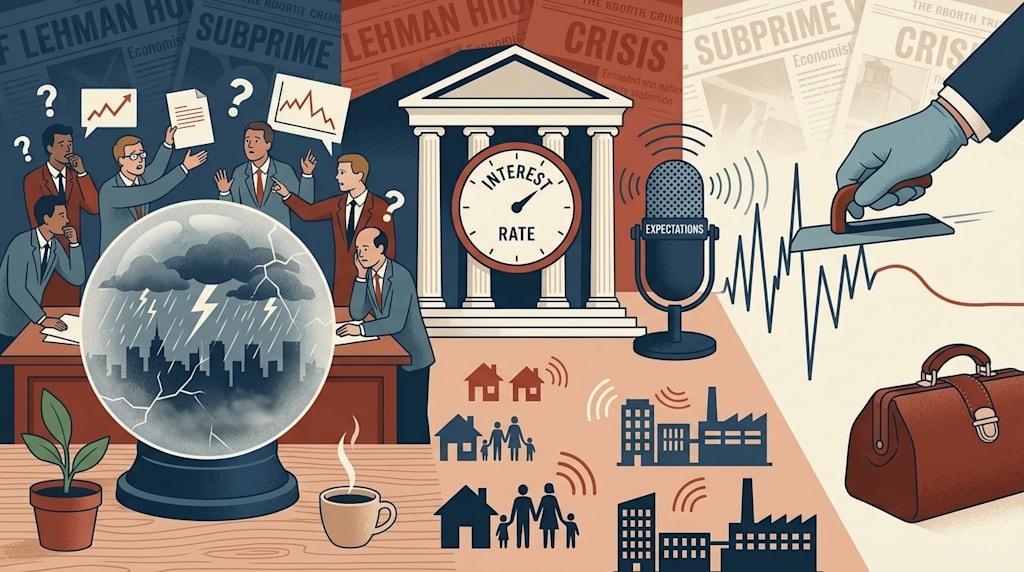
On October 12, 2026, the Royal Swedish Academy of Sciences awarded the Nobel Prize in Economic Sciences to Robert E. Hall and Michael Woodford. The announcement said their models “significantly improved our ability to conduct effective stabilization policy.” It did not use the phrase “predict economic crises.” It used “conduct stabilization policy.”
That wording is half the answer.
A theory built for response, not prediction
To understand why Hall and Woodford won, go back to the 1970s. Keynesian macroeconometric models failed during the oil crisis. The Phillips curve’s trade-off between unemployment and inflation became unstable. Forecasts based on historical data collapsed. Robert Lucas of the University of Chicago then made his critique: when policy changes, households and firms change expectations, so past macroeconomic relationships no longer hold.
Hall rebuilt the household side. In 1978 he published “Stochastic Implications of the Life Cycle-Permanent Income Hypothesis.” His conclusion: if households plan consumption using rational expectations of future income, current consumption already contains all available information about that income. Consumption changes only when new information arrives. New information cannot be predicted. Therefore consumption changes cannot be systematically predicted in advance. The conclusion forced a shift in method. If you cannot predict consumption, study what moves it.
Woodford integrated household expectations, firm pricing, and central bank rate policy into one framework. His 2003 book Interest and Prices: Foundations of a Theory of Monetary Policy became a reference for modern monetary policy. The mechanism: a central bank affects the economy not only through today’s rate. What people believe about future rates also changes today’s decisions. So a central bank’s ability to explain its goals and future actions clearly and credibly matters for stabilizing expectations.
John Hassler, chair of the Nobel Committee, confirmed the orientation: “With them, we can better respond to economic shocks, such as energy crises or sudden changes in household consumption.” The verb was “respond.”
Four reasons prediction fails
Hall and Woodford’s theory is about response because crisis prediction runs into structural obstacles. These obstacles are built into the object economics studies. They are not a shortage of technique.
First, mainstream models are not designed to predict crises. The dominant tool is the dynamic stochastic general equilibrium model, or DSGE. These models treat business cycles as caused by “exogenous random shocks,” disturbances from outside the system with an average of zero. The model asks: if a shock happens, how does the economy respond? It does not ask when a shock will happen. DSGE models rule out crisis prediction at the methodological level. They treat the cause as a known unknown outside the model, not a predictable variable inside it. That was a theoretical choice. The model exists to analyze policy, not to serve as an early-warning system.
Second, the Lucas critique creates a reflexivity problem. Lucas explained why crises cannot be predicted: if such an event could be predicted, people would act on the prediction and avoid it, making the prediction wrong. Economic forecasts target people who are conscious, who learn, and who adjust behavior. A physicist predicting a planet’s orbit does not change the orbit. An economist predicting a recession changes the expectations of firms and households, and the forecast can fail for that reason.
Third, the economic system is complex and contingent. Economists can identify accumulating systemic risk: too much credit, asset bubbles, rising leverage. They cannot identify which event will be the final trigger. World War I was the result of long-building contradictions among European powers. The assassination of the Austro-Hungarian heir was the contingent trigger. Economic crises work the same way. An economist may see that a crisis is coming. That economist cannot say when, in what form, or through which event it will break. Timing and form are exactly what preventive policy needs.
Fourth, incentives can kill a warning. Even a successful warning may not become collective action. During a boom, business-unit bonuses depend on current performance. Anyone who questions a profitable opportunity is labeled a permabear. Management also prefers to believe “this time is different,” because acting on a warning means giving up large current profits. The unpredictability of crises is an epistemological problem. It is also a political-economy problem. A warning must cross cognitive barriers and interest barriers.
A warning that worked and was ignored
In 2005, Raghuram Rajan, then chief economist at the International Monetary Fund, presented a paper at the Jackson Hole central banking symposium. The title: “Has Financial Development Made the World Riskier?” Rajan wrote that financial-sector incentives were badly distorted. Executives earned large rewards when they made money and suffered mild penalties when they lost it. That asymmetry pushed institutions into complex, high-risk products. It could produce a “catastrophic collapse.”
What happened to the paper? By Rajan’s own account, attendees mocked him as a Luddite and a permabear. Three years later, Lehman Brothers collapsed and the global financial system nearly followed. Rajan’s warning looked disturbingly accurate.
The case shows something simple. Economists are not unable to see risk. The problem is that during a boom, warnings are almost impossible to adopt. Merrill Lynch’s business divisions ignored economists’ crisis warnings because of performance pressure. The firm took huge subprime losses and survived only by being acquired by Bank of America. The warning was accurate. The cost of adopting it looked too high during the boom. The cost of ignoring it became visible only after the crisis.
From prediction to response: what economics is for
With those constraints in view, Hall and Woodford’s contribution has a clearer place. Their work sidesteps crisis prediction, which may have no methodological solution, and aims at a more practical goal. After a shock hits, how can policy reduce the damage and stop local risk from becoming a systemic crisis?
Hall’s microanalysis of consumption helps policymakers judge whether a change in spending is temporary or persistent. That judgment shapes whether fiscal stimulus is needed and how large it should be. Woodford’s work on central bank rates and expectation management gives central banks a framework. During downturns, they can adjust rates and communicate policy clearly to stabilize market expectations. That reduces the amplitude of fluctuations.
The medical analogy fits. Doctors cannot predict when a person will get sick. They can understand immune mechanisms, strengthen resistance, and treat disease after it appears. Economics provides tools for understanding how the economy works and how to restore stability after a shock. It does not provide prophecy.
None of this means economists should stop warning about risk. Hall and Woodford’s framework can model financial frictions and credit-market distortions. But warnings remain hard to turn into prevention. The reason is not weak theory. It is the nature of crises: inevitability mixed with contingency, endogenous reflexivity, and interest conflict. Those features make crisis prediction nearly impossible as a systematic capacity.
The 2026 Nobel Prize honors work on the response side. That choice may be the profession’s statement about prediction and response. The better question is whether we are prepared to respond when it arrives. Hall and Woodford’s theory is meant to improve that answer.
About the Creator
Jin
Writer of reamstories
https://reamstories.com/jin
Enjoyed the story? Support the Creator.
Subscribe for free to receive all their stories in your feed. You could also become a paid subscriber, letting them know you appreciate their work.
Comments
There are no comments for this story
Be the first to respond and start the conversation.