
The $120 Billion Door: Why India’s Central Bank Is Forcing Tata Sons to Go Public
A century-old empire, an 18.37% family stake, and a shadow-banking rule are colliding in the fight over India’s largest IPO.
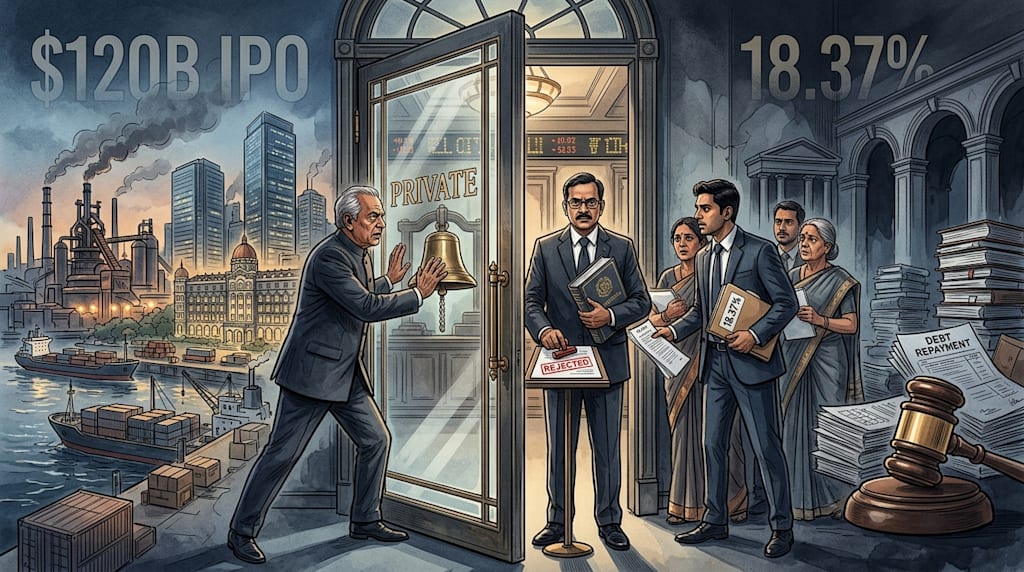
Inside the door, outside the door: why is India’s central bank forcing Tata Sons to list?
In September 2026, the Reserve Bank of India rejected Tata Group’s exemption application. Tata Sons must list.
Analysts estimate that once the holding company lists, its valuation could exceed $120 billion. That would make it the largest initial public offering in Indian history. As of September 17, 2026, the specific arrangements remain unsettled.
Listing is usually a goal. Here it is a requirement. Tata is reluctant. The Mistry family is eager. Four parties are involved: the Reserve Bank of India, Tata Sons, the Mistry family, and the Indian capital market.
The door is open. People inside are ready. Tata is holding the frame. A major shareholder wants to help it let go.
1. The RBI is targeting shadow banking, not Tata
The RBI’s demand that Tata Sons list is not a custom order for Tata. It comes from a general regulatory framework for large non-banking financial companies, or NBFCs.
In 2021, the RBI introduced a scale-based regulatory framework. The logic: the larger the financial institution, the greater its systemic importance, and the tighter the regulation. Under rules revised in June 2026, an NBFC with assets above 1 trillion rupees, about $12 billion, is automatically classified as an upper-layer institution. An upper-layer NBFC must complete a public listing within three years of classification.
The reason goes back to 2018. Infrastructure Leasing & Financial Services, a large Indian infrastructure leasing and financial services company, suddenly defaulted on its debt. The default shook financial markets. Regulators saw that if non-banking financial institutions are huge, highly leveraged, and opaque, trouble can spread through the entire financial system.
Forced listing serves transparency, market discipline, and lower systemic risk. Fundraising is not the point. A listed company must disclose finances, submit to audits, and face public shareholders and regulatory inquiries. For regulators, this is like installing a glass door on large shadow banks.
Tata Sons stood at the threshold. As the investment holding company of the Tata Group, it has assets of about 2.01 trillion rupees, far above the 1 trillion rupee line. It was classified as an upper-layer NBFC and triggered the mandatory listing requirement.
Tata Sons is not an ordinary financial company. It controls Tata Motors, Tata Steel, Tata Consultancy Services, Tata Hotels, and many other businesses. Many subsidiaries are already listed. The holding company is not. It is the nerve center of a vast empire. Normally, it does not need to explain itself to public shareholders or face quarterly capital-market pressure. Now the central bank wants it under a spotlight.
Tata does not want that.
2. Why doesn’t Tata Sons want to list?
Tata Sons’ ownership structure is unusual.
About 66 percent of its shares are held by charitable trusts. These include several public charitable trusts established by the Ratan Tata family. They control Tata Sons, and through it, the entire Tata Group. The trusts aim for long-term dividends, philanthropy, and group stability. Listing brings outside shareholders, more disclosure, a changed governance structure, and possible pressure on control.
Tata Sons also has money. It does not need an IPO. Listing would bring shareholder pressure, quarterly scrutiny, hostile takeover risk, and more complex bargaining between the family and the trusts.
So Tata tried to get off the list.
In fiscal year 2024, Tata Sons repaid more than 200 billion rupees of debt. Then it applied to cancel its financial institution registration. The logic: if regulatory status triggers listing, drop the status.
In September 2026, the RBI rejected the attempt. The debt repayment was done. No listing remained on the to-do list.
3. The Mistry family wants the door open
The Mistry family holds about 18.37 percent of Tata Sons. The family runs the large Shapoorji Pallonji Group and has long held a stake in Tata Sons. The family is rich. Cashing out is difficult. Tata Sons is not listed, so the shares lack liquidity. Selling is not easy.
More importantly, the relationship between the Mistry family and the Tata Group had already turned from insider to opponent.
In 2011, Tata Group chairman Ratan Tata was preparing to retire and began looking for a successor. After more than a year, in 2012, Cyrus Mistry formally took over. His family ran the Shapoorji Pallonji Group, held a long-term stake in Tata Sons, and he had management experience. The setup looked solid.
Later, he discovered that binding does not have to be deep, but it must be possible to untie.
About 66 percent of Tata Sons’ shares are held by charitable trusts. After Ratan handed over the chairman position, he still led the main charitable trusts. Cyrus had an office, performance responsibility, and a major shareholder whose opinion had to be respected. The job description read like chairman. The actual experience sometimes felt like a lifetime contractor.
Cyrus wanted to get things done. Getting things done requires decision-making power. Ratan believed he had been inside the company for years, the water was deep, and Cyrus could not handle it. Both had reasons. Both got angrier.
On October 24, 2016, the board removed Cyrus as chairman. Ratan returned as interim chairman. The successor who had taken more than a year to find was back on the market in less than four years.
The board removed a chairman. It did not remove the Mistry family’s shares. An ordinary fired person packs up and leaves. The Mistry family had to figure out how to move a large fortune. The people no longer wanted to eat at the same table. Capital kept the friendship going.
The two sides fought in court over corporate governance and shareholder rights. In 2017, Tata Sons received shareholder approval to convert into a private limited company. For someone looking for the exit, this felt like studying the door while someone upgraded the access control.
The litigation ran until 2021. The Supreme Court of India ruled in Tata’s favor and supported Cyrus’s removal. The position was settled. The share price was not. The Mistry family’s stake remained inside.
The two sides could negotiate a buyback. Then price came up. The Mistry side valued its stake at about 1.76 trillion rupees. Tata offered about 800 billion rupees. A difference of more than double. In a capitalist country, that is not bargaining. That is cutting.
The only consensus was that the other side did not seem ready to negotiate.
Find another buyer? Possible. A new buyer is not stupid. He looks at the structure, then at the relationship, and worries. The asset looks good. Why is the old shareholder stuck? If I buy today, who buys from me tomorrow?
The Mistry family wants cash. There is no way to cash out. Listing became the possible road.
4. The central bank arrived with homework
While the two sides fought over valuation and exit, the Reserve Bank of India arrived.
The RBI did not arrive to mediate. It arrived with a regulatory checklist.
In 2021, the RBI introduced its scale-based framework for non-banking financial companies. In 2022, Tata Sons was placed in the upper layer. In 2025, Tata Sons had to list.
Tata heard this and thought: our assets are large, we are connected to many funding relationships, we do not lack money, and we do not want to list. Tata brought out its century-old history. The central bank listened. Then it handed the form back: the corporate culture is well written. Please continue with page two.
For the Mistry family, this was good news. They wanted to cash out. The central bank did not care about the two families. This felt like waiting on customer service for ages, then watching an inspection team arrive downstairs. One of the inspection items was yours.
Listing does not mean selling all 18.37 percent the day after the bell rings. For someone who has waited years, a road is better than studying what can be done in principle.
Tata’s controlling side resisted. Its reasons: the charitable trusts need long-term dividends and public welfare; the group needs governance and a stable shareholding structure; it cannot revolve around one shareholder’s exit. The Mistry family could ask: you want long-term stability. Why must my exit remain stable indefinitely?
Management received two reasonable tasks. First, try not to list. Second, resolve the major shareholder’s exit. Doing both at once is why management is paid. The most touching thing about a client is the faith in your creativity.
Tata management found a direction: change the regulatory conditions and cancel the registration. If the financial regulatory status triggers listing, drop the status. That led to the large debt repayment and the cancellation application.
The Mistry family was furious. My money. Sixteen percent of the debt repayment is my money. I wanted to list to cash out. Now cashing out is blocked, and the money is paying company debt.
The fight continued. 2025 arrived. The original listing deadline arrived. Tata was still fighting to avoid listing. In September 2026, the RBI rejected Tata Sons’ attempt to avoid listing by canceling the relevant registration.
The debt repayment was done. After all that running around, repayment was complete. No listing remained a to-do item.
5. If it lists, what happens?
Onlookers began studying what records this potential IPO could break. Analysts estimate that Tata Sons’ listing valuation could exceed $120 billion. That would make it India’s largest IPO. It could change the ownership and governance structure of the century-old group.
A valuation is not the same as issue size. Listing has not been completed because of one rejection letter. As of September 17, 2026, the arrangements remain unsettled. Tata’s controlling side still has to respond. The Mistry family finally has reason to hope the next negotiation opens differently.
If Tata Sons lists, several effects are likely.
The Mistry family gets a public exit. The 18.37 percent stake stops being paper wealth locked inside a private company. It can be sold gradually on the public market. Even if not all at once, there is a pricing benchmark and liquidity.
Tata Sons’ governance becomes more transparent. Public shareholders, disclosure, independent directors, and related-party reviews enter the nerve center of the group. The charitable trusts keep control, but with more external constraints.
The Indian capital market gets a large event. A $120 billion valuation would break India’s IPO record. It would also make global investors look again at family-controlled groups and shadow banking regulation.
The Tata Group’s internal power structure may be redefined. Charitable trusts, the Tata family, the Mistry family, public shareholders, and regulators would all play on one platform. The old model, where the office is yours but the major shareholder’s opinion must be respected, would face capital-market testing.
Tata’s controlling side still has options. A partial listing. Business restructuring. A buyback with the Mistry family. More legal challenges. A push for regulatory exemption. Every option is hard. The central bank has made its position clear: rules are not there to make way for corporate culture.
Conclusion: inside the door, outside the door
Cyrus thought he had become chairman. Later he found that many things still had to be asked of others. The family thought the shares belonged to it. When it wanted to sell, it found it still had to negotiate. A position can be printed on a business card. Wealth can be written on a rich list. When the time comes to use it, the system prompt says: contact the administrator.
The potential listing has produced a strange scene.
A group waits for the door to open because it wants to go in and make money.
An old shareholder also waits for the door to open. It is already rich. It wants to take the money and leave.
The RBI rejection did not ring the listing bell. It pushed the door open a crack. Inside are the governance secrets of a century-old Tata. Outside is the Mistry family’s long wait to exit. The regulator at the door says one thing: comply with the rules.
Whether India’s largest IPO happens is still unsettled. Whatever the result, this is a clear case: modern financial regulation collided with a century-old family group; systemic risk prevention entered a private equity dispute; the capital market door is no longer decided only by the people inside.
Tata wants to stay inside. The Mistry family wants to walk outside. The RBI has measured the frame again.
Everyone is waiting to hear for whom the next bell will ring.
About the Creator
Jin
Writer of reamstories
https://reamstories.com/jin
Enjoyed the story? Support the Creator.
Subscribe for free to receive all their stories in your feed. You could also become a paid subscriber, letting them know you appreciate their work.
Comments
There are no comments for this story
Be the first to respond and start the conversation.